Sunday, September 21, 2008

Alochana-What, Who and How is Durga?


Dear readers,

This article is not strictly religious and completely my views on Mahamaya Maa Durga and DurgaPujo.

You have every right not to agree with me and I absolutely respect any different opinion on this topic.

This is a original article and no part of this article is taken from any website.

This is a thought that came to me on my 29th. birthday and I had to express it in my blog.

Symbolism of Durga

Let us first visit the story of Mahamaya Maa Durga.
Rambha, (boon gainer from Agni Dev), fell in love with a Mahisha and through their union was born Mahisasur. After severe austerities Mahisasura was given a boon by the creator Brahma that no man or God would be able to kill him.

Mahish or the Bull is indicative of desire, lust, craving, intertia - the most basic of human instincts.
The very nature of this instinct is that it cannot be killed by a man or a God. It is immune to punishment, hard-work, stress etc.
The only aspect this instinct is stimulus to is that to the object of its deep rooted desire - its object of lust, in this case a woman.

When MahaDevi appeared before Mahisasura, he wanted to mate with Her and make Her his wife. Thus, this instinct fails to realize and undermines the fact that the very object of its affection can cause its demise.

Durga crumbles this ego in humans. Durga stands for the fact that one's own desire can be the cause of one's end. Desire, interia, unquenched thirst is represented by the Bull, Mahisa. The vahana of Mahamaya is the Lion, the symbolic of the soul.

When the soul realises that the desire is improper, then only can it pounce upon it and Devi kills it.

Improper desire, passion etc. rise in the human mind every time. However, the soul has to be shaken, the consciousness has to fight it and there by making the Lion pounce upon the Bull.
It is this very soul that differentiates us from lesser species which acts only based on instinct. This consciousness is our touch with the divine.

The Devi is within all of us, Durga is in all of us and the battle with Mahisasura is being fought every day, every hour and every minute.

It is important we see this battle and make Durga win every time.

Regards,

Souvik

Monday, September 15, 2008

Aagamani


Pitr-Paksha begins: Tuesday, 16-09-2008

~ Souvik

Tuesday, September 02, 2008

Arambha Utsav


Wishing all readers a Happy Ganesh Chaturthi!

Jai Shree Ganesh!

~ Souvik

Sunday, August 24, 2008

Adbhut Lila

Dear reader,

Happy Janmashtami to all!

~ Souvik


o maiyyā morī, maiń nahiń mākhan khāyo

(1)

bhor bhayo gaiyana ke pāche

(tune) madhubana mohi paṭhāyo

cara prahara vaḿśī vata bhaṭakyo

sāñjha pade ghara āyo

(maiyyā, maiń kab mākhan khāyo)

(2)

maiń bālaka vahi yan ko choṭo choṭo

yeh chīko vidhī pāyo

yeh gvāla bāla sab bair pade haiń

bar-bas mukha lapaṭāyo

(3)

yeh le apani lakuṭa kambalīya

bahuta hī nāca nacāyo

jiye tere kuch bheda upaj hai

tuhe mohe jāñyo, parayo jāñyo

sūra dāsa tab hasī yaśodā

le ura kaṇṭha lagāyo

(naina nīra bharī āyo)

(te nahin mākhan khāyo)


Saturday, August 16, 2008

Alochana-Capillary Action

‘Milk-gulping’ Shiva
Thursday August 14 2008 10:55 IST
ROURKELA: Call it a scientific process or a miracle, stone images of Lord Shiva and His carrier Nandi reportedly gulped milk in Sundargarh district. Hundreds of devotees thronged the Shiva temple at Gopabandhupali here and reportedly fed both the divine objects milk and water. Scientists attributed the cause to capillary action.

This is not the first time this incident has happened. September 21st., 1995-Hindus all over the world observed this phenomenon.

To read the details about the incident, please click here.

I guess it is time that we realised two things:
1) Science either has an explanation about the things we call "miracles" or there exists one but it still hasn't be discovered.
2) We don't need miracles to have faith

~Souvik

Monday, June 09, 2008

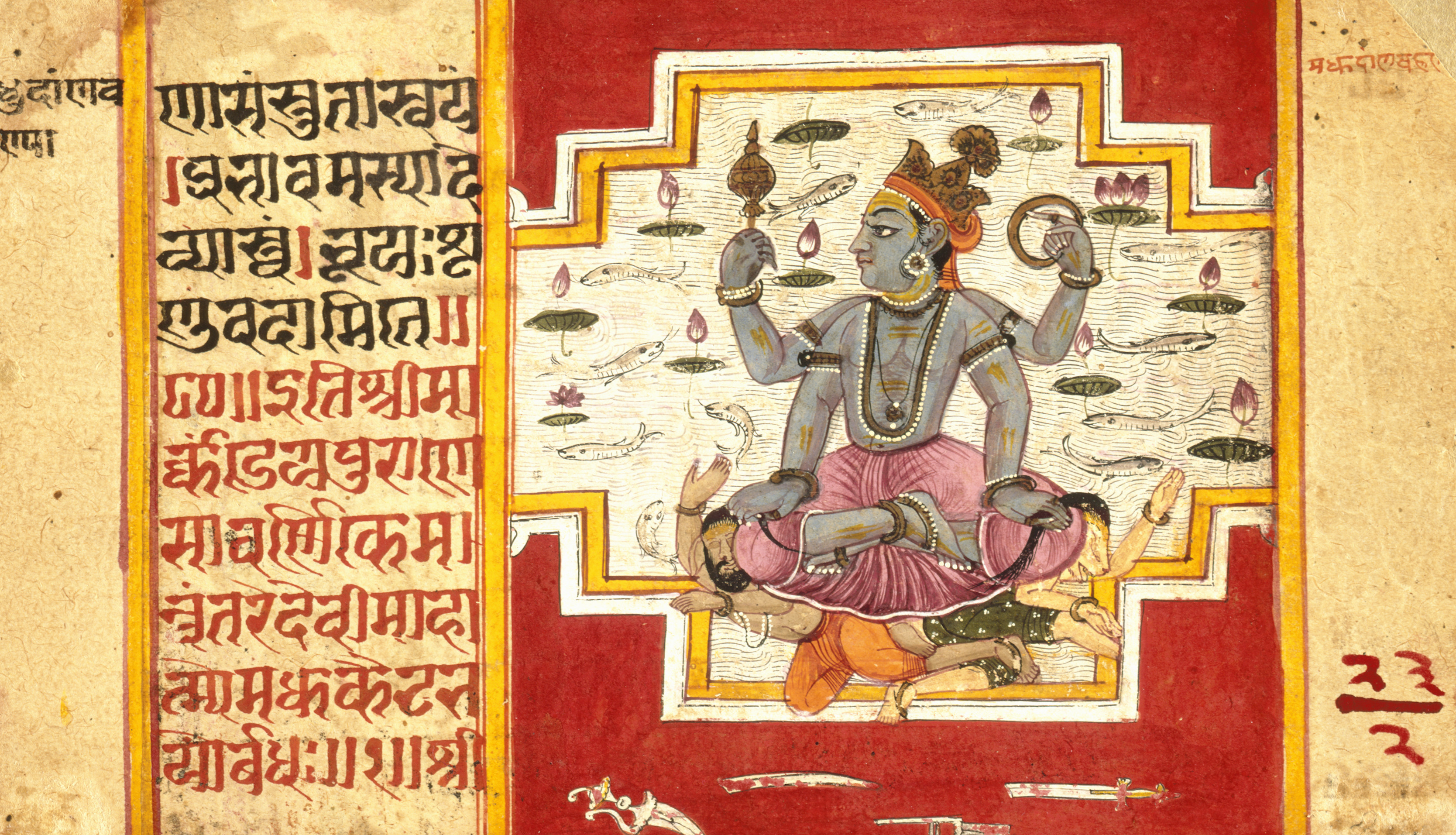
Aadi Shakti


Image from here.

To read Durga Saptashati in Sanskrit click here.
To read the interpretation click here.

The story:
Before the creation of the world, Lord Vishnu lay in deep meditative sleep on his serpent coiled in the form of a couch. A lotus then sprang from his navel, on which was seated the god of creation Brahma. No sooner had this happened than two demons named Madhu and Kaitabh also sprang from the earwax of Vishnu, intending to kill Brahma.
Brahma tried to awaken Lord Vishnu by shaking the stalk of the lotus he was sitting on, but in vain. He then realized that the sleep that had settled on Vishnu’s eyes was the Great Goddess in her form of Mahamaya, an expression of the divine mother’s power of delusion. Brahma then worshipped her with an inspiring hymn of praise, asking her to release Vishnu from his slumber. The ever-compassionate goddess obliged.
Awakening, Vishnu held Madhu Kaitabh and engaged them in a combat, which went on for five thousand years. The two demons then puffed up with pride, thinking themselves invincible. It was at this moment that the great goddess struck at the duo with her maya, making them vain enough to say to Lord Vishnu himself:
"We are pleased with your power and strength. Go ahead and ask for a boon."
Vishnu immediately seized the opportunity and asked for the boon that they be slain by him then and there. Indeed, one should always watch out for those moments of pride, which are the opportune instances for maya to delude us.
Thus cornered, the duo realized their folly; but seeing water everywhere, were wise enough to ask that they be killed only in a dry place. Vishnu then sat down in the water itself. However, like the auspicious lotus remains untouched by the water it grows in, similarly did Vishnu’s lotus like body remain untainted. He then proceeded to place both of them on either thigh, and cut off their heads.
I have found two interpretations of the Madhu Kaitabha story on the internet.
Version 1 from here:
Madhu actually means honey and he represents attachment (raag) to this world, which seems sweet to us. Kaitabh means a pricking thorn and signifies our aversion (dvesha) to things we deem as unpleasant. Both of these traits, which do much to make up our overall nature or temperament (prakriti or svabhav), is a residue carried over from numerous previous births. Both are products of maya and need to be annihilated.
In another interpretation, Madhu is honeyed praise, while Kaitabh is sour criticism, both of which enter through our ears, but are two side of the same mayic coin and need to be discarded. In either of the interpretations, the two demons attack our intelligence, symbolized by Brahma who is the patron deity of intellect. The Bhagavad Gita says:
"When your intellect, though perplexed by what you have heard, shall stand immovable and steady, then shall you attain self-realization". (2.53)
The goddess as restful sleep is an apt metaphor signifying her motherhood. When a mother sees her small child tired after playing in the fierce sun, she catches hold of him, feeds him and pats him to sleep, even against his own wishes, knowing very well that the sleep will restore his energy. Indeed, while our whole day is spent in emptying our shakti, the compassionate goddess takes it on herself to continue replenishing it. So she puts Vishnu to rest, tired after the exhausting task of maintaining the universe, and when the next creative cycle begins, relieves him from his slumber.
However, we cannot win over the two demons of attachment/aversion or praise/criticism, relying solely on our own powers, like Lord Vishnu who was unable to defeat them even after many years of fierce battle. The only way to win over maya is to surrender ourselves to Mahamaya, the goddess who created it in the first place. The fact that the two demons asked to be killed in a dry spot is also loaded with spiritual symbolism. Both these pairs of traits can only be destroyed on the ground of Vairagya (disenchantment), which is the dry state of existence, devoid of all worldly rasa.
However, the state of the goddess symbolized by sleep is not her brightest manifestation. The Gita says:
"The pleasure arising from sleep is known as tamasic." (18.39)
Version 2 from here:
Madhu means honey. "Madhu keeta" means an insect of honey, i.e. honey bee. Madhukaita means belonging to honey bees. It can be the qualities or nature of honeybees. One of the meanings of "bha" is "having a similarity to". Thus, in myjudgment, "Madhu Kaitabha" means "having a semblance to the nature of honeybees".

Madhu Kaitabhameans "having a semblance to the quality of honeybees". What is the quality ofhoney bees? Well, they keep working hard to accumulate the sweet honey! They arenot intelligent enough to think about any higher things in life. Thus, MadhuKaitabha are an allegory to the quality within us which makes us work hard, likehoneybees, with a single-minded focus on accumulating material comforts. Likehoneybees accumulate honey, we accumulate material objects and spend whole lifeworking hard doing just that.

Vishnu is a personification of the sattwa guna of the Parama Purusha(Universal/Absolute Being). Within us, Vishnu is an allegory to the sattwa gunawithin us. Madhu Kaitabha were born from Vishnu's earwax when He was alseep. Theability to work hard like a bee is not really a terrible thing. This ability isessentially born from the sattwa guna within us, when it is in deep slumber(i.e. sattwa guna covered by taamasi shakti, i.e. sattwa guna that "manifests"in a taamasik way).

There are so many good people in this world, who just spend their entire livesin honest labor like the honeybees and accumulate things for themselves andothers around them. Their sattwa is in deep sleep and Madhu Kaitabha born fromthat asleep sattva are very much active.

The problem with this focus on hard work and accumulation of material objects isthat it keeps us away from supreme bliss. Madhu Kaitabha's attack on Brahma andVedas is symbolic of that. Vedas symbolize the supreme and liberating knowledgeof self and Brahma, the carrier of Vedas, symbolizes the sadhana to achieve thesupreme knowledge. The focus on working like honeybees and accumulating materialobjects tries to kills one's ability to do sadhana and obtain supreme knowledgeof self.

Vishnu battles Madhu Kaitabha for 5,000 years. Devi Bhagavatam even describesthat Vishnu wondered in the middle how to defeat Madhu Kaitabha, as He findsthem quite formidable! Even when the sattva in us awakens, it is difficult forit to overcome the formidable instinct to lead the life of a honeybee and toaccumulate the material objects for oneself and others.

When Madhu Kaitabha finally agree to be slain by Vishnu, they ask Him to killthem in a place where there is no water. They see that there is water all aroundand think that there is no place where there is no water. The Mooladhara,Swadhishthana, Manipoora, Anahata and Visuddhi chakras are the seats of earthy,watery, fiery, airy and ethery elements respectively. Swadhishthana chakra issupposed to control desires and hence water symbolizes desire. As long as thereis desire, it is tough to overcome the instinct of just working for materialobjects!

When they want a place that has no water, Vishnu shows his thighs. There is nowater there and only earthy element. This suggests that Parama Purusha'sMooladhara chakra is in the thighs of Vishu.

According to Parasara, thighs are seen from the 9th house of dharma. The earthyelement symbolizes the commitment and stability. The fact that earthy elementcame from the thighs of Vishnu shows that it is the dharma of sattwa gunasustaining this universe that ensures that there is commitment and stability inthis creation.

Moreover, it is apt that someone born in the ears (3rd house) of Vishnu foundend in the thighs (9th house, i.e. 7th house of death from the 3rd house) ofVishnu! Similarly, Brahma, who is born from the navel (6th house) of Vishnu should naturally find His end in the 12th house of Vishnu (feet), which is the7th house of death from the 6th house! That may be why Vishnu goes to sleep,when there is a change of Brahma.

Thus, the instinct within us to keep accumulating material objects like honeybees accumulate honey finds its end in the dharma of the sattwa guna, i.e. whenthe sattwa guna within us follows its dharma. Then we are fully awakespiritually. Naturally, the path to self-knowledge becomes open then and Brahmabecomes elated.

Thus, the story of Madhu-Kaitabha refers, allegorically, to the instinct most ofus have towards leading a "regular" life, working hard like honeybees andaccumulating objects for self and others and how that instinct needs to bedefeated by waking up the sattwa guna and allowing to perform its dharma.

Monday, April 14, 2008

Advent into Aries


Shubho Noboborsho and Happy Mesh Shankranti to all readers!

~ Souvik

Friday, March 21, 2008

Add a little color!


Dear readers,
Wish you and your loved ones Happy Holi!
Here's a little about Holi.
Regards,
Souvik

Wednesday, March 05, 2008

Astral Details

Maha Shiv Ratri timings (USA, CST)
Start:
Date: March 5, 2008
Time: 14:01:45
Time Zone: 6:00:00 (West of GMT)
Place: 87 W 39' 00", 41 N 51' 00"
Chicago, Illinois, USA
Altitude: 596.00 meters
Tithi: Krishna Chaturdasi (Ve) (100.00% left)
Vedic Weekday: Wednesday (Me)
Nakshatra: Dhanishtha (Ma) (67.55% left)
Yoga: Siva (Me) (55.09% left)
Karana: Vishti (Sa) (99.99% left)
Hora Lord: Mercury (5 min sign: Ar)
End:
Date: March 6, 2008
Time: 12:55:29
Time Zone: 6:00:00 (West of GMT)
Place: 87 W 39' 00", 41 N 51' 00"
Chicago, Illinois, USA
Altitude: 596.00 meters
Tithi: Krishna Chaturdasi (Ve) (0.00% left)
Vedic Weekday: Thursday (Ju)
Nakshatra: Satabhishak (Ra) (70.38% left)
Yoga: Siddha (Ke) (50.77% left)
Maha Shivratri or Maha Sivaratri or Shivaratri or Sivaratri (Night of Shiva) is a Hindu festival celebrated every year on the 13th night/14th day in the Krishna Paksha of the month Maagha (as per Shalivahana) or Phalguna (as per Vikrama) in the Hindu Calendar.

Monday, March 03, 2008

Advent of the Event


Date: 6th. day of March, 2008

Day: Thursday

The Event: Maha Shiv Ratri


From here


The term ‘Shiva' is a confluence of two syllables, ‘Shi' and ‘Va', meaning the ‘redeemer of sins' and ‘liberator of sufferings'.


The Shvetashvetara Upanishad says, "Shiva is more minute than the minutest".


He is often considered to convey a divine dot, a point or seed of cosmic creation, sustenance and conclusion. In numerical counting, the devout Hindus says ‘Shiva' instead of uttering ‘one' which points to His position in the universe as the originator.


Shivapurana mentions the oval flame or jyotirlinga form of Shiva. The Sanskrit suffix linga signifies mark, sign, symbol, quality or characteristics of an entity that has two phonetic parts: lin or laya and gam or agaman respectively, referring to the process of destruction and recreation which Shiva epitomises.


Shiva is effulgent and beyond three attributes of sattva , rajas and tamas . With rajas in the form of Brahma, He creates; with sattva in the form of Vishnu, He preserves, and with tamas in the form of Rudra, He destroys. When the world is in darkness of ignorance Shiva appears in the form of a column of light, Jyotirlinga , in front of deities Brahma and Vishnu. In the race to prove their superiority they try to fathom the column of light, but fail. Shiva, along with all human souls, dwells in the supreme abode of divine illumination and complete silence. It is called Shanti Dham or Param Dham and is located amidst the sixth element of sacred light, far beyond the physical universe.


Localised in incarnated bodies through successive births and interaction with material world, humans experience entropy and complete loss of all available energy. They pray for divine intervention and help. In human ignorance, Jyotirlinga Shiva descends on earth in the corporeal body of Prajapita Brahma and reveals His sacred knowledge about soul, supreme soul, world drama, law of karma and raja-yoga meditation for recharging human souls by linking their minds to the supreme source of spiritual energies. His divine knowledge, revealed through Brahma, gives us insight to see the self and other beings as soul (tiny conscient point of divine light in the forehead) and to experience its innate and original qualities of purity, peace, love, bliss, knowledge, power and happiness. The regular practice of such soul consciousness would make you so light, positive, peaceful, blissful and powerful that your meditation and contemplation become effortless.


Cultivation of soul consciousness would also foster essential unity, harmony and brotherhood of mankind under the spiritual fatherhood of one incorporeal Supreme Being. By seeking the companionship of Supreme Soul Shiva in meditation, we need not make special efforts to weed out unwanted, negative and harmful personality traits, habits, leanings and dependencies as they would automatically not only get sublimated in the subtle fire of intellectual communion or yoga of our inner self with the divine being, but would also be substituted with the natural, pure, positive, healthy and benevolent qualities, powers and proclivities. Being firmly seated in the joyful experience of our inner-self, we can smoothly connect and commune with the Almighty who is the eternal source of infinite spiritual knowledge, virtues and strength. By this simple and natural process of introspection and contemplation on self and the Supreme, we can empower ourselves and become one with Sat-Chit-Anand , truth-consciousness-bliss.


From here


Shiva is 'Shakti', Shiva is power, Shiva is the destroyer, the most powerful god of the Hindu pantheon and one of the godheads in the Hindu Trinity. Known by many names - Mahadeva, Mahayogi, Pashupati, Nataraja, Bhairava, Vishwanath, Bhava, Bhole Nath - Lord Shiva is perhaps the most complex of Hindu deities.
Hindus recognize this by putting his shrine in the temple separate from those of other deities. Shiva, in temples is usually found as a phallic symbol of the linga, which represents the energies necessary for life on both the microcosmic and the macrocosmic levels, that is, the world in which we live and the world which constitutes the whole of the universe.
In a Shaivite temple, the linga is placed in the centre underneath the spire, where it symbolizes the naval of the earth. The actual image of Shiva is also distinct from other deities: his hair piled high on the top of his head, with a crescent tucked into it and the river Ganges tumbling from his hairs. Around his neck is a coiled serpent representing Kundalini or the spiritual energy within life.
He holds a trident in his left hand in which is bound the 'damroo' (small leather drum). He sits on a tiger skin and on his right is a water pot. He wears the 'Rudraksha' beads and his whole body is smeared with ash.
Shiva is believed to be at the core of the centrifugal force of the universe, because of his responsibility for death and destruction. Unlike the godhead Brahma, the Creator, Shiva is the dissolving force in life. But Shiva dissolves in order to create, since death is the medium for rebirth into a new life. So the opposites of life and death and creation and destruction both reside in his character.
He is also often portrayed as the supreme ascetic with a passive and composed disposition. Sometimes he is depicted riding a bull called Nandi decked in garlands. Although a very complicated deity, Shiva is one of the most fascinating of Hindu gods.
Since Shiva is regarded as a mighty destructive power, to numb his negative potentials he is fed with opium and is also termed as Bhole Shankar, one who is oblivious of the world. Therefore, on Maha Shivratri, the night of Shiva worship, devotees, especially the men folk, prepare an intoxicating drink called Thandai (made from cannabis, almonds, and milk) sing songs in praise of the Lord and dance to the rhythm of the drums.
Maha Shivratri, the night of the worship of Shiva, occurs on the 14th night of the new moon during the dark half of the month of Phalguna. It falls on a moonless February night, when Hindus offer special prayer to the lord of destruction.
Shivratri is the night when he is said to have performed the Tandava Nritya or the dance of primordial creation, preservation and destruction. The festival is observed for one day and one night only. According to the Puranas, during the great mythical churning of the ocean called Samudra Manthan, a pot of poison emerged from the ocean.
The gods and the demons were terrified as it could destroy the entire world. When they ran to Shiva for help, he in order to protect the world, drank the deadly poison but held it in his throat instead of swallowing it.
This turned his throat blue, and since then he came to be known as Nilkantha, the blue-throated one. Shivratri celebrates this event by which Shiva saved the world. Shivratri is considered especially auspicious for women.
Married women pray for the well being of their husbands and sons, while unmarried women pray for an ideal husband like Shiva, who is the spouse of Kali, Parvati and Durga. But generally it is believed that anyone who utters the name of Shiva during Shivratri with pure devotion is freed from all sins.
He or she reaches the abode of Shiva and is liberated from the cycle of birth and death. On the day of Shivratri, a three-tiered platform is built around a fire. The topmost plank represents swargaloka (heaven), the middle one antarikshaloka (space) and the bottom one bhuloka (earth).
Eleven urns or kalash, are kept on the swargaloka plank symbolizing the eleven manifestations of the Rudra Shiva. These are decorated with bilva (woodapple leaves) and mango leaves atop a coconut representing the head of Shiva.
The uncut shank of the coconut symbolizes his tangled hair and the three spots on the fruit Shiva's three eyes.


From here


167 Hindu pilgrims arrive in Lahore


LAHORE: About 167 Hindu pilgrims crossed into Pakistan on a special train from Wagha Border on Monday to celebrate Maha Shivratri. The pilgrims will stay till March 10. Evacuee Trust Property Board (ETPB) officials Syed Faraz Abbass, Syed Raghib Ali and Azhar Abbass received the guests and accompanied them to Gurdwara Dera Sahib, where the ETPB had made arrangements for their stay. About 200 pilgrims were expected to visit Pakistan to celebrate Maha Shivratri, but only 167 pilgrims arrived. ETPB official Aslam said the pilgrims would stay at Gurdwara Dera Sahib for a night and then would proceed to Katas Raj Temples, Chakwal, on Tuesday. He said the pilgrims would stay at the temple till March 7. He said the pilgrims would then return to Lahore. The pilgrims would stay in Lahore on March 8 and March 9, and then would visit Krishna Mandar. He said the pilgrims would leave for India on March 10. He said the authorities concerned had made special security arrangement for the pilgrims. The ETPB authorities have set up a medical dispensary, deputed Rescue 1122 squads and made provision for langar (charity meal). The word Maha Shivratri means the night of Shiva, and ceremonies are pre-arranged chiefly at nighttime. Maha Shivratri is the night on which lord Shiva and Parvati got married. Maha Shivratri falls on the 13th (or 14th) day of the dark half of ‘Phalgun’ (February-March). The event marks the night when lord Shiva performed the Tandav dance (the dance of destruction).

Friday, January 11, 2008

A Quest Beyond Astrology


Dear readers,

Today I started my new yahoo group "A Quest Beyond Astrology"

All the questioning minds can join the group with and contribute their views on the subject of astrology based on modern science.

Here is the link to the group.

Below is the description of my group:

"It is indeed very difficult to explain the astrological phenomenon. I am not in the least disposed to an either-or explanation. I always say that with a psychological explanation there is only the alternative: either and or! This seems to me to be the case with astrology too."

~ Carl G. Jung in a letter to Hans Bender, April 10, 1958, Carl G. Jung Letters, Volume 2, 1951-1961, p. 428.

"I know nothing of the science of astrology and I consider it to be a science, if it is a science, of doubtful value, to be severely left alone by those who have any faith in Providence."

~ Mahatma Gandhi

"We should take astrology seriously. No, I don't mean we should believe in it. I am talking about fighting it seriously instead of humouring it as a piece of harmless fun."

~ Richard Dawkins, British ethologist, evolutionary biologist and popular science

"Courteous Reader, Astrology is one of the most ancient Sciences, held in high esteem of old, by the Wise and the Great. Formerly, no Prince would make War or Peace, nor any General fight in Battle, in short, no important affair was undertaken without first consulting an Astrologer."

~ Benjamin Franklin, among many other things one of the Founding Fathers of United States of America.

We can love it or hate it but no one can deny its existence. Astrology has survived through ages and in diverse geographical locations.It is practiced in many different countries of the world and in numerous different methods.Belief is a personal choice but truth has to stand to the test of science and logic.How true is astrology? Is their any truth in it in terms of modern science? Is it science at all? Is it philosophy, psychology, art or mere gibberish?Facts, figures and references in this forum has to be concrete with authentic, recognized and respected sources and it has to be backed by science and over all logic.Join me in a quest beyond astrology to share, discuss and find the truth behind this subject.

Monday, January 07, 2008

Ashtradharini


(Image from here)
On 31st. eve, a group of 70-80 men ran after and molested two girls for 15 minutes by pinning down their male friends to the ground in Mumbai, India.
Similar incidents of molesting girls or attempts to do so occured all around the country.
And we also know that this is not the first time such incidents have happened.
So, what should we do about it?
Well, these are a few things that are available for self-defense in some countries.
Other common ones are pepper spray etc.
For a country like India where population is way beyond the control of police, women needs to be empowered.
I think its high-time to legalize self-dense weapons to women with some registration code to keep track of the items being used.
Wish draupadi had a stunt gun to immobilize Dushashan.
Its time we gave Durga the trishul she deserves.
~ Souvik

Sunday, October 28, 2007

Aanta-Shubho Bijoya and Happy Dusshera


Shubho bijoya and happy dusshera to all readers!

~ Souvik

Saturday, October 20, 2007

Aaj Shubho Nobomi-Pala prai shesh


Aaj Moha Nobomi

Bangali'r mon ta jeno kharap kharap

Utsav prai shesh

Maa jeno Shob Bangali'r Maa'er kachey eki kamona

Maa, Nobomi'r ta jeno tartari shesh na hoi

Utsav kay dhore rakhar ek ontim proyash

Shubho Nobomi to all!

Jay Durga!

~ Souvik

Ananda Utsav-BAGC Durga Pujo


Dear readers,

I went to the BAGC Moha Ashthomi anushthan yesterday.

Here are some pics from the pujo and the function.

Maa Durga with her family killing Mahishashur.


Pujo shonkha and Bengali DVD/CD stall


Saree'r stall. How can Bengali women be kept away from buying sarees?


The great Indian dancer Tanushree Shankar doing the Surya Mantra dance depicting the dance associated with the dawn.


Tanushree's troupe doing the "Reincarnation" dance.


Shubhomita with her beautiful voice singing songs from her albums.


Friday, October 19, 2007

Ananda Utsav-Kolkata 'r Pandal


Dear readers,
If you wish to see Kolkata's pandals, please click here.
Jai Durga!
Souvik


Aaj Moha Ashtomi - E-Porikroma


Dear readers,

For E-porikroma of Siliguri mandaps, click here.

Enjoy Ashtomi!

Jai Maa Durga!

~ Souvik

Aaj Moha Ashtomi - E-Anjali is ready

Dear Durga Bhakts,
E-anjali and E-tours of temple mandaps are ready by a great effort by the Siliguri Team.

For E-anjali, click here.

Jai Durga!

Shubho Moha Ashtomi!

~ Souvik


Thursday, October 18, 2007

Aaj Moha Shoptami - Pujor Shomoy


Shubho Shoptomi!
Jai Durga!

Aaj Moha Shoptami - Pujor Manei ki?


Pujo manei pujor kodin porashuno bondho
pujo manei shat shokale shiuliphuler gondho........
pujo manei shondhyebela thakur dekhar bheer
hoichoi aar utshobete chardeek awsthir ..............
pujo manei patshalate bajlo chhutir ghonta
pujo elei chhelebelay paliye phere monta..........
pujo manei ma duggar ahsur nidhon pala
anjali aar proshad petam pujor dupurbela..........
pujo manei notun jama notun notun shaaj
alpona aar thakurdalan daaker shaajer kaaj.........
pujo manei pujoshonkhya didir shathe aari
didi ekhon onek dure,didir shwoshurbari............
pujo manei mahalaya kashphule math shada
pujo manei aponjoner tane poruk badha..........
pujo manei shagor pahar ekchhutetei pari
shwapne kokhon pouchhe jetam meghbhashano bari.........
pujo manei dhaker baddi,pujor bishorjon
ashchhe bochhor abar esho monkharaper mon..........
ajke pujo onyorokom onnobhabe ashe
bhorer bela shishir pore? shiuli gondho bhashe?????????
hoyto ashe! hoyto shobai bodle gechhi aaj
bohumulya shomoy ekhon shobar bheeshon kaaj............
bhalo theko bondhura shob bondhu thakuk mone..........
pujor dine chhelebela abar poruk mone.........