Dear readers,
May 31st., 2007 to June 25th., 2007 I took a vacation from work and visited India and my home town Kolkata.
Here is a brief of some of the places I visited.
City Centre, Salt Lake City- Really a cool place to hang out. Inox is good.
Forum- Another cool place. Inox is good.
Hakka Restaurant, City Centre- Average. Good decor but I wasn't really impressed with the food.
La Terrasse, Grand Hotel- Splendid. Loved it.
Eden Pavillion, Sonar Bangla- Ok. Excellent Decor but didn't get too impressed with the food.
Dakshineshwar Kali Bari- As usual my favourite place from childhood. Had a darshan of Maa on Amavasya (pure coincidence). Did a pradikshin of the dwadash shiva lingas (used to do it from childhood). Loved the renovated decor of the mandir. Did Maha Mantra kirtan with devotees. Visited Krishna mandir and Thakur's room. As usual it was an experience beyond words.
Tara peeth- Suddenly decided to visit Tara peeth. Took an A/C chair car ticket and went to Rampurhat. Had a car take me to Tara peeth. I was extremely lucky to have a "onabrito" darshan of Maa's "prokrito" rupa.
Spent a lot of time with family and near and dear ones.
In short my home visit after 2.5 years was a great experience. I loved it!
Regards,
Souvik
Monday, June 25, 2007


Tuesday, May 15, 2007
Aloukik

Dear readers,
A glimpse at these eyes, a pinch of reverence and a drop of devotion in a heart full of selflessness and you get nothing short of an ecstasy!
Shivoham!
I bow to the Shiva in you!
Sunday, April 29, 2007
Amrit(a)-The nectar of immortality, the goal of life

Amrita or Amrit (Sanskrit: अमृत; Punjabi: ਅੰਮ੍ਰਿਤ) is, according to Dharmic religions, immortal nectar or ambrosia (of which it is a cognate). It is the drink of the gods, which grants them immortality. In Sanskrit the word amrita literally means "without death", and is often referred to in texts as nectar.
In Hinduism
Amrit features in the Samudra manthan myth, where the gods, because of a curse from the sage Durvasa, begin to lose their immortality. With the help of the asuras (demons), they churned the sea in order to find the nectar of immortality, amrit. After drinking it, the gods regained their immortality and defeated the demons.
Amrit features in the Samudra manthan myth, where the gods, because of a curse from the sage Durvasa, begin to lose their immortality. With the help of the asuras (demons), they churned the sea in order to find the nectar of immortality, amrit. After drinking it, the gods regained their immortality and defeated the demons.
In Hinduism, Samudra manthan (Devanagari: समुद्र मंथन) or The churning of the ocean of milk is one of the most famous episodes in the Puranas and is celebrated in a major way every twelve years in the festival known as Kumbha Mela. The story is related in the Srimad Bhagavatam, a major work that describes the avataras in great detail.
Samudra manthan is also known as —
Samudra manthanam — Manthanam is the Sanskrit equivalent of Manthan meaning 'to churn'.
Sagar manthan — Sagar is another word for Samudra, both meaning an ocean or large water body.
Ksheersagar manthan — Ksheersagar literally means the ocean of milk. Ksheersagar = Ksheer (milk) + Sagar (ocean)
The story of Samudra manthan
The story begins with Indra riding his elephant. He came upon a sage named Durvasa. The sage decided to honor Indra by giving him a scented garland. Indra took the garland, but placed it on the forehead of his elephant. The elephant was irritated by the scent and threw the garland off, trampling on it. The angry sage cursed Indra and the Adityas(Gods)to lose all their wealth. Indra was thus immediately dispossesed of all his wealth and treasures.
Appeal to Brahma
Indra then approached Brahma to help him regain his treasures who suggested him to churn the Ocean of Milk in order to regain his treasures and obtain the Nectar of Immortality. However, such a stupendous task could not be performed by the Adityas (Gods) themselves so they sought the help of their enemies, the Asuras, with the understanding that the Asuras would be allowed to partake a portion of the Amrutha (divine nectar of immortality).
Churning the Milky Ocean
The Ocean was churned by using the Mount Mandara as the pole and the king of snakes, Vasuki as the rope which was wrapped around the mountain. The Gods held the tail of the snake while the demons(Asuras) held the head end of the snake and pulled on it alternately, causing the mountain to rotate, which in turn would caused the Ocean to be churned. However, once the mountain was put on the Ocean, it began to sink. Then came Vishnu in his second incarnation, the form of a turtle Kurma, to support the mountain on his shell back.
Halahal
As the ocean was churned, a deadly poison known as Halahala emerged. This poison threatened to suffocate all living things. In response to various prayers, Shiva drank the poison; his wife Parvati, alarmed, stopped it in his throat with her hands. This caused the throat to turn blue. Due to this, he is called Nīlakantha (nīla = "blue", kantha = "throat"). Then, various treasures (ratnas) emerged from the ocean of milk.
The 14 Ratnas were:
Sura, goddess and creator of wine
Apsarases, various divine nymphs like Rambha, Menaka
Kaustubha, the most valuable jewel in the world
Uchhaishravas, the divine 7-headed horse
Kalpavriksha, the wish-granting tree
Kamadhenu, the first cow and mother of all other cows
Airavata, the elephant which is the steed of Indra
Lakshmi, the Goddess of Fortune and Wealth
Parijat vriksh (tree)
Halahala or Kaalkut poison
Chandra, the moon
Dhanvantari with
Amrita
The nectar of immortality
Finally, Dhanvantari, the Heavenly Physician, emerged with a pot containing amrita, the heavenly nectar of immortality. As the Asuras rushed to take the nectar, the frightened Adityas appealed to Vishnu, who then took the form of Mohini. As a beautiful and enchanting damsel, Mohini distracted the Asuras, took the amrita and distributed it amongst the Adityas who drank it. One Asura, Rahu, disguised himself as an Aditya, and drank some Nectar. But before the Nectar could pass his throat, Mohini cut off his head with Her Sudarshana Chakra. The head, due to its contact with the amrita, remained immortal. It is believed that this immortal head occasionally swallows the sun or the moon, causing eclipses. Then, the sun or moon passes through the opening at the neck, ending the eclipse.
The story ends with the rejuvenated Adityas defeating the Asuras.
Symbolism of Samudra manthan
The story represents the spiritual endeavor of a person to achieve self-realisation through concentration of mind, withdrawal of senses, control of desires and practice of austerities and asceticism.
The Devas and Asuras represent the positives and negatives respectively of one's personality. The participation of both the Devas and the Asuras signifies that when one is seeking bliss through spiritual practice, one has to integrate and harmonise both the positive and negative aspects and put both the energies to work for the common goal.
The ocean of milk is the mind or the human consciousness. The mind is like an ocean while the thoughts and emotions are the waves in the ocean.
Mandhara, the mountain symbolises concentration. The word Mandhara is made up of two words Mana (mind) and Dhara (a single line) which means holding the mind in one line. This is possible only by concentration.
Mount Mandhara was upheld by Lord Vishnu as a Kurma (tortoise). The tortoise here symbolises the withdrawal of the senses into oneself (just as a tortoise withdraws its head into its shell) as one practices mental concentration and meditation or contemplation.
Vasuki symbolises desire. Vasuki used in the churning of the ocean denotes that the Devas and the demons held desire (to seek immortality) as a rope and churned the mind with the help of concentration and withdrawal of the senses. Desire, if not controlled will overpower and destroy an individual.
The Halahala poison symbolises suffering and pain (counter-reaction of the mind and body) that one undergoes at the beginning of spiritual sadhana (practice). When the mind is subjected to intense concentration, the first thing that comes out of the process is intense suffering and great inner turmoil. These must be resolved otherwise further progress is not possible.
Lord Shiva symbolises the ascetic principle. His role in this story as the consumer of poison suggests that one can deal with the early problems of spiritual life by cultivating the qualities of Lord Shiva, namely, courage, initiative, willingness, discipline, simplicity, austerity, detachment, compassion, pure love and asceticism.
The various precious objects that come out of the ocean during the churning stand for the psychic or spiritual powers (Siddhis) which one gains as s/he progresses spiritually from stage to stage. The seeker should be careful about these powers as they can hamper her/his progress unless s/he uses them judiciously, not for selfish gains but for others' welfare. This is the reason why the Gods and demons distributed these objects as they did not want to lose sight of their original aim which was to gain immortality.
Dhanvantari symbolises health and signifies that immortality (longevity, to be correct) or spiritual success can be achieved only when the body and the mind are in a perfect state of health.
Mohini symbolises delusion of the mind in the form of (or originating from) pride. It is the pride of achievement to which the asuras or the demons succumbed and thus lost sight of their goal. Pride and egoism are the last hurdles one has to overcome in spiritual life before experiencing self-realisation.
The Amrit(a) symbolises the ultimate achievement of the goal of self-realistion.
In yogic philosophy (see yoga, Hindu philosophy) amrita is a fluid that can flow from the pineal gland down the throat in deep states of meditation. It is considered quite a boon: some yogic texts say that one drop is enough to conquer death and achieve immortality.
In Sikhism
Amrit is the name of the holy water used in the baptism ceremony (known as Amrit Sanchar or Amrit Chhakhna by the Sikhs). This ceremony is observed to initiate the Sikhs into the Khalsa brotherhood. The ceremony requires the drinking of the Amrit. This water is created by mixing a number of soluble ingredients, including sugar, and is then mixed with a Khanda (a type of sword) with the accompaniment of scriptural recitation of five sacred Banis (chants).
Amrit is the name of the holy water used in the baptism ceremony (known as Amrit Sanchar or Amrit Chhakhna by the Sikhs). This ceremony is observed to initiate the Sikhs into the Khalsa brotherhood. The ceremony requires the drinking of the Amrit. This water is created by mixing a number of soluble ingredients, including sugar, and is then mixed with a Khanda (a type of sword) with the accompaniment of scriptural recitation of five sacred Banis (chants).
In Buddhism
Amrita, under its Tibetan name of dutsi, also features in Tibetan Buddhist mythology, where it is linked to the killing of the monster Rahu by Vajrapani, whose blood dripped onto the surface of this earth, causing all kinds of medicinal plants to grow - which are now used to make dutsi.
Amrita, under its Tibetan name of dutsi, also features in Tibetan Buddhist mythology, where it is linked to the killing of the monster Rahu by Vajrapani, whose blood dripped onto the surface of this earth, causing all kinds of medicinal plants to grow - which are now used to make dutsi.
Sunday, April 15, 2007

Sunday, April 01, 2007
Sunday, March 04, 2007
Are you ready to face the truth?
 Dear readers,
Recently I have been accused of not paying too much attention to my blogs and my yahoo group. Well there is truth to some extent to this but there are justifiable reasons to this too - some personal and some official.
However, in this article I would try to make up for my lack of projected devotion to my "alternative" life.
As I have restated time and again, that to me Shiva is not just a mythological figure and I have time and again tried to delve deeper into Him in cosmological perspective.
2012 has been an extremely intriguing subject for me for long. Recently an episode on the History Channel reignited this interest again.
The below article is completely my research and has absolutely no copyright. Anybody can reproduce it, make copies as many as they like and share it with anyone (even put their names as the author as I don't really care about it). The intention is to bring forth my ideas and the substantial evidence to support my claims. This is my view-point and the reader is absolutely free to disregard it as non-sense. I have tried to stick to references from reliable sources (websites) rather than "personal websites" which may indulge in their biased views (which may or may not be universally accepted).
Shiva as the centre of the galaxy-The Black hole!
We all know the very popular mythological tale of Ganesha winning a contest against his brother Murugan (Kartikeya) by cirumbulating the Shiva and Parvati as the center of the universe.
Was this tale just a mythological lesson of respect to one's parents or was there more to it than this?
(Link from here)
February 29, 2000 -- The core of the Milky Way galaxy is a busy place. It's filled with giant molecular clouds, the remnants of exploding stars, and mysterious filaments hundreds of light years long. At the center of this menagerie lies an object radio astronomers call Sagittarius A*. Sag A* is a radio source that looks like a faint quasar. Scientists have long suspected that it is powered by a supermassive black hole with 2.6 million times the mass of our Sun.
In the diagram above (taken from the NASA website), a few things caught my sight.
The snake, the mouse and the location of the "black hole" in constellation of Saggitarius.
I am sure most readers are well aquainted with the symbolism of Snakes with Shiva and mouse with Ganesha. Was this story of circumbulating Shiva by Ganesha actually trying to project this cosmic phenomenon?
In Hindu astrological system, the Dwi-bhava Rasis (Dual zodiac signs) have been designated to be ruled by Shiva. Pisces, Saggitarius, Gemini and Virgo being the four Dual signs. Out of these four signs, the sign with Agni tattwa (Firy sign) is Saggitarius. Most of us are aware of the association of Shiva with the third eye and fire. Is this just another coincidence?
2012/2013/2014
Extremely intruiging are these three years. Here is the summary of why I belive these three years are quite important.
2012
The Legend: Readers are just requested to google "Mayan + 2012" or any such sensible words and there are tons of websites where the readers would find intelligible material on this calender and this year. The summary is that Mayans along with some other ancient civilizations (mentioned in I-Ching) have predicted the end of the world (as we know of today) on 21st. December, 2012.
The Science: Astronomers believe that on this very day, the Earth, the Sun (our Sun) and the Black hole at the centre of our galaxy would come in perfect alignment. The results are yet unknown. Most scientists believe that the process would cause polar reversals and some claim that the process has already begun. In lay man terms, it could mean a topographical reconstruction of the Earth's outer strata (well not so lay man terms I guess).
2013
The reversal of this date gives an extremely interesting number. If 2013 is mirrored it gives the number 3102. It is believed by most Hindu ancient scholars that Kali Yug began after the "death" of Sri Krishna and the date is speculated to have been 18th. February, 3102 B.C.
A mirror image of the end of Kali yuga but is that the only reason why this year is special, if at all we can say it is. The below analysis of number is my personal observation and if I am lucky you may not have seen this earlier.
3102 B.C. to 0 B.C. (A.D.) = 3102 years
2013 A.D. to 0 A.D. (B.C.) = 2013 years
Total years = 5115 years
This year from again the ZERO B.C. (A.D.) line seems to have a special significance (under margins of error).
The expected birth year of Sri Rama (the avataar of Vishnu ) by most ancient scholars is 10th. January, 5114 B.C.
5114 years is approximately (within an error margin of 1 year ~ 5115) the total of time difference between the beginning of Kali Yuga and its error image year. Another coincidence perhaps!
2014
I have written about this year years ago in many astrological groups I was a member of. This relates to the Srimad Bhagvatam - the appearance of Kalki.
When Sun, Moon and Jupiter together enters Pushya nakshatra then would appear Kalki...it goes to give the description of his birth etc.
This astrological phenomenon happens on 26/27th. July 2014 A.D.
Interested in more...then please await my next article...trust me this is just the tip of the iceberg!
~ Souvik
Saturday, March 03, 2007
Ang se Ang lagana-Holi Hay!

In Vaishnava Theology, Hiranyakashipu is the king of demons, and he had been granted a boon by Brahma, which made it almost impossible for him to be killed. The boon was due to his long penance, after which he had demanded that he not be killed "during day or night; inside the home or outside; not on earth or on sky; neither by a man nor an animal; neither by astra nor by shastra". Consequently, he grew arrogant, and attacked the Heavens and the Earth. He demanded that people stop worshipping gods and start praying to him.
Despite this, Hiranyakashipu's own son, Prahlad, was a devotee of Lord Vishnu. In spite of several threats from Hiranyakashipu, Prahlad continued offering prayers to Lord Vishnu. He was poisoned but the poison turned to nectar in his mouth. He was ordered to be trampled by elephants yet remained unharmed. He was put in a room with hungry, poisonous snakes and survived. All of Hiranyakashipu's attempts to kill his son failed. Finally, he ordered young Prahlad to sit on a pyre on the lap of his sister, Holika, who could not die by fire by virtue of a shawl which would prevent fire affecting the person wearing it. Prahlad readily accepted his father's orders, and prayed to Vishnu to keep him safe. When the fire started, everyone watched in amazement as the shawl flew from Holika, who then was burnt to death, while Prahlad survived unharmed, after the shawl moved to cover him. The burning of Holika is celebrated as Holi.
It is also said that later Lord Vishnu came in the form of a Narasimha (who is half-man and half-lion) and killed Hiranyakashipu at dusk (which was neither day nor night), on the steps of the porch of his house (which was neither inside the house nor outside) by restraining him on his lap (which is neither in the sky nor on the earth) and mauling him with his claws (which are neither astra nor shastra).
In Vrindavan and Mathura, where Lord Krishna grew up, the festival is celebrated for 16 days (until Rangpanchmi in commemoration of the divine love of Radha for Krishna). Lord Krishna is believed to have popularized the festival by playing pranks on the gopis here. Krishna is believed to be complained to his mother about the contrast between his dark colour and his consort Radha's fair colour. Krishna's mother decided to apply colour to Radha's face. The celebrations officially usher in spring, the celebrated season of love.
There is another story about the origin of holi. Kamadeva is a god of love. Kama's body was destroyed when he shot his weapon at Shiva in order to disrupt his penance and help Parvati to marry Shiva. Shiva then opened his third eye, the gaze of which was so powerful that Kama's body was reduced to ashes. For the sake of Kama's wife Rati (passion), Shiva restored him, but only as a mental image, representing the true emotional and mental state of love rather than physical lust. The Holi bonfire is believed to be celebrated in commeration of this event.
~Wish all readers a safe and happy holi!
Friday, February 16, 2007
Ananda Utsav

Dear Readers,
On this auspicious ocassion, please accept a humble gift from me.
Click on the link below to download the Sacred Chants of Shiva!
Here
Shivoham!
Souvik
Thursday, February 15, 2007
Archana

Dear readers,
Har Har Mahadev!
Please enjoy your day and seek the blessings of elders on this auspicious day of Shiv Ratri!
Om Namah Shivay!
~Souvik
Tuesday, January 30, 2007
Aagaman

Dear readers,
February 16th., 2007 is Maha Shiva Ratri.
As I have always said, Shiva (and Shakti) are much more than just mythological figures and spans across the limited man-made boundaries of religion, society and rituals. However, given an ocassion to celebrate and dance to the tunes of damru, one would be a fool not to rejoice in the festivity.
There is no place that does not have Shiva's presence. Life is just another name of Shiva. Swami Vivekananda just said "Shiva Jnaney Jeeva Puja".
Shivoham!
~ Souvik
Thursday, January 11, 2007

Wednesday, December 20, 2006
Alochana-The origin of Christmas, Surya Dev and Makar Sankranti
Dear readers,
The Origin of Christmas
Origin of Christmas - The Traditions and ControversiesFor today's Christian, the origin of Christmas is, and should be, the birth of Jesus Christ as recorded in the Bible. Nothing more and nothing less. However, most of what we witness on December 25th each year has absolutely nothing to do with that blessed day, which probably occurred in late summer or early fall about 2,000 years ago. In fact, most of the customs and traditions of Christmas actually pre-date the birth of Jesus, and many of them are downright deceptive in their meaning and origin. Here are a few examples: The date of December 25th probably originated with the ancient "birthday" of the son-god, Mithra, a pagan deity whose religious influence became widespread in the Roman Empire during the first few centuries A.D. Mithra was related to the Semitic sun-god, Shamash, and his worship spread throughout Asia to Europe where he was called Deus Sol Invictus Mithras. Rome was well-known for absorbing the pagan religions and rituals of its widespread empire. As such, Rome converted this pagan legacy to a celebration of the god, Saturn, and the rebirth of the sun god during the winter solstice period. The winter holiday became known as Saturnalia and began the week prior to December 25th. The festival was characterized by gift-giving, feasting, singing and downright debauchery, as the priests of Saturn carried wreaths of evergreen boughs in procession throughout the Roman temples. Variations of this pagan holiday flourished throughout the first few centuries after Jesus Christ, but it probably wasn't until 336 AD that Emperor Constantine officially converted this pagan tradition into the "Christian" holiday of Christmas.
The Sun god (Surya Dev)
25 December was also associated with Mithras, as he was Sun god.
The Catholic liturgist Mario Righetti (in addition to Duchesne and also Cullman) held that:
After the peace of the Church of Rome, to facilitate the acceptance of the faith by the pagan masses, found it convenient (sic) to institute the 25th of December as the feast of the temporal birth of Christ, to divert them from the pagan feast, celebrated on the same day in honour of the "Invincible Sun" Mithras, the conqueror of darkness (fn 74, II, p. 67 quote also in Bacchiocchi, From Sabbath to Sunday, Pontifical Gregorian University Press, Rome, 1977, p. 260).
Thus, Mithras was the god of the festival of the solstice on 25th December, which followed immediately on from the Saturnalia. With this deity, we see Sunday worship emerge in Rome.
The dedications to Mithra was as Soli invicto Mithrae or the Invincible Sun – the Unconquered Sun as Frazer terms it (p. 304). It was also related to him as Sol Invictus Elagabal in the public form of the religion.
The term Father was a rank held by the priests of Mithra. The term is forbidden to Christians (Mat. 23:9). It entered Christianity with the Mystery cults.
What actually occurred was that the original calendars of the Roman system began the week on Saturday and were in use in the first years of the Augustan era (27 BCE to 14 CE) following the discovery of the calendar of Nola (cf. A Degrassi, fn. 26, p. 104; cf. Bacchiocchi, ibid., p. 244). This structure appears to be related to the system of Mithras (as we know from the Epicurean Celcus (c. 140-180 CE) where the Sun occupied the highest place on the ladder of ascent through the seven gates of the Mithraic ladder from Saturn to the Sun. This is classic Shamanism and is practiced by animistic religion throughout the world. In Origen Contra Celsum, 6,21-22 we see that Celsus lists the planets in the reverse order enabling the Sun to occupy the significant seventh position.
We later see this system emerge as the eight-day symbolism in the Roman system for the week beginning on Saturn’s day or Saturday and ending with the day of the Sun or Sunday, which was always a holiday. The planetary week was also not in the accepted order of the planets and people could not account for the difference (cf. Plutarch Complete Works, III, p. 230; cf. Bacchiocchi, ibid., p. 246).
The differences can be seen also by comparison with the Ziggurat of the Babylonian system and the seven levels of ascent to the Moon god there (cf. the paper The Golden Calf (No. 222)).
The statement of Tertullian (Ad Nationes, 1, 13, ANF, III, p. 123), attempts to refute the charge of Sun-worship. Tertullian admits that, by then, Christians had commenced praying towards the east and made Sunday a day of festivity. He directly places the responsibility for Sunday worship over the Sabbath on the Sun-worshipping cults where he says they selected its day in preference to the previous day of the week (i.e. the Sabbath or Saturday) (cf. Bacchiocchi, pp. 248-249). However, by then, they were both worshipping on that day as well as the Christian Sabbath.
Prayer to the Sun in the east
Apparently, prayer to the east originated by prayer towards Jerusalem as Irenaeus mentions being the custom of the Ebionites (Adv. Her., 1,26, ANF, I, p. 352). By the time of Clement of Alexandria and Origen, we see the orientation to be towards the source of light that dispels the darkness of the night although Clement still mentions the ancient temples (Stromateis, 7,7,43, GCS, 3, 32; cf. Bacchiocchi, p. 255).
Bacchiocchi makes it clear that the association between the Christian Sunday and the pagan veneration of the day of the Sun is not explicit before the time of Eusebius (c. 260-340 CE). Although previous writers associated him as true light and sun of justice, no deliberate attempt prior to Eusebius was made to justify Sunday observance by means of the symbology of the day of the Sun (ibid., p. 261).
The process thus entered Christianity by means of the earlier December festival, which was originally derived from the worship of Saturn and Opis in the Saturnalia, and its association with the Heavenly Virgin or Mother goddess and her infant child.
The gospels say nothing as to the day of Christ’s birth and the early Church did not celebrate it.
The custom of celebrating Christ’s birth began in Egypt, being derived from the Mother goddess cult there, and the Christians there celebrated it on 6 January. By the fourth century it had become generally established in the East (Frazer, v, p. 304). The western church had never recognised 6 January as the true date and, in time, its decision was accepted by the eastern church. At Antioch this change was not introduced until about 375 CE (Frazer, ibid.).
The origin of the practice is plainly recorded by the Syrian Christians as we see from Frazer quoting also Credner and Momsen and also Usener (v, pp. 304-305).
The reason why the fathers transferred the celebration of the sixth of January to the twenty fifth of December was this. It was a custom of the heathen to celebrate on the same twenty-fifth of December the birthday of the Sun, at which they kindled lights in token of festivity. In these solemnities and festivities the Christians also took part. Accordingly when the doctors of the Church perceived that the Christians had a leaning to this festival, they took counsel and resolved that the true Nativity should be solemnized on that day and the festival of the Epiphany on the sixth of January. Accordingly, along with this custom, the practice has prevailed of kindling fires till the sixth.
Thus, the Saturnalia led up to the solstice when presents were given to children from 23 December or now Christmas Eve on 24 December in the Gregorian calendar. The rites of the solstice then took over from the original Saturnalia but the period then became lengthened from three to seven days to which was added the twelve days.
When we count five days from 25 December we come to 31 December from which some of the Celts and Germans begin the count. The addition of St Stephen’s Day (or Boxing Day) brings the five-day period from 27 December in line to 1 January.
The pagan origin of Christmas is also evident in Augustine when he exhorts his brethren not to celebrate this solemn day like the heathen on account of the Sun but on account of him who made the Sun (Augustine Serm., cxc, 1; in Migne Patriologia Latina, xxxviii, 1007). Leo called the Great likewise rebuked the pestilent belief that Christmas was solemnised because of the birth of the new Sun, and not because of the nativity of Christ (Frazer, ibid.; cf. Leo the Great Serm., xxii (al xxi) 6 and Migne, liv, 198).
However, by then, it was a hopeless cause. The entire system was endemic to Christianity and the Mother goddess cult was entrenched.
Frazer says:
Thus it appears that the Christian Church chose to celebrate the birthday of its Founder on the twenty-fifth of December in order to transfer the devotion of the heathen from the Sun to him who was called the Sun of Righteousness (p. 305).
There was a theory put forward by one Mgr Duchesne that 25 December arose from the conformity with the equinox on 25 March and this was the day on which Christ was killed and also on which his mother conceived. This digs an even deeper pit because 25 March was indeed initially adopted in Africa and elsewhere as the date of the crucifixion. However, it was on a Sunday in the only year that 14 Nisan could have fallen on 25 March. It is thus destructive to the theory. Moreover, 25 March is associated with the festival of the god Attis as Frazer notes in his footnote to page 305. We will examine this in the sections below.
Makar Sanktranti and Uttarayan
Makar Sankranti coincides with the beginning of the Sun's northward journey or the movement of the Sun to the Northern hemisphere(Uttarayan); it is the most auspicious day in the Hindu calendar. Falling on the 15th January. This day has a very special implication because the day and night on Makar Sankrant are of precisely of equal hours. This day is celebrated as a festival right from the times of the Aryans. Makar accurately means "Capricorn" and Sankranti is the day when the Sun changes it's position from one sign of the Zodiac to the other. Even though Sankranti comes every month, but in the month of "Magha" (January) auspicious it coincides with the crop season and marks the end of the winter season and then celebrated largely.
Meaning of Uttarayana (Makar Sankranti) :Uttar-Ayan (Northern-Arrival of the Sun)----Uttrayana marks the end of a long winter with the return of the sun tothe Northern Hemisphere and hence the name Uttarayan.Makara Sankranti: In terms of Zodaic sign, on this day, the sun makes atransition to Capricorn from Sagittarius----Agriculturual Importance:Around this time winter (Kharif) crops are ready and are reaped.Celebrated on:14th January, every year.How is it celebrated in Gujarat:Kite flying:One of the most celebrated festivals of Gujarat. People in large numbersgather on terraces, grounds to fly kites of various colors, sizes and shapes tocelebrate Uttrayana, the welcome to the sun after the cold winter months. Theatmosphere at the festival is electrifying-glass strengthened threads of theIndian fighter kites are matched against each other in the air (act called "paich ladava-no"or dual), and the kite fighter who cuts the other thread is thevictor.It is celebrated all over Gujarat but the excitement runs highest atAhmedabad, Surat (known particularly for the strong string which is made byapplying glass powder on the row thread to provide it a cutting edge) Nadiadand Vadodara. To be in any one of these places during this festival is to feelthe heart and pulse of Gujarat and its people.The excitement continues with the onset of night. As the sun sets and darknesshovers over, youngsters continue competing each other in supremacy in thesky, now with the paper lanterns tied to their kite-strings. These lanterns
known as tukkal swaying at the mild stroke of wind presents a lovely imagewhile some try to cut off these tukkals and enjoy the fun.The fun continues on the next day too. 15th January is called "VaasiUttrayana". During this day, people still continue kite flying fun. Most of thepeople try to use up all their kites and threads, but, many kids would savethem for next year’s pre-Uttrayana kite-flying. (Pre-Uttrayana - most of thepeople start the warm-up by 1st week of January and are geared up for 14thJan)The festival draws expert kite-makers and flyers not only from cities of Indiabut also from around the world. Designer's Kites of infinite variety aredisplayed at the venue. Gujarat Tourism also hosts the International KiteFestival drawing crowds to witness the show of eminent kitists from manystates and countries. This International Kite Festival is always held atAhmedabad on January 14, to coincide with the festival of Uttarayan or MakarSankranti.Harvest:In an economy which is purely agricultural, domestic animals are not forgottenand grass is freely distributed to the village cattle. Uttarayan, thus, becomes aharvest festival in the true sense of the term.In Gujarat grain from the new harvest is used to cook 'khichdo'. Typical foodlike Undiya, sugar cane juice and local sweets are served to celebrate the day.Cows and trees are also offered pujan since man's existence depends on them.And of course, there are sweets too: Tal-Sankdi (made from sesame seeds),Chiki (made from peanuts) and mamra-n-ladvaa.Celebrations in other parts of India:North India:Lohri - the popular bonfire festival of North India is celebrated on 13th Januaryevery year. As the date of Lohri is decided according to the position of the sunits date remains fixed. Lohri marks the coldest day of winter.East India:Gangasagar Mela is the largest fair celebrated in West Bengal. This fair is heldwhere the Ganga and the Bay of Bengal form a nexus. Hence the nameGangasagar Mela.
South India:It is celebrated as a three-day festival and the fourth day is a day for outdoorsand excursions.Bhogi Pongal (Day-1):It is usually meant for domestic activities and of being together with the familymembers. On this day before sunrise a huge bonfire is lit in front of the housesSurya Pongal (Day-2):The "Puja" of the Sun God starts after the auspicious moment of the birth ofthe new month Thai. Prayers are rendered to the Sun God to seek hisbenedictions.Mattu Pongal (Day-3):Festival of cattle. To the village people cow, the giver of milk and the bullwhich draws the plough in the fields are very valuable and therefore thefarmers honor their dumb friends by celebrating it as a day of thanks-giving tothem.This day is also known by the name of Kanu Pongal when colored balls ofcooked rice are placed in the open air by girls for the birds and crows to eat.With each ball of rice that the sister makes she prays for her brother'shappiness and the brothers and sisters wherever they may be remember eachother.Tamil Nadu:Thai Pongal is a harvest festival - the Tamil equivalent of Thanksgiving. It isheld to honor the Sun, for a bountiful harvest. Families gather to rejoice andshare their joy and their harvests with others. Thai Pusam occurs on January 31a fortnight before the Mahasivarathri which is on February 14th, 2002.Celebrating in BayArea:Since celebrating this festival mainly involves kite-flying and having energybars(tal-sankdi, chiki, mamra-na-ladvaa), it can be celebrated as half daypicnic in park or at bay (weather permitting).You can buy kites from walmart, target, kmart or frys (!!!) or amazon rangingfrom $8 to $20. Try making an Indian-kite (use plastic instead of paper). It isvery simple to make and needs less wind to fly as compared to Chinese orAmerican kites. You can use any nylon thread. Many stores (try Albertson) carrykite-flying spool (it is exactly a firki --- nylon string-spool).
Is there any connection between these festivals?
~ Souvik
Friday, November 03, 2006
Alochana-Buddha as the 9th. Avataar of Vishnu
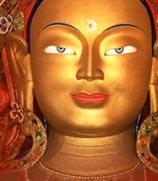
Buddhism is a dharmic religion. The systems of Buddhism and Hinduism must not be considered to be either contradictory to one another or completely self contained. Coomaraswamy wrote:
"The more supreficially one studies Buddhism, the more it seems to differ from Brahmanism in which it originated; the more profound our study, the more difficult it becomes to distinguish Buddhism from Brahmanism, or to say in what respects, if any, Buddhism is really unorthodox." [2]
Buddhist scholar Rahula Vipola wrote that the Buddha was trying to shed the true meaning of the Vedas. Buddha is said to be a knower of the Veda (vedajña) or of the Vedanta (vedântajña) (Sa.myutta, i. 168) and (Sutta Nipâta, 463).
Hinduism and Buddhism share many common features including Sanskrit, yoga, karma and dharma. Indians such as Ashoka the great and B.R. Ambedkar took to Buddism. India also is home to the government of Tibet in exile under Tenzin Gyatso, the 14th Dalai Lama.
Buddha (meaning 'the enlightened one') appeared in the Kali Yuga (specifically as Siddhartha Gautama).
From here
The Buddha in Puranic scripture
The description of Buddha incorporated in ten incarnations in Puranas comes with slight difference here and there in various Puranas like,
Harivamsha (1.41),
Vishnu Purana (3.18),
Bhagavata Purana (1.3.24, 2.7,37, 11,4.23) [7],
Garuda Purana (1.1),
Agni Purana (16),
Narada Purana (2.72),
Linga Purana (2.71),
Padma Purana (3.252) etc. (Dhere Ramchandra Chintaman) [8]
Other important scriptures which mention him is an Avatar are Rishi Parashara's Brihat Parashara Hora Shastra(2:1-5/7)
During the Guptas, one of the nine gems of the court of the king, Amarasimha refers to the Buddha in the following commentary: Amarakosha-grantha (Sanskrit dictionary) list many of the names and epithets by which the Buddha is traditionally known:
sarvajnah sugato buddho dharmarajastathagatah
samastabhadro bhagavan marajillokajijjinah
shadabhijno dasabalo ’dvayavadi vinayakah
munindrah srighanah sasta munih sakyamunistu yah
All-knowing, transcendental, awakened, king of righteousness, he who has come, beneficent, all-encompassing, lord, conqueror of the god of love-mara, victorious of three worlds, he who controls his senses, protector from the six enemies, possessor of the ten powers, speaker of non-dualism, teacher, lord of the sages, embodiment of splendor and eminent saint.
sa sakyasimhah sarvarthasiddhah sauddhodanisca sah
gautamascarkabandhusca mayadevisutasca sah
teacher of the sakyas, lion of the sakyas, accomplisher of all goals, son of suddhodana, of Gautama’s line, friend of scholars, son of mayadevi.
In some of the Puranas, in one he is described as having taken birth to "mislead the demons":
mohanartham danavanam balarupi pathisthitah
putram tam kalpayamasa mudhabudhirjinah svayam
tatah sammohayamasa jinadyana suramsakan
bhagavan vagbhirugrabhirahimsa vacibhirharih
(Brahmanda Purana)
In order to delude the demons, he (Lord Buddha) was present in the form of a child on the way while the fool, jina (a demon), imagined him to be his son. Later on, Lord Sri Hari (as avatara-buddha) expertly deluded jina and other demons by his strong words of non-violence.
A similar episode is found in the Linga Purana, which says Sakyamuni was sent to preach in the demon realms, which resulted in Shiva being able to destroy Tripura.
matsya kurmo varahasca nrisimha vamanastatha
ramo ramasca ramasca buddha kalki ca te dasah
Here the Buddha is said to have taken birth to restore the 'Devas'.
tatah kalau sampravritte sammohaya sura-dvisham
buddho namnanjana-sutah kikateshu bhavishyati
(srimad-bhagavatam 1.3.24)
Then, in the beginning of Kali-yuga the Lord will appear as Lord Buddha, the son of Anjana, in the province of Gaya (Bihar) just for the purpose of infatuating those who are envious of the devas.
This topic as been much of debate.
Some have even claimed Balarama to be the 9th. incarnation of Vishnu and not Buddha.
However, the concept of God incarnating to lull people into darkness is indeed an interesting concept. It does bring a a parallel between Mohini and Buddha on these grounds. However, it would be extremely unfair to draw such a parallel here because the perfection of spiritualism taught by Buddha seems to be an extremely unlikely a work of deceit.
Views are most welcome on this subject.
~Souvik
Friday, October 20, 2006
Anadamoyee Maa

Dear readers,
Happy Diwali to all!
Along with Diwali, Anandamoyee Maa Maha Kali is also worshipped during this time.
I miss my ancestral home and my 200 years tradition of Kali pujo like anything this time of the year.
Here's a video of my mother doing "boron" of the Eternal Mother.
http://www.youtube.com/watch?v=5SmIUX51VCQ
Jay Maa Kali!
~ Souvik
Saturday, October 07, 2006
Ai Kavi
Dear readers,
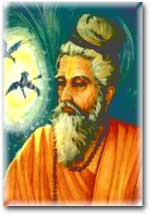
Today is Valmiki Jayanti (October 7th., 2006).
From here
The birthday of the Ai Kavi (the first poet), Valmiki is celebrated on the full moon day of Ashvina (September - October). Valmiki is the author of the so-celebrated Ramayana in Sanskrit. He was contemporary of Rama, the hero of the Ramayana. Valmiki himself represented as taking part in some of these scenes he relates. He received the banished Sita into his hermitage and educated her twin sons Kusha and lava. The invention of the "Shioka" (epic meter) is attributed to Valmiki.Originally, Valmiki belonged to a depressed class and was a sort of robber. He robbed and even killed the people passing through the forest, but because of the influence of some sages, he repented and betook himself to a hermitage on a hill in the district of Bonda in Bundelkhanda. There, he is said to have eventually received Sita, when banished by Rama.He got his name "Valmiki" because when immersed in meditation, he allowed himself to be overrun with ants like an anthill. His original name was "Ratnakar". Many depressed classes in the country trace their lineage to Valmiki. On his birthday he is worshipped and prayed and his portraits are taken out in processions through the and streets. Kirtans are also held in Valmiki temples.
From here
The story of Valmiki is steeped in legend. One version has it that Valmiki was originally a dalit dacoit called Ratna who haunted the forests and preyed upon the unwary travellers. One day a sage called Narada passed through the forest. Ratna saw him and immediately attacked him. Narada asked him why he did his foul deeds to which Ratna replied that it was to take care of his family, which consisted of his aged parents, wife and children. The sage then wanted to know if they would be willing to share in the punishment for his misdeeds. Ratna was sure they would but the sage advised him to go and ask them. Ratna tied the sage to a tree and ran home to ask his family if they would share in his punishments. His family replied in the negative, saying that it was Ratna's duty to take care of them and they were not responsible for the path he chose to do so. Disappointed, Ratna returned to the forest and confessed to the sage. The sage told him to repent for his sins and to stop his evil ways and to chant the name of Lord Rama. Legend has it that Valmiki meditated in one place till an ant-hill formed on top of him without him realising it. Hence the name Valmiki (from 'Valmik' which means ant-hill in Sanskrit). Valmiki became a maharishi (great sage).
There is another legend behind his writing the Ramayana. According to this legend, Valmiki was in the forest one day, when a hunter shot a bird. Valmiki was so touched by the pain of the bird that he composed and sang a sad song. Brahma was greatly moved by the touching song. He appeared before Valmiki and asked him to compose the life of Sri Rama in a similar verse. This is how maharishi valmiki started to write Ramayana
Brahma gave the gift of insight of Sri Rama's life to Valmiki. Valmiki began to compose the great eternal song and poem of the life of Sri Rama—The Ramayana. Valmiki's Ramayana is the very first poem in Sanskrit. Therefore, it is called the Adikavya or "The first poem" and Valmiki is also known as the Adikavi, which means "The first poet".
Legend has it that it was Maharshi Valmiki who offered refuge to Sita the wife of Lord Rama, and the queen of Ayodhya when she was banished from the kingdom. It was in his hermitage in the forest that Rama and Sita's twin sons Lava and Kusha were born and brought up.
Maharishi Valmik is accepted by many Indian communities as the author of the Yoga Vasistha, this particular piece of work was taught to Rama when he was disillusioned with the world in large . The Yoga Vasistha is an incredible piece of text which discusses a wide array of philosophical issues. Moreover, it appears to have been written over 5000 years ago
Wednesday, October 04, 2006
Abhinandan-Shubho Bijoya
Dear readers,
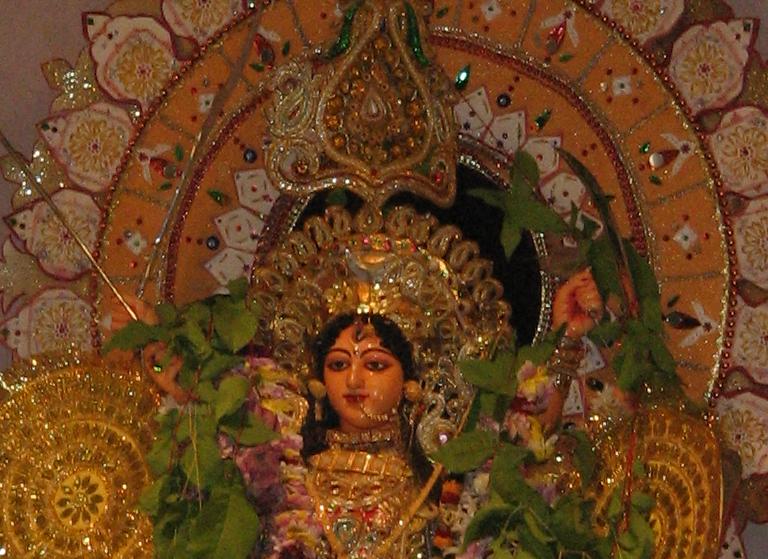
Shubho Bijoya to all!
Here's a small write up on Bijoya.
From here
"
The tenth day or Dashami is also known as Bijoya Dashami, as this was the day on which Devi Durga attained victory over buffalo demon Mahishasura. This day also coincides with Dussehra, the tenth day of Navaratri celebration. Durga Puja is not just a religious celebration. It is a social and cultural celebration. This is the occasion to send invitations and spend some quality time with your friends, family and acquaintances, to let them know your appreciation and wish each other Shubho Bijoya, the common phrase used to wish someone, a blessed bijoya.
This is also the last day of worshipping Maa Durga, this is the day when idol of Goddess Durga will be immersed in the near by river. With colorful and majestic parade accompanied by Dhunuchi dance, a kind of ritualistic dance and beating of the dhaak, the idol is taken to the near by river. With the believers yelling loudly, proclaiming, next year it’ll happen once again, the idol is immersed in the river water. A sense of sadness suddenly overshadows the festive mood as one has to wait for another year to feel the elation associated with Durga Puja celebration.
Several emotional and ritualistic customs take place on Bijoya Dashami before the idol of Maa Durga is taken for immersion. One such colorful and emotional custom is “Sindoor Khela” - “The Game of Vermillion”. This custom is practiced exclusively by the married women. Before the idol of Durga leaves for immersion they put sweet on the lips of the clay idol and wipe the corner of the eyes as someone wipes off the tears before bidding goodbye for a long time. Vermilion which is a symbol of marital bliss is applied on the forehead of the Goddess and among each other. The vermilion powder is applied at the parting of women’s hair which symbolizes to strengthen the marital bond. The sindoor is also applied on the red and white traditional bangles and on the ‘loha’ which is an iron bangle interlaced with gold or silver, presented to the bride by her mother in law as an acknowledgement of marriage. All these rituals are performed along with the friends and family, though every one can not take part in it but it is a wonderful experience to witness this living theatre of color, life and emotion.
This is also the time to meet up with friends and relatives living far off places, as they try to come back to their loved ones at this time of the year. In the evening they enjoy a hearty conversation or light hearted chit chats with their friends and family members, whom they missed all year long.
On Shubho Bijoya people invite others to come to their place and spend joyous time in the spirit of the celebration.They also visit the homes of their friends and acquaintances to thank them for there care and wish them shubho bijoya. Adults embrace each other with warm wishes, exchange gifts and greet Shubho Bijoya to each other, which is known as KolaKuli in Bengali. The children in an expression to show respect toward the elders touch the feet and seek their blessings.
The sumptuous dishes and mouth watering sweetmeats prepared for this special occasion are an integral part of Shubho Bijoya. Such yummy treats like ‘malpoa’ and probably the most popular snack, ‘Nimki’ are among the regular items in the Shubho Bijoya menu. Nowadays people buy the sweets and snacks straight from the market and don’t go in to all the trouble of making it at home. Friends and family devour these special treats, enjoy the festivity, catch up with friends and soak up the spirit of celebration.
"
~ Souvik
Sunday, October 01, 2006
Ashtami Puja

Dear readers,
Houston Durga Bari is famous for its Durga Puja all over the United States.
I was fortunate to attend and be a part of it this year. Thanks to Tampi and Ani!
Here are some photographs of Maa's Ashtami Puja.
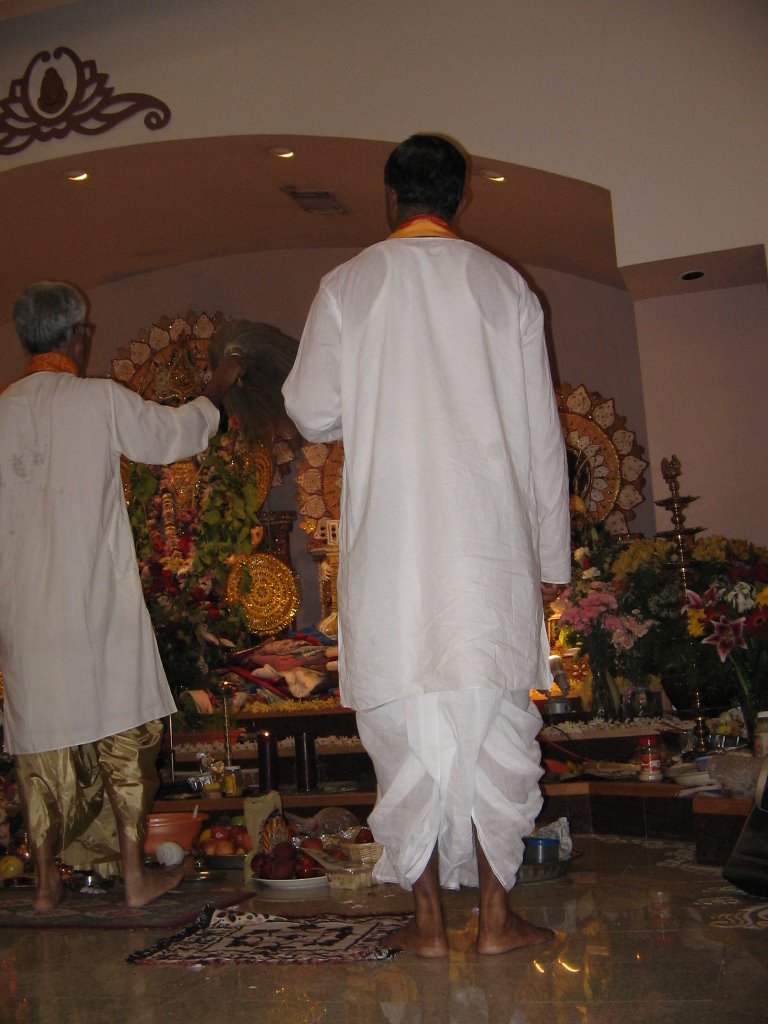
Ashtami sandhya aarati
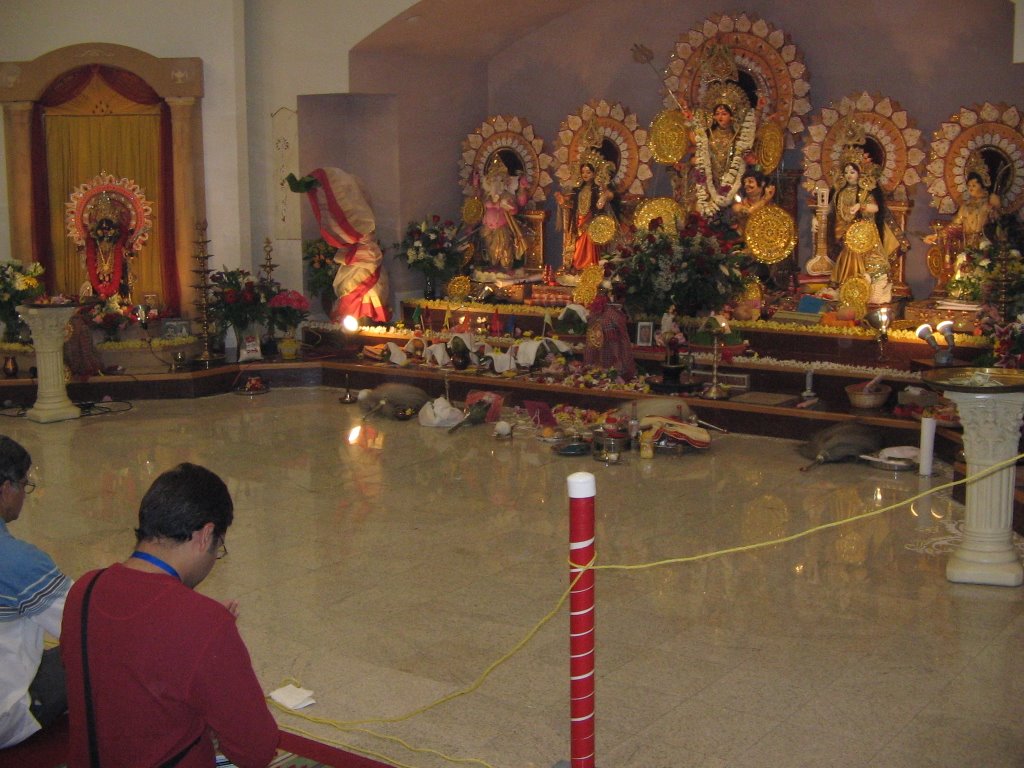
Maa's mandap

Chandi paath
Subscribe to:
Posts (Atom)