
Dear Readers,
On this auspicious ocassion, please accept a humble gift from me.
Click on the link below to download the Sacred Chants of Shiva!
Here
Shivoham!
Souvik

Dear readers,
Har Har Mahadev!
Please enjoy your day and seek the blessings of elders on this auspicious day of Shiv Ratri!
Om Namah Shivay!
~Souvik

Dear readers,
February 16th., 2007 is Maha Shiva Ratri.
As I have always said, Shiva (and Shakti) are much more than just mythological figures and spans across the limited man-made boundaries of religion, society and rituals. However, given an ocassion to celebrate and dance to the tunes of damru, one would be a fool not to rejoice in the festivity.
There is no place that does not have Shiva's presence. Life is just another name of Shiva. Swami Vivekananda just said "Shiva Jnaney Jeeva Puja".
Shivoham!
~ Souvik

Dear readers,
Happy Diwali to all!
Along with Diwali, Anandamoyee Maa Maha Kali is also worshipped during this time.
I miss my ancestral home and my 200 years tradition of Kali pujo like anything this time of the year.
Here's a video of my mother doing "boron" of the Eternal Mother.
http://www.youtube.com/watch?v=5SmIUX51VCQ
Jay Maa Kali!
~ Souvik
Dear readers,
Shubho Bijoya to all!
Here's a small write up on Bijoya.
From here
"
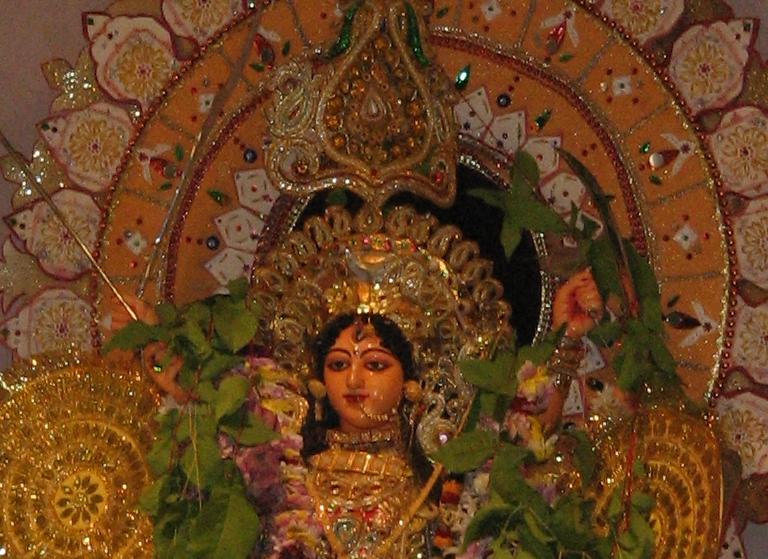
The tenth day or Dashami is also known as Bijoya Dashami, as this was the day on which Devi Durga attained victory over buffalo demon Mahishasura. This day also coincides with Dussehra, the tenth day of Navaratri celebration. Durga Puja is not just a religious celebration. It is a social and cultural celebration. This is the occasion to send invitations and spend some quality time with your friends, family and acquaintances, to let them know your appreciation and wish each other Shubho Bijoya, the common phrase used to wish someone, a blessed bijoya.
This is also the last day of worshipping Maa Durga, this is the day when idol of Goddess Durga will be immersed in the near by river. With colorful and majestic parade accompanied by Dhunuchi dance, a kind of ritualistic dance and beating of the dhaak, the idol is taken to the near by river. With the believers yelling loudly, proclaiming, next year it’ll happen once again, the idol is immersed in the river water. A sense of sadness suddenly overshadows the festive mood as one has to wait for another year to feel the elation associated with Durga Puja celebration.
Several emotional and ritualistic customs take place on Bijoya Dashami before the idol of Maa Durga is taken for immersion. One such colorful and emotional custom is “Sindoor Khela” - “The Game of Vermillion”. This custom is practiced exclusively by the married women. Before the idol of Durga leaves for immersion they put sweet on the lips of the clay idol and wipe the corner of the eyes as someone wipes off the tears before bidding goodbye for a long time. Vermilion which is a symbol of marital bliss is applied on the forehead of the Goddess and among each other. The vermilion powder is applied at the parting of women’s hair which symbolizes to strengthen the marital bond. The sindoor is also applied on the red and white traditional bangles and on the ‘loha’ which is an iron bangle interlaced with gold or silver, presented to the bride by her mother in law as an acknowledgement of marriage. All these rituals are performed along with the friends and family, though every one can not take part in it but it is a wonderful experience to witness this living theatre of color, life and emotion.
This is also the time to meet up with friends and relatives living far off places, as they try to come back to their loved ones at this time of the year. In the evening they enjoy a hearty conversation or light hearted chit chats with their friends and family members, whom they missed all year long.
On Shubho Bijoya people invite others to come to their place and spend joyous time in the spirit of the celebration.They also visit the homes of their friends and acquaintances to thank them for there care and wish them shubho bijoya. Adults embrace each other with warm wishes, exchange gifts and greet Shubho Bijoya to each other, which is known as KolaKuli in Bengali. The children in an expression to show respect toward the elders touch the feet and seek their blessings.
The sumptuous dishes and mouth watering sweetmeats prepared for this special occasion are an integral part of Shubho Bijoya. Such yummy treats like ‘malpoa’ and probably the most popular snack, ‘Nimki’ are among the regular items in the Shubho Bijoya menu. Nowadays people buy the sweets and snacks straight from the market and don’t go in to all the trouble of making it at home. Friends and family devour these special treats, enjoy the festivity, catch up with friends and soak up the spirit of celebration.
"
~ Souvik


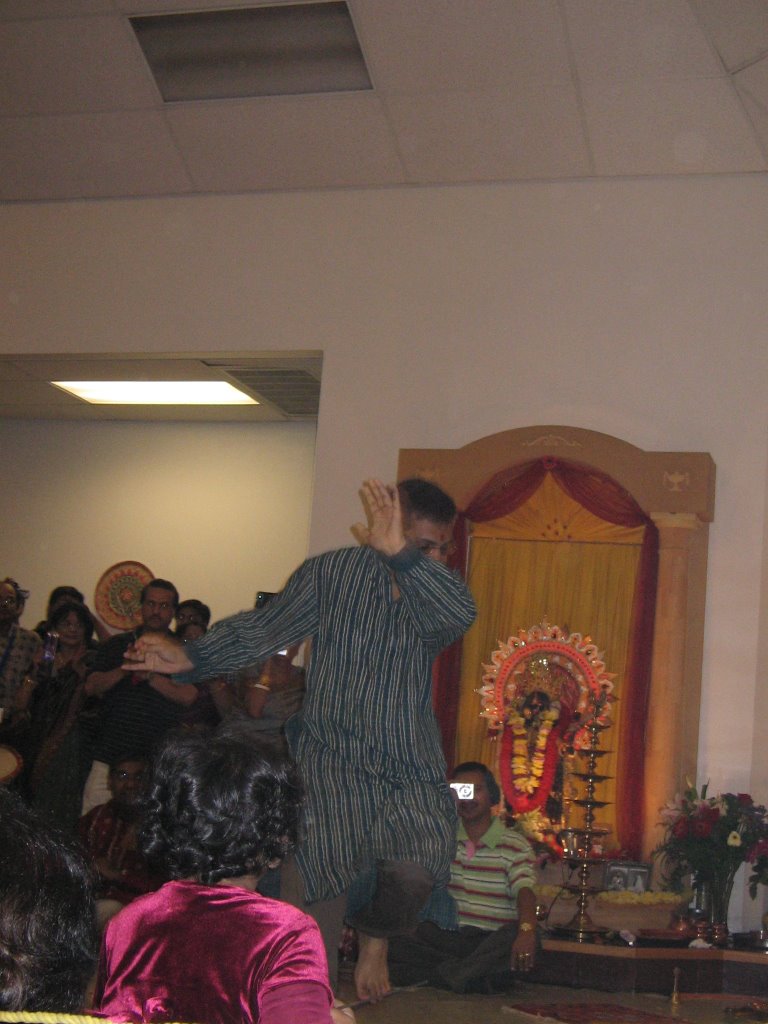
Dear readers,
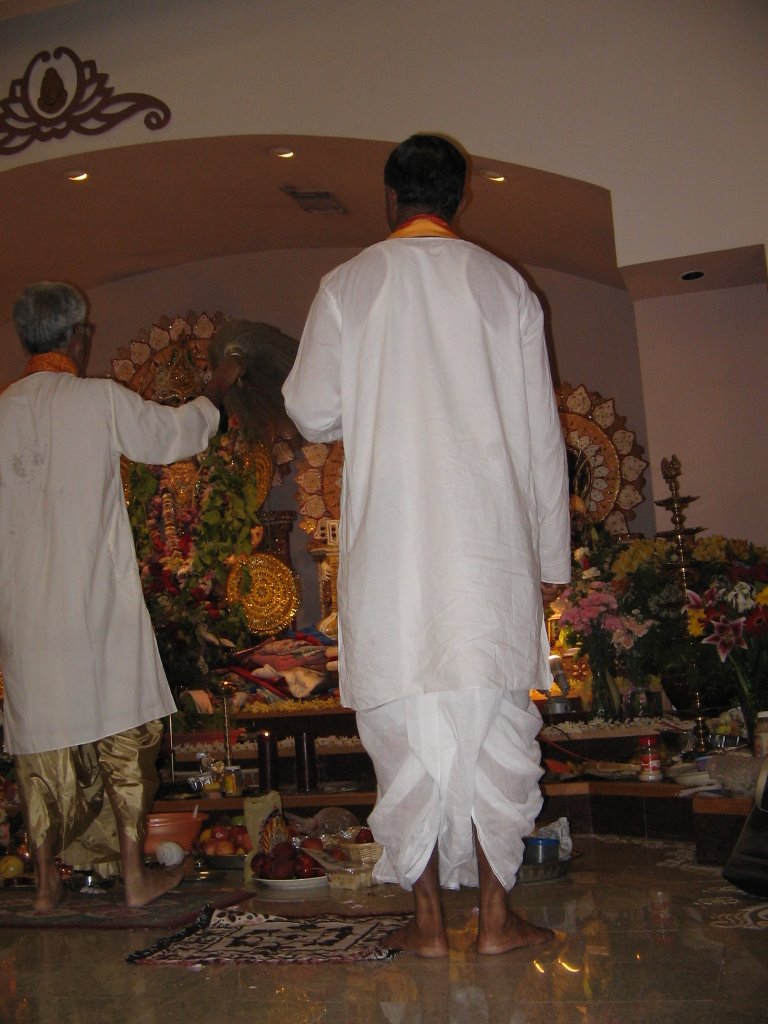
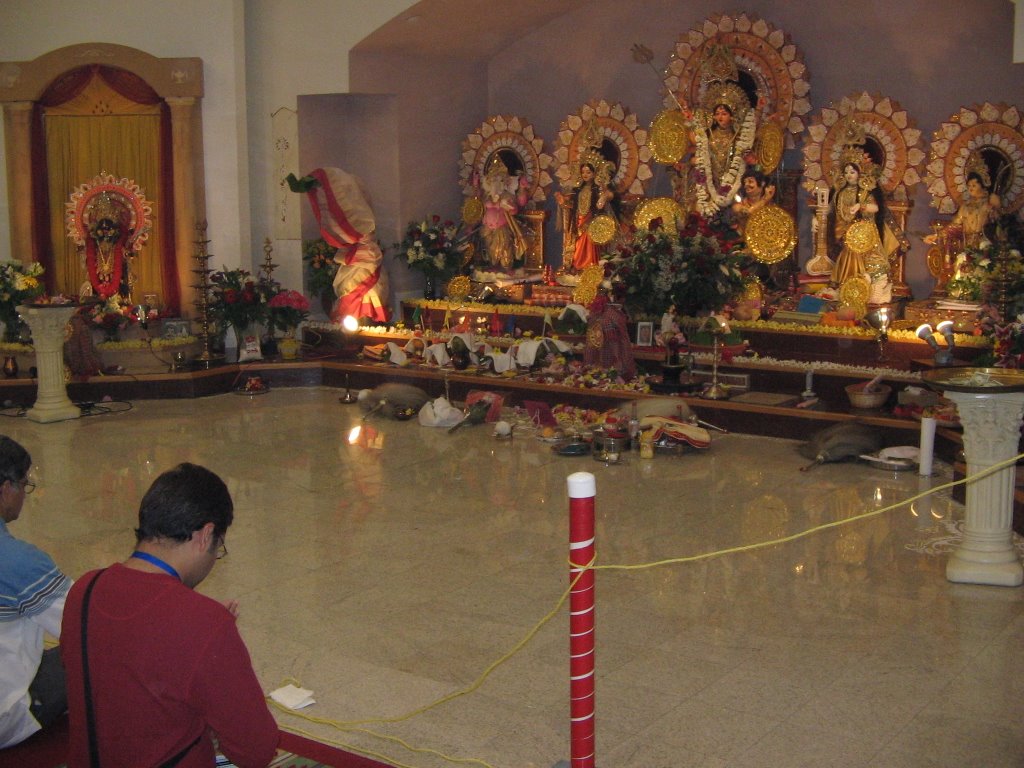
Yesterday at Houston Durga Bari I participated in a dhunichi dance competetion and won a trophy.
Winning was not at all important but the feeling of performing infront of Jagadambey Maa Durga was very fulfilling experience.
I humbly present the video recording for your viewing.
http://youtube.com/watch?v=9TT40bEBXow
Shubho Navami to all!
Dhunuchi nach-some facts:
Dhunuchi Naach - the dance with effervescent smokeIndia is known for her diverse traditions and this diverse tradition is the origin of the folk art. Folk Dances are based on religious and festive occasions. They reflect the basics of life. Folk dances are aimed at providing entertainment and which involves group participation. The dances are very rhythmic and the lyrics and music have the typical overtone of the specific locality or festival.'Dhunuchi nritya' or ‘the dance with effervescent smoke' is a traditional dance form from Bengal,which is performed in front of the idol to the sound of dhak, the traditional drums.In the evenings, an elaborate aaarti is performed. After the aaarti, young men perform Dhunuchi Naach (Dhunuchi Dance) before the Goddess Durga.
In Houston Durga bari due to unavailability of Dhunuchi, dhoop sticks were used to subsitute dhunichi in the dance.
Jay Durga!
Souvik

Dear readers,
Aug 27th. is Ganesh Chaturthi.
Wish all readers a peaceful and joyful Ganesh Chaturthi.
May Vighneshwer remove the obstacles in your life.
Regards,
Souvik
From here.
Festivals and Worship of Ganesha
In India, there is an important festival honouring Lord Ganesha. While it is most popular in the state of Maharashtra, it is performed all over India. It is celebrated for ten days starting from Ganesh Chaturthi. This was introduced by Balgangadhar Tilak as a means of promoting nationalist sentiment when India was ruled by the British. This festival is celebrated and it culminates on the day of Ananta Chaturdashi when the murti of Lord Ganesha is immersed into the most convenient body of water. In Mumbai (earlier known as Bombay), the murti is immersed in the Arabian Sea and in Pune the Mula-Mutha river. In various North and East Indian cities, like Kolkata, they are immersed in the holy Ganga river. One who really wants to taste the festival needs to come down to the city of Mumbai; particularly at Lalbaug where the divine idol of Lalbaugcha raja (The Lord Of Lalbaug, as Ganesha is fondly called) is set.
The Ganesha festival starts on Ganesh Chaturthi (fourth day of Hindu calendar month Bhadrapada) and ends on Anant Chaturdashi (fourteenth day of Bhadrapada). It is widely believed that every wish one expresses to Lord Ganesha must come true. All devotees from every corner of the globe gather at Lalbaug for the festival.
Representations of Shri Ganesh are based on thousands of years of religious symbolism that resulted in the figure of an elephant-head god. In India, the statues are impressions of symbolic significance and thus have never been claimed to be exact replications of a living figure. Ganesh is seen not as a physical entity but a higher spiritual being, and murtis, or statue-representations, act as signifiers of him as an ideal. Thus, to refer to the murtis as idols betrays Western Judeo-Christian understandings of insubstantial object worship whereas in India, Hindu deities are seen to be accessed through points of symbolic focus known as murtis. For this reason, the immersion of the murtis of Ganesh in nearby holy rivers is undertaken since the murtis are acknowledged to be only temporal understandings of a higher being as opposed to being 'idols,' which have traditionally been seen as objects worshipped for their own sake as divine.
The worship of Ganesha in Japan has been traced back to 806.
Resurgence of Popularity
Recently, there has been a resurgence of Ganesha worship and an increased interest in the "Western world" due to a spate of alleged miracles in September 1995. On September 21 1995, according to Hinduism Today magazine (www.hinduismtoday.com), Ganesh statues (as well as other statues) in India began spontaneously drinking milk when a spoonful was placed near the mouth of statues honoring the elephant god. The phenomena spread from New Delhi to New York, Canada, Mauritius, Kenya, Australia, Bangladesh, Malaysia, the United Kingdom, Denmark, Sri Lanka, Nepal, Hong Kong, Trinidad, Grenada and Italy among other reported places. This was seen as a miracle by many although skeptics contend that this was another example of collective hysteria. Some scientific experiments conducted in that time frame suggested capillary action as an explanation for this phenomenon. It had remained a mystery why such capillary action did not repeated itself [2] until the same thing happened again on 21 August 2006 [3]. Of course, now the question is why it happened again.
The book Ganesha, Remover of Obstacles by Manuela Dunn Mascetti is another of many resources that testify to the Hindu milk miracle.
Ganesha has two Siddhis (symbolically represented as wives or consorts): Siddhi (success) and Riddhi (prosperity). It is widely believed that "Wherever there is Ganesh, there is Success and Prosperity" and "Wherever there is Success and Prosperity there is Ganesh". This is why Ganesh is believed to be the harbinger of good fortune, and why he is invoked first at any ritual or ceremony. Whether it is diwali puja, a new house, a new vehicle, students praying before the exams, or people praying before job interviews, it is Ganesha they pray to, because it is believed that he will come to their aid and grant them success in their endeavor.
Ganesha is worshipped as Vinayak (knowledgeable) and Vighneshwer (remover of obstacles). It is believed that he blesses those who meditate upon him. Ganesha, in astrology, is believed to help people know what can be achieved and what cannot be.
This same article with all images can be downloaded from here.
Jai Shree Krishna!
Souvik
 |
| Supported by website-hit-counters.com . |


_by_RRV_edited.jpg)