Sunday, November 27, 2005

Aaradhana


I completed my Solah Somvar Vrat on last Monday and wanted to share the tale that lulled me into this vrat.
I am conducting Rudrabhsihek and Shiv Puja tomorrow for the completion of this vrat. All my friends in Chicago are welcome to join me.
Jai Shiv Shanbhu!
The beautiful Solah Somvar Vrat Katha
Once Lord Shiva visited the famous city of Amravati. Parvati also accompanied him. On their way, they saw a beautiful Shiva temple and decided to spend some time there. One day, Parvati found Lord Shiva in a playful mood.
She said to him, Oh my Lord, let us have a dice game. Lord Shiva obliged her and the game started. Meanwhile, the priest of the temple had come there. Parvati turned towards him and said Please foretell who will win this game? The Brahman gave no serious thought to her question and abruptly said, Lord Shiva will win the game. Incidentally Parvati won the game. She was angry because the Brahman had told a lie. Lord Shiva tried to pacify her, but she cursed the Brahman that he be a leper. In due course, the Brahman became a leper and spent a miserable life.
After some time a few fairies descended on the earth and pitied the fate of the priest. On asking him, the priest narrated the whole episode. One of the fairies said, You observe Monday fasts for sixteen weeks without break.
On the seventeenth Monday, prepare some holy food or Prasaad with flour mixed with ghee and gur. Distribute this prasaad among the members of your family and take some yourself. You will be free from this leprosy. The fairies disappeared and the priest followed the instructions. Soon, he regained his normal health.
Once Lord Shiva and Parvati again visited that temple. Parvati was surprised to see the priest. He was his normal self. She enquired about this feat and the priest narrated the whole story. Parvati was happy, she also decided to observe Monday fasts for sixteen weeks.
Incidentally, on the seventeenth Monday, when she broke her fast, her beloved son Kartikeya, who was displeased with her, appeared and said, 0 dear mother what is that power with which you have called me? What is the mystery? Parvati said, 0 my dear son, all this miracle is due to observing Monday fasts for sixteen weeks without interruption. Kartikeyas Brahman friend had been in a foreign land for quite some time.
Kartikeya said, I shall observe Monday fasts for sixteen weeks for happy reunion with my friend. He observed the 16 weeks fasts as per rules and to his great surprise his friend returned hale and hearty. The friend enquired about the miracle and Kartikeya told him the modalities to be observed for Monday fast.
The Brahman friend was very curious about his marriage. He decided to observe the Monday fasts for sixteen weeks. On the seventeenth Monday, the Brahman friend went to a city. The ruler of the city decided to marry his daughter to a person on whose neck his well-decorated elephant would put the garland. The Brahman joined the show.
Incidentally, the elephant garlanded him. The ruler of the city gave him his daughter and also a lot of money. The couple departed the next day and were back in their home. On the honeymoon night, the bride said, 0 my dear, how is it that the elephant ignored all the princes and garlanded you? How did you succeed on the auspicious moments?
The bridegroom said, I observed fasts on sixteen Mondays. Monday is Lord Shivas day. It is due to his blessings that I got a beautiful wife like you. My friend Kartikeya revealed this secret to me. The bride too decided to observe fasts on sixteen Mondays for a beautiful son full of knowledge. Her devotion bore fruit and she gave birth to a beautiful son. As the son grew up, he said to his mother, 0 my dear mother, what is the mystery behind my birth? Please reveal it to me. The mother told him how she observed Monday fasts.
The son also decided to observe the fasts to gain a kingdom for his parents. Incidentally, an old kings messengers from a nearby State came there in search of a beautiful and learned bridegroom for the princess. They proposed the princess hand for him and he readily agreed. The king expired after sometime and the boy became the king. The newly-made king continued his fasts for the next sixteen Mondays.
On the seventeenth Monday, he arranged a large prayer party at a temple. All the arrangements were made well in advance. The king requested the queen to accompany him to the temple for breaking the fast after taking prasaad from the priest. The queen refused to go with him.
The king had to go alone. The king heard an oracle who echoed, 0 king, turn out the queen from the palace or destruction will fall upon you. The king returned to his palace. He summoned a conference of his ministers and told about the oracle. All of them were taken aback, as it was due to that princess that he became the king of the state. They agreed to his proposal only with a heavy heart.
The queen was ultimately turned out. The queen left the palace bare footed and in worn-out clothes. She was thirsty and fatigued. She met an old lady who had a load of spinned spindles on her head. She was going to the city. She felt pity on her and asked to help her in selling the yarn because she did not know the art of selling. The queen took that load on her head. Incidentally, strong wind blew away the spindles which disappeared in the dusty wind. The queen felt sorry and the old lady asked her to go away. The queen went to an oilmans house and sought shelter. The oilman obliged her, but as she stepped in, all of his oil pots developed cracks and the oil began to flow on the ground. The oilman immediately turned her out. The queen was now disheartened. She went to the bank of a river to quench her thirst. As she touched the water, the water dried up. She then went to a deep jungle and saw a tank of water. As she went down the stairs and touched the crystal dear water, it became muddy. She cursed her fate and put a few drops of the muddy water in her mouth. She was now tired and wanted to take rest under a shady tree. As she went near the tree its leaves began to fall and soon it became leafless. The cowherds saw this incident and told the whole story to the priest of a nearby temple. The priest called for the woman.
He was surprised to see that the woman had royal features. He consoled her and provided her with all the facilities. But after some days, he also got fed up with her because whatever the woman touched became impure — may it be milk, food or water. One day, the priest said, 0 lady, what curse has fallen upon you? You reveal the mystery. The woman told him how she rejected a proposal to attend Monday fast prayer. The priest understood the whole thing.
He knew it was Shivas curse. He said, 0 dear lady, you observe fasts on sixteen Mondays and Lord Shiva will absolve you of your sins. The woman realised her mistake and observed the Monday fasts for sixteen Mondays. On the seventeenth Monday, the king said to himself, My queen left my palace long ago. Her condition must be very miserable. He called for his courtiers and ordered them to search out the queen. The courtiers reached the temple where the queen was residing. The priest refused to hand over the queen to them and said, Let the king himself come to receive her. The courtiers went to the king and related the whole story.
The king was happy to hear the news. He went to the temple and requested the priest to return his queen to him. The king admitted that he deserted the queen to avoid Lord Shivas wrath. The priest trusted the kings words and the queen returned to the palace. She was given a royal welcome. The king distributed money among the needy and arranged food for the hungry.
The king and queen now regularly observed fasts on sixteen Mondays each year and lived a very happy life. After their death they found abode in Lord Shivas city, Shivapuri. Since, then it is believed that a person who observes fasts on sixteen Mondays, gets all pleasures and enters Shivapuri after his death.

Friday, November 25, 2005

Aadieshwar


His name means The Auspicious One. He is Pure Consciousness, Chidanandaroopa - the form of joy that pure consciousness takes. He is the oldest god known to mankind, and more interestingly is perhaps the oldest living god, tracing a genealogy of worship that is easily five thousand years old. Naturally, therefore, he is described as the God with no lineage. Like Yahweh, who may be his only contemporary, his name was not to be taken in vain. In fact his name was not to be uttered at all. He is the howler, Rudra, when he first appears to us in the Rig Veda. He is Raudra Brahman, the wild God of the Hymns. He is also Nataraja, the elegant King of the Dance, and in fact of all the fine arts. He is the Lord of yoga, the culmination of the universe, the cause of its dissolution - yet always transcending such petty events.
To attempt an overview of Shiva in one essay is an act of extreme idiocy. I shall therefore seek to communicate some of the flavors that are associated with Shiva, trusting that time will be vouchsafed us to explore him in detail as we grow as a web-site. Shiva has been around for so long that entire encyclopedias on him are necessary to get just a bird's eye view. This god is perhaps the single most important influence on the arts and culture of the Indian subcontinent. In a very real sense, you find Shiva all over the country, he is in fact the country, so closely interwoven are the myths of his actions with the culture and geography of the land. So strong is Shiva's hold on the imagination that all local area gods which seek to gain in prestige, or are sought to be subverted to the main body of the Hindu religion, end up being described as various manifestations of Shiva. If the god lives on a hill, a forest or a cave then there is no way he escapes being but one more aspect of Mahadeva - the great god who loves to linger in hills, forests and caves. This is what has happened to Khandoba in Maharashtra, Skanda in Tamil Nadu and Ayyapan in Kerala to give the three most common examples. In fact another manner of accommodating these local religions was to decree the gods to be sons of Shiva.
The Rig Vedic Shiva was known as Rudra. He was a grim mysterious god, living on the fringes of Vedic society, a god who was so much of an outsider that he was not even entitled to a share in the fire sacrifices. Yet the Vedic pantheon was clearly in awe of this self sufficient Hunter-God. The hymns praise him in all-too-visible anxiety that his strange powers may be aroused, and his name as mentioned was never to be invoked. "We live in dread, and pray that you pass us by", quavers the Rig Vedic verse. Yet it immediately goes on to add that He is the Awakener, who when touched by pleas, grants a thousand kinds of balm that heal.
In a sense Rudra was too much a part of the Life-Force, too acutely felt to be just a god. Rudra punishes Prajapati for the first primordial act of incest and in a sense he is the defender of Dharma ever since. He is also a slayer of a brahmana, Prajapati, in the service of a higher morality, a fact that has caused much anguish to medieval commentators who were busy trying to show brahmanas were gods on earth as well as in heaven. Rudra-Shiva is thus always about living an authentic life, with utter disdain for convention.
This Vedic manifestation of Shiva was thought to be the earliest known(1500 B.C.) before he became the great God of later Hinduism. Then came the discovery of a few seals from the Harrapan civilization (2750 B.C.) and the picture changed completely. The seals show a figure who is so manifestly Shiva that it had to be acknowledged as such, even though it smashed the nice theory that was emerging of invading Aryans destroying the cities of the Indus valley. It is known as the proto-Shiva seal. However, for those who can read the signs and can decode the evidence, this figure is far more important.
He is surrounded by animals, which directly links him up with the Rudra-Pashupatinatha of the Vedas. The tiger, the elephant, and the bull depicted here, all play prominent parts in the Shiva mythology. Even more importantly he is shown in a typical yogic posture, which would indicate the knowledge of the ancient art.
This posture is the Udharva Linga posture (and not the ithyphallic posture as is so easily assumed) and it indicates the triumph over the sexual impulse.. The balls of the feet press into the sacral region behind and beneath the testicles as is shown. The lingam is erect and it presses into the navel, signifying the complete conquest of the sexual energy. He is now Udharva Retas, "he whose semen flows upwards". In the yogic system when you do not dissipate semen through ejaculation, it transforms itself into a food for the brain called ojas, vital energy, and is the source of the creative force that alone can provide you with the fuel to break through into enlightenment. This posture is commonly practiced even today and the udharva linga experience is not uncommon for many spiritual practitioners. Even the founder of Kriya yoga has left an account of precisely this linga entering the navel and the subsequent freedom from all thoughts and desire of lust.
Inevitably, Shiva the Conqueror of Lust and Desire is also known as the erotic ascetic! The Tantrik tradition uses the Shiva Energy very heavily and many of the texts of Tantra are lectures that Shiva gives to his spouse who may be Kali or Parvati, but actually is a representative of all the Divine Feminine energy in the world.
Shiva's sexuality inevitably brings us to the Shiva lingam, the supposedly sacred phallus. Contrary to popular perception, the Shiva lingam has a world of meaning attached to it and it is not just the obvious one of phallic symbolism. Most lingams are representations of Shiva who is never worshipped in the form of an image. Popular mythology holds that he was cursed so by an enraged rishi. The lingam is an abstract stand-in for the Howler who must never be named. The entire process is an elaborate avoidance of naming the dread name by substituting something else, which is also a creative and generative force.
Under Tantrik influence, the lingam placed in a yoni base - which means exactly what it sounds like - became a frank avowal of the ultimate origin of new life, it was fertility symbolism at its best. Educated Hindus tend to be over-apologetic about this aspect, though the average Hindu lives in a curious innocence about the nature of the Lingam. This was typically expressed in Gandhi's naïve confession that he had to read foreign authors before he realized that there might be anything sexual about the lingam.
According to Swami Vivekananda, not just the lingam but also the entire external image of Shiva is an elaborate symbolical construct. In his view, Shiva is a personification of the entire Vedic fire sacrifice. Thus the ash with which his body is smeared is the ash of the sacrifice. (Ash is also what's left when everything is destroyed and it does not decay. So too with god, what is left when everything is gone. Shiva covers himself with ash because he is the only life form in the Universe who is aware of this truth at every moment.) The white complexion of Shiva is indicative of the smoke of the sacrifice. The animals He is associated with indicate the animals tied to the sacrificial posts and so on. The Shiva linga, in Vivekananda's view is actually a feebly recalled Yupa Stambha, the Cosmic Pillar that is the center and support of the Universe, The Axis Mundi, in fact. This yupa stambha is always represented in all fire sacrifices and it is permanently installed in temples in the form of the linga.
If prayers could not be offered to images of Shiva, then the temples could be covered with depictions of scenes from his ancient life. So great was the Shiva factor in Indian art forms that it almost obscures the other gods. The temples and their sculptures run riot. Khajuraho, Ellora, Elephanta, Rameshwaram, the Chola temples, the Bhuvaneshwar and Madhya Pradesh temples, and the great dancing Shiva temple at Chidambaram, it's a universe drunk on the creative energy, fertile and fecund with originality and beauty that is not as well regarded as it should be, merely because there is too much of it. If there were only one such temple in India the world would have gone mad with appreciation. As such, you can actually overdose on beauty, the Beauty that is the transcendent state of the Truth that is Shiva, expressed in the famous formulation Satyam, Shivam, Sundaram.
The mythologies surrounding Shiva are immense. It must be remembered that the Shiva story has been going on for five thousand years now and they only too obviously reflect the concerns of people at the time they were being composed. Shiva Himself is a composite god today, involving many local area gods and little tradition mythologies into his all-embracing grasp. Shiva is more or less what you want Him to be, as in Him all contradictions casually coexist. The notion of Shiva as exclusively a Wild Man of the forests and mountains, traveling with a band of ghosts and ghouls as their leader, Bhoothnath, is a recent phase of his worship. For while He was always capable of peculiar behavior, Shiva used to live outside of society not because He had rejected it but because He had transcended it. Shiva is repeatedly described as the Supreme Master of all the Arts, and that indicates a highly socialized being, the Nagarika of ancient India, not a rustic.
To those who did not understand this aspect of the lord, to those who still had on their defensive shell of sophistication and cynicism, Shiva was Bholenath, the Simpleton God. Yet, traditionally India has regarded Shiva not as any of these roles but as Vishwanatha - the Lord of the Universe. That is why in all the old temples you find him represented as a king, decked out in lordly robes with crowns and jewels. This homeless-wanderer recent incarnation of Shiva was perhaps a reflection of a culture that had lost its moorings and was reeling under alien domination.
Yet even at this much reduced level, Shiva seems to appeal the most powerfully, of all the gods of India, to the collective unconscious. Since most Goddess worshipers also acknowledge Him as the divine spouse of the Goddess, Shiva may easily have the most devotes in sheer number alone. He is laughed at as an old man by devotees with the affection that comes only with comfort. Yet in some corner of the old limbic brain he lurks, Rudra-Shiva, the old god of India, the source of the songs of the Rig Veda.

"Of all who are born You are the greatest Of all the powers, you are the most compellingLustre itself becomes pale and outshone by you O Rudra!Protect us from the hordes of sins that assault us Stand between us and them Repel them with the thunderbolt of your arm O Rudra! Lead us to the other bank Let us cross with ease."

Monday, November 14, 2005

Anek Saivam Ekam Shivam

Saivism, also transliterated Shaivism and Saivism, is a branch of Hinduism that worships Siva as the Supreme God. Followers of Saivism are called Saivas or Saivites. Saivism is a monotheistic faith. Saivites believe that there is only one God, who simultaneously permeates all creation and exists beyond it, being both immanent and transcendent. The concept is in contrast with many semitic religious traditions, where God is seen as transcendent only. As all other Hindu denominations, Saivism acknowledges the existence of many lower Gods under the Supreme One. These Gods are encompassed by Him, seen as either as manifestations of the Supreme Being or as powerful entities who are permeated by Him, as is all Creation. This type of Monotheism is called Panentheism or Monistic Theism. Saivism is a very deep, devotional and mystical denomination of Hinduism. It is considered the oldest of the Hindu denominations, with a long lineage of sages and saints who have outlaid practices and paths aimed at self-realization and the ultimate goal of moksha, liberation. As a very broad religion, Saivism encompasses philosophical systems, devotional rituals, legends, mysticism and varied yogic practices. It has both monistic and dualistic traditions. Saivites believe God transcends form, and devotees often worship Siva in the form of a lingam, symbolizing all universe. God Siva is also revered in Saivism as the anthropomorphic manifestation of Siva Nataraja. Originated in India, Saivism has appeal all over India and is particularly strong among the Tamils of Southern India and Sri Lanka. Some traditions credit the spreading of Saivism into southern India by the great sage, Agastya, who is said to brought Vedic traditions as well as the Tamil language. There can be found almost innumerable Saivite temples and shrines, with many shrines accompanied as well by murtis dedicated to Ganesa, Lord of the Ganas, followers of Siva, and son of Siva and Sakti. The twelve Jyotirling, or "golden Iingam", shrines are among the most esteemed in Saivism. Benares is considered the holiest city of all Hindus and Saivites. A very revered Saivite temple is the ancient Chidambaram, in South India. One of the most famous hymns to Siva in the Vedas is Sri Rudram. The foremost Saivite Vedic Mantra is Aum Namah Sivaya. Major theological schools of Saivism include Kashmir Saivism, Saiva Siddhanta and Virasaivism. It is believed that the greatest author on the Saiva religion writing in Sanskrit was Abhinavagupta, from Srinagar, Kashmir, c. 1000 CE. Nayanars (or Nayanmars), saints from Southern India, were mostly responsible for development of Saivism in the Middle Ages. The presence of the different schools within Hinduism should not be viewed as a schism. On the contrary, there is no animosity between the schools. Instead there is a healthy cross-pollination of ideas and logical debate that serves to refine each school's understanding of Hinduism. It is not uncommon, or disallowed, for an individual to follow one school but take the point of view of another school for a certain issue.


Kashmir Shaivism is the philosophical school of consciousness that arose in Kashmir about 1200 years ago. The notion of Kashmir Shaivism originated in 1913 with the publication of J.C. Chatterji's text of the same name. Before that point the same thoughts would have been labeled Shaiva Monism, or the generic form Trika. Kashmir Shaivism is a tantric system with emphasis in areas which Navjivan Rastogi describes in his foreword for Dynamic Stillness by Swami Chetanananda, "The logical structure of Kashmir Shaivism may be said to be rooted in recognition (pratyabhijna); its ontic structure, in autonomy (svatantrya); its metaphysical structure, in the synthesis of Being and self-referential consciousness (prakasha-vimarsha); its process of spiritual practice (sadhana), in the refinement of the mental constructs (vikalpa-samskara); its yogic framework, in the awakening of the spiral energy (kundalini); and its empirical and epistemic transactions, in synthetic activity. Kashmir Shaivism reached its culmination in the philosophy of Abhinavagupta and Kshemaraja (tenth to eleventh century CE). Abhinavagupta's work on Kashmir Shaivism is unparalleled and can be seen in his classic texts Tantraalokaand Tantrasaara. Vijnaanabhairava Tantra is another important text which covers the 112 ways of understanding true God-consciousness it is written in the literary style of a conversation between Shiva and his consort Parvati. The majority of Abhinavagupta's works have not yet been translated into English, though substantial Italian and French translations exist. One of the leading North American scholars in this area is Paul E. Muller-Ortega in his text The Triadic Heart of Siva: Kaula Tantricism of Abhinavagupta in the Non-Dual Shaivism of Kashmir. Abhinavagupta writes from an esoteric internalized form of Tantra which places its emphasis on the role of insight into the true nature of reality and meditative mysticism. Kashmir Shaivism is a trika (three-fold) school. It argues for three categories, personified as goddesses: transcendental (paraa), immanent (aparaa), and intermediate (paraaparaa). These are saktis or powers of Siva, the divine consciousness. This school of Yoga philosophy argues for a connection and unity between everything in the universe. The attraction and connection between Siva and Sakti embodies the male and female attraction which creates the universe. One of the greatest modern gurus of Kashmir Shaivism was Swami Lakshmanjoo who passed on the tradition in his texts The Secret Supreme, Lectures on Practice and Discipline in Kashmir Shaivism and the collection of his oral teachings edited by John Hughes, Self Realization in Kashmir Shaivism. The most accomplished historical scholar of Kashmir Shaivism is Alexis Sanderson of All Souls College, Oxford, whose article Shaivism and the Tantric Traditions (1986) is probably the best place to start for those interested in an academic introduction to the topic.


Saiva Siddhanta is the oldest, most vigorous and extensively practiced Shaivaite Hindu school active today, encompassing millions of devotees, thousands of active temples and dozens of living monastic/ascetic traditions. Despite its popularity, Siddhanta’s past as an all-India denomination is relatively unknown and it is primarily identified with its South Indian, Tamil form. The term Saiva Siddhanta means “the final or established conclusions of Saivism.”
It is the formalized theology of the divine revelations contained in the twenty-eight Saiva Ågamas.
1 Gurus
2 Saints and Ascetics
3 Siddhas
4 Saiva Siddhanta Teachings
5 The Spread of Saiva Siddhanta
6 A New Siddhanta
7 A Dualistic Development
8 Saiva Siddhanta Today

Gurus
The first known guru of the Suddha, or “pure,” Saiva Siddhanta tradition was Maharishi Nandinatha of Kashmir (ca 250 BCE), recorded in Panini’s book of grammar as the teacher of Rishis Patanjali, Vyaghrapada and Vasishtha. The only surviving written work of Maharishi Nandinatha is the twenty-six Sanskrit verses, called the Nandikesvara Kasika, in which he carried forward the ancient teachings. Due to his monistic approach, Nandinatha is often considered by scholars as an exponent of the Advaita school. The next prominent guru on record is Rishi Tirumular, a Siddha in the line of Nandinatha who came from the Valley of Kashmir to South India to propound the sacred teachings of the twenty-eight Saiva Ågamas. In his work the Tirumantiram, "Sacred Incantation," Tirumular put the vast writings of the Ågamas and the Suddha Siddhanta philosophy into the Tamil language for the first time. Tirumular’s Suddha Saiva Siddhanta shares common distant roots with Mahasiddhayogi Gorakshanatha’s Siddha Siddhanta in that both are Natha teaching lineages. Tirumular’s lineage is known as the Nandinatha Sampradaya, while Gorakshanatha’s is called the Ådinatha Sampradaya.
Saints and Ascetics
Saiva Siddhanta flowered in South India as a forceful bhakti movement infused with insights on siddha yoga. During the seventh to ninth centuries, saints Sambandar, Appar and Sundarar pilgrimaged from temple to temple, singing soulfully of Shiva’s greatness. They were instrumental in successfully defending Shaivism against the threats of Buddhism and Jainism. Soon thereafter, a king’s Prime Minister, Manikkavasagar, renounced a world of wealth and fame to seek and serve God. His heart-melting verses, called Tiruvasagam, are full of visionary experience, divine love and urgent striving for Truth. The songs of these four saints are part of the compendium known as Tirumurai, which along with the Vedas and Saiva Ågamas form the scriptural basis of Saiva Siddhanta in Tamil Nadu.
Siddhas
Besides the saints, philosophers and ascetics, there were innumerable siddhas, “accomplished ones,” God-intoxicated men who roamed their way through the centuries as saints, gurus, inspired devotees or even despised outcasts. Saiva Siddhanta makes a special claim on them, but their presence and revelation cut across all schools, philosophies and lineages to keep the true spirit of Siva present on Earth. These siddhas provided the central source of power to spur the religion from age to age. The well-known names include Agastya, Bhogar, Tirumular and Gorakshanatha. They are revered by the Siddha Siddhantins, Kashmîr Saivites and even by the Nepalese branches of Buddhism.
Saiva Siddhanta Teachings
Rishi Tirumular, like his satguru, Maharishi Nandinatha, propounded a monistic theism in which Shiva is both material and efficient cause, immanent and transcendent. Shiva creates souls and world through emanation from Himself, ultimately reabsorbing them in His oceanic Being, as water flows into water, fire into fire, ether into ether. The Tirumantiram unfolds the way of Siddhanta as a progressive, four-fold path of charya, virtuous and moral living; kriya, temple worship; and yoga—internalized worship and union with Para Shiva through the grace of the living satguru—which leads to the state of jñana and liberation. After liberation, the soul body continues to evolve until it fully merges with God—jîva becomes Shiva. Affirming the monistic view of Saiva Siddhanta was Srikumara (ca 1056), stating in his commentary, Tatparyadîpika, on Bhoja Paramara’s works, that Pati, pasu and pasa are ultimately one, and that revelation declares that Shiva is one. He is the essence of everything. Srikumara maintained that Shiva is both the efficient and the material cause of the universe.
The Spread of Saiva Siddhanta
In Central India, Saiva Siddhanta of the Sanskrit tradition was first institutionalized by Guhavasi Siddha (ca 675). The third successor in his line, Rudrasambhu, also known as Amardaka Tirthanatha, founded the Åmardaka monastic order (ca 775) in Andhra Pradesh. From this time, three monastic orders arose that were instrumental in Saiva Siddhanta’s diffusion throughout India. Along with the Åmardaka order (which identified with one of Saivism’s holiest cities, Ujjain) were the Mattamayura Order, in the capital of the Chalukya dynasty, near the Punjab, and the Madhumateya order of Central India. Each of these developed numerous sub-orders, as the Siddhanta monastics, full of missionary spirit, used the influence of their royal patrons to propagate the teachings in neighboring kingdoms, particularly in South India. From Mattamayura, they established monasteries in the regions now in Maharashtra, Karnataka, Andhra and Kerala (ca 800). Of the many gurus and acharyas that followed, spreading Siddhanta through the whole of India, two siddhas, Sadyojyoti and Brihaspati of Central India (ca 850), are credited with the systematization of the theology in Sanskrit. Sadyojyoti, initiated by the Kashmir guru Ugrajyoti, propounded the Siddhanta philosophical views as found in the Raurava Ågama. He was succeeded by Ramakantha I, Srikantha, Narayanakantha and Ramakantha II, each of whom wrote numerous treatises on Saiva Siddhanta. Later, King Bhoja Paramara of Gujarat (ca 1018) condensed the massive body of Siddhanta scriptural texts that preceded him into a one concise metaphysical treatise called Tattvaprakasa, considered a foremost Sanskrit scripture on Saiva Siddhanta. Saiva Siddhanta was readily accepted wherever it spread in India and continued to blossom until the Islamic invasions, which virtually annihilated all traces of Siddhanta from North and Central India, limiting its open practice to the southern areas of the subcontinent.
A New Siddhanta
It was in the twelfth century that Aghorasiva took up the task of amalgamating the Sanskrit Siddhanta tradition of the North with the Southern, Tamil Siddhanta. As the head of a branch monastery of the Åmardaka Order in Chidambaram, Aghorasiva gave a unique slant to Saiva Siddhanta theology, paving the way for a new pluralistic school. In strongly refuting any monist interpretations of Siddhanta, Aghorasiva brought a dramatic change in the understanding of the Godhead by classifying the first five principles, or tattvas (Nada, Bindu, Sadasiva, Èsvara and Suddhavidya), into the category of pasa (bonds), stating they were effects of a cause and inherently unconscious substances. This was clearly a departure from the traditional teaching in which these five were part of the divine nature of God. Aghorasiva thus inaugurated a new Siddhanta, divergent from the original monistic Saiva Siddhanta of the Himalayas. Despite Aghorasiva’s pluralistic viewpoint of Siddhanta, he was successful in preserving the invaluable Sanskritic rituals of the ancient Ågamic tradition through his writings. To this day, Aghorasiva’s Siddhanta philosophy is followed by almost all of the hereditary Sivacharya temple priests, and his paddhati texts on the Ågamas have become the standard puja manuals. His Kriyakramadyotika is a vast work covering nearly all aspects of Saiva Siddhanta ritual, including dîksha, saµskaras, atmartha puja and installation of Deities.
A Dualistic Development
In the thirteenth century, another important development occurred in Saiva Siddhanta when Meykandar wrote the twelve-verse Sivajñanabodham. This and subsequent works by other writers laid the foundation of the Meykandar Sampradaya, which propounds a pluralistic realism wherein God, souls and world are coexistent and without beginning. Siva is efficient but not material cause. They view the soul’s merging in Siva as salt in water, an eternal oneness that is also twoness. This school’s literature has so dominated scholarship that Saiva Siddhanta is often erroneously identified as exclusively pluralistic. In truth, there are two interpretations, one monistic and another dualistic, of which the former is the original philosophical premise found in pre-Meykandar scriptures, including the Upanishads.
Saiva Siddhanta Today
Today Saiva Siddhanta has sixty million Tamil Saivites in South India and Sri Lanka. Prominent Siddhanta societies, temples and monasteries also exist in a number of other countries.


Virasaivism is a religious movement of Hinduism in India. The adherents are known as Veerashaivas, or more commonly Lingayats. This important sect of Hinduism represents a reform movement attributed to Basavanna in the 12th century. Basavanna lived and taught in what is now Karnataka State. Some believers believe that Basavanna is an incarnation of Nandi, Shiva's greatest devotee. Nandi serves Shiva perpetually as Garuda does for Vishnu.
Lingayats believe in a monotheistic world where Shiva is the supreme deity. They worship Shiva as a lingam. Additionally, Lingayats wear the lingam in a similar way as Christians wear the crucifix. Basavanna attempted to rid society of caste distinctions, although these can be found to a degree in modern Lingayats. Many of the reforms which Basavanna pushed for would be later adopted by Gandhi, Swami Vivekananda, and others. Also, the Lingayats favor gender equality and in fact, have women gurus.
However, unlike practically all Hindus, Lingayats reject the Vedas but rather focus more on the Hindu Agamas, specifically, the Shaivite Agamas. Some Lingayats view the Vedas to be polytheistic in nature while the Agamas are strictly monotheistic and devotional in nature.
The term Virasaiva is derived from vira (heroic), and saiva (worshipper of Siva). The term Lingayat is derived from the lingam, or the abstract symbol of Shiva in which God is worshipped without form.
Basavanna was a brahmin, he tried to bring social change in society by encouraging inter-caste marriages between untouchables and people of other castes, though he himself did not follow that and married a brahmin. The revolution he brought about helped people of many low castes and untouchables who eagerly became followers of basava to attain social status.

Friday, October 28, 2005

Aum Kring Kalikaye Namah Aum

This is the time of Diwali and the time of Kali Pujo.
This is a time when my heart pains for my home, my ancestral home, where every year all our relations gather together to worship our kula devi, Maha Kali.
We have a "parampara" of Kali Pujo down to me from my ancestors as far back as 200 years.
Maha Kali has been with our family ever since and it is this very faith, very belief that has made us Dutta's stand together in years of turbulence, proving that human belief can do miracles.
Wish you all a blessed Diwali, a prosperous New Year and a glorious Kali Pujo
Jai Kali!

The worship of a mother goddess as the source of life and fertility has prehistoric roots, but the transformation of that deity into a Great goddess of cosmic powers was achieved with the composition of the Devi Mahatmya (Glory of the goddess), a text of the fifth to sixth century, when worship of the female principle took on dramatic new dimensions. The goddess is not only the mysterious source of life, she is the very soil, all-creating and all consuming.

Kali makes her 'official' debut in the Devi-Mahatmya, where she is said to have emanated from the brow of Goddess Durga (slayer of demons) during one of the battles between the divine and anti-divine forces. Etymologically Durga's name means "Beyond Reach". She is thus an echo of the woman warrior's fierce virginal autonomy. In this context Kali is considered the 'forceful' form of the great goddess Durga.

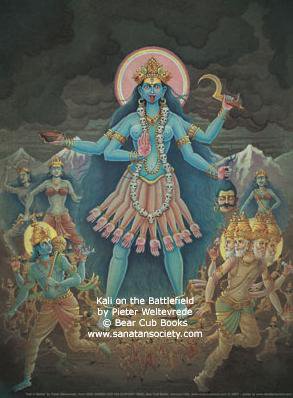
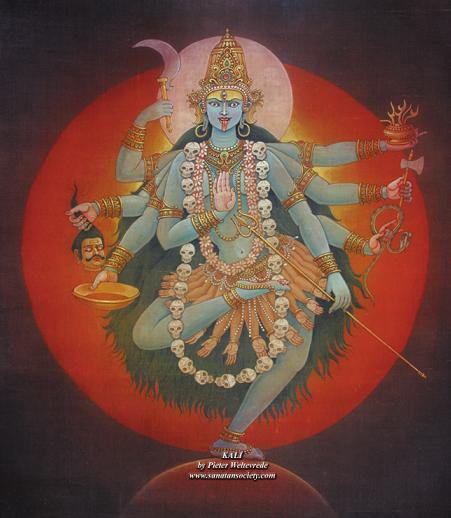
Kali is represented as a Black woman with four arms; in one hand she has a sword, in another the head of the demon she has slain, with the other two she is encouraging her worshippers. For earrings she has two dead bodies and wears a necklace of skulls ; her only clothing is a girdle made of dead men's hands, and her tongue protrudes from her mouth. Her eyes are red, and her face and breasts are besmeared with blood. She stands with one foot on the thigh, and another on the breast of her husband.

Kali's fierce appearances have been the subject of extensive descriptions in several earlier and modern works. Though her fierce form is filled with awe- inspiring symbols, their real meaning is not what it first appears- they have equivocal significance:
Kali's blackness symbolizes her all-embracing, comprehensive nature, because black is the color in which all other colors merge; black absorbs and dissolves them. 'Just as all colors disappear in black, so all names and forms disappear in her' (Mahanirvana Tantra). Or black is said to represent the total absence of color, again signifying the nature of Kali as ultimate reality. This in Sanskrit is named as nirguna (beyond all quality and form). Either way, Kali's black color symbolizes her transcendence of all form.
A devotee poet says:
"Is Kali, my Divine Mother, of a black complexion? She appears black because She is viewed from a distance; but when intimately known She is no longer so.The sky appears blue at a distance, but look at it close by and you will find that it has no colour. The water of the ocean looks blue at a distance,but when you go near and take it in your hand, you find that it is colourless."
... Ramakrishna Paramhansa (1836-86)

Kali's nudity has a similar meaning. In many instances she is described as garbed in space or sky clad. In her absolute, primordial nakedness she is free from all covering of illusion. She is Nature (Prakriti in Sanskrit), stripped of 'clothes'. It symbolizes that she is completely beyond name and form, completely beyond the illusory effects of maya (false consciousness). Her nudity is said to represent totally illumined consciousness, unaffected by maya. Kali is the bright fire of truth, which cannot be hidden by the clothes of ignorance. Such truth simply burns them away.
She is full-breasted; her motherhood is a ceaseless creation. Her disheveled hair forms a curtain of illusion, the fabric of space - time which organizes matter out of the chaotic sea of quantum-foam. Her garland of fifty human heads, each representing one of the fifty letters of the Sanskrit alphabet, symbolizes the repository of knowledge and wisdom. She wears a girdle of severed human hands- hands that are the principal instruments of work and so signify the action of karma. Thus the binding effects of this karma have been overcome, severed, as it were, by devotion to Kali. She has blessed the devotee by cutting him free from the cycle of karma. Her white teeth are symbolic of purity (Sans. Sattva), and her lolling tongue which is red dramatically depicts the fact that she consumes all things and denotes the act of tasting or enjoying what society regards as forbidden, i.e. her indiscriminate enjoyment of all the world's "flavors".

Kali's four arms represent the complete circle of creation and destruction, which is contained within her. She represents the inherent creative and destructive rhythms of the cosmos. Her right hands, making the mudras of "fear not" and conferring boons, represent the creative aspect of Kali, while the left hands, holding a bloodied sword and a severed head represent her destructive aspect. The bloodied sword and severed head symbolize the destruction of ignorance and the dawning of knowledge. The sword is the sword of knowledge, that cuts the knots of ignorance and destroys false consciousness (the severed head). Kali opens the gates of freedom with this sword, having cut the eight bonds that bind human beings. Finally her three eyes represent the sun, moon, and fire, with which she is able to observe the three modes of time: past, present and future. This attribute is also the origin of the name Kali, which is the feminine form of 'Kala', the Sanskrit term for Time.

Another symbolic but controversial aspect of Kali is her proximity to the cremation ground:
O Kali, Thou art fond of cremation grounds; so I have turned my heart into oneThat thou, a resident of cremation grounds, may dance there unceasingly.O Mother! I have no other fond desire in my heart; fire of a funeral pyre is burning there; O Mother! I have preserved the ashes of dead bodies all aroundthat Thou may come. O Mother! Keeping Shiva, conqueror of Death, under Thy feet, Come, dancing to the tune of music; Prasada waits With his eyes closed
... Ramprasad (1718-75)

Kali's dwelling place, the cremation ground denotes a place where the five elements (Sanskrit: pancha mahabhuta) are dissolved. Kali dwells where dissolution takes place. In terms of devotion and worship, this denotes the dissolving of attachments, anger, lust, and other binding emotions, feelings, and ideas. The heart of the devotee is where this burning takes place, and it is in the heart that Kali dwells. The devotee makes her image in his heart and under her influence burns away all limitations and ignorance in the cremation fires. This inner cremation fire in the heart is the fire of knowledge, (Sanskrit: gyanagni), which Kali bestows.

The image of a recumbent Shiva lying under the feet of Kali represents Shiva as the passive potential of creation and Kali as his Shakti. The generic term Shakti denotes the Universal feminine creative principle and the energizing force behind all male divinity including Shiva. Shakti is known by the general name Devi, from the root 'div', meaning to shine. She is the Shining One, who is given different names in different places and in different appearances, as the symbol of the life-giving powers of the Universe. It is she that powers him. This Shakti is expressed as the i in Shiva's name. Without this i, Shiva becomes Shva, which in Sanskrit means a corpse. Thus suggesting that without his Shakti, Shiva is powerless or inert.

Kali is a particularly appropriate image for conveying the idea of the world as the play of the gods. The spontaneous, effortless, dizzying creativity of the divine reflex is conveyed in her wild appearance. Insofar as kali is identified with the phenomenal world, she presents a picture of that world that underlies its ephemeral and unpredictable nature. In her mad dancing, disheveled hair, and eerie howl there is made present the hint of a world reeling, careening out of control. The world is created and destroyed in Kali's wild dancing, and the truth of redemption lies in man's awareness that he is invited to take part in that dance, to yield to the frenzied beat of the Mother's dance of life and death.

O Kali, my Mother full of Bliss! Enchantress of the almighty Shiva!In Thy delirious joy Thou dancest, clapping Thy hands together!Thou art the Mover of all that move, and we are but Thy helpless toys
...Ramakrishna Paramhans

Kali and her attendants dance to rhythms pounded out by Shiva (Lord of destruction) and his animal-headed attendants who dwell in the Himalayas. Associated with chaos and uncontrollable destruction, Kali's own retinue brandishes swords and holds aloft skull cups from which they drink the blood that intoxicates them. Kali, like Shiva, has a third eye, but in all other respects the two are distinguished from one another. In contrast to Shiva's sweet expression, plump body, and ash white complexion, dark kali's emaciated limbs, angular gestures, and fierce grimace convey a wild intensity. Her loose hair, skull garland, and tiger wrap whip around her body as she stomps and claps to the rhythm of the dance.

Many stories describe Kali's dance with Shiva as one that "threatens to destroy the world" by its savage power. Art historian Stella Kramrisch has noted that the image of kali dancing with Shiva follows closely the myth of the demon Daruka. When Shiva asks his wife Parvati to destroy this demon, she enters Shiva's body and transforms herself from the poison that is stored in his throat. She emerges from Shiva as Kali, ferocious in appearance, and with the help of her flesh eating retinue attacks and defeats the demon. Kali however became so intoxicated by the blood lust of battle that her aroused fury and wild hunger threatened to destroy the whole world. She continued her ferocious rampage until Shiva manifested himself as an infant and lay crying in the midst of the corpse-strewn field. Kali, deceived by Shiva's power of illusion, became calm as she suckled the baby. When evening approached, Shiva performed the dance of creation (tandava) to please the goddess.
Delighted with the dance, Kali and her attendants joined in.
This terrific and poignant imagery starkly reveals the nature of Kali as the Divine Mother. Ramaprasad expresses his feelings thus:
Behold my Mother playing with Shiva, lost in an ecstasy of joy!Drunk with a draught of celestial wine, She reels, and yet does not fall. Erect She stands on Shiva's bosom, and the earth Trembles under Her tread; She and Her Lord are mad with frenzy, casting Aside all fear and shame.
... Ramprasad (1718-75)

Kali's human and maternal qualities continue to define the goddess for most of her devotees to this day. In human relationships, the love between mother and child is usually considered the purest and strongest. In the same way, the love between the Mother Goddess and her human children is considered the closest and tenderest relationship with divinity. Accordingly, Kali's devotees form a particularly intimate and loving bond with her. But the devotee never forgets Kali's demonic, frightening aspects. He does not distort Kali's nature and the truths she reveals; he does not refuse to meditate on her terrifying features. He mentions these repeatedly in his songs but is never put off or repelled by them. Kali may be frightening, the mad, forgetful mistress of a world spinning out of control, but she is, after all, the Mother of all.
As such, she must be accepted by her children- accepted in wonder and awe, perhaps, but accepted nevertheless. The poet in an intimate and lighter tone addresses the Mother thus:
O Kali! Why dost Thou roam about nude? Art Thou not ashamed, Mother! Garb and ornaments Thou hast none; yet Thou Pridest in being King's daughter. O Mother! Is it a virtue of Thy family that Thou Placest thy feet on Thy husband? Thou art nude; Thy husband is nude; you both roam cremation grounds. O Mother! We are all ashamed of you; do put on thy garb. Thou hast cast away Thy necklace of jewels, Mother, And worn a garland of human heads.Prasada says, "Mother! Thy fierce beauty has frightenedThy nude consort.
... Ramaprasad

The soul that worships becomes always a little child: the soul that becomes a child finds God oftenest as mother.
In a meditation before the Blessed Sacrament, some pen has written the exquisite assurance: "My child, you need not know much in order to please Me. Only Love Me dearly. Speak to me, as you would talk to your mother, if she had taken you in her arms."

Kali's boon is won when man confronts or accepts her and the realities she dramatically conveys to him. The image of Kali, in a variety of ways, teaches man that pain, sorrow, decay, death, and destruction are not to be overcome or conquered by denying them or explaining them away. Pain and sorrow are woven into the texture of man's life so thoroughly that to deny them is ultimately futile. For man to realize the fullness of his being, for man to exploit his potential as a human being, he must finally accept this dimension of existence. Kali's boon is freedom, the freedom of the child to revel in the moment, and it is won only after confrontation or acceptance of death. To ignore death, to pretend that one is physically immortal, to pretend that one's ego is the center of things, is to provoke Kali's mocking laughter. To confront or accept death, on the contrary, is to realize a mode of being that can delight and revel in the play of the gods. To accept one's mortality is to be able to let go, to be able to sing, dance, and shout.
Kali is Mother to her devotees not because she protects them from the way things really are but because she reveals to them their mortality and thus releases them to act fully and freely, releases them from the incredible, binding web of "adult" pretense, practicality, and rationality.


19 Quotes on KALI, THE DIVINE MOTHER - MAHASHAKTI by Paramhamsa

"The Primordial Power is ever at play.She is creating, preserving, and destroying in play, as it were. This Power is called kAli. kAli is verily Brahman,and Brahman is verily kAli. It is one and the same Reality."

"Oh, She plays in different ways. It is She alone who is known as MahA-kAli, Nitya-kAli, ShmashAna-kAli, RakshA-kAli, and ShyAmA-kAli. ShyAmA-kAli has a somewhat tender aspectand is worshipped in the Hindu households.She is the Dispenser of boons and the Dispeller of fear.People worship RakshA-kAli, the Protectress, in times of epidemic, famine, earthquake, drought and flood. ShmashAna-kAli is the embodiment of the power of destruction."

"The Divine Mother wants to continue playing with Her created beings. In a game of hide-and-seek the running about soon stops if in the beginning all the players touch the 'granny'. If all touch her, than how can the game go on? That displeases Her. Her pleasure is in continuing the game."

"It is as if the Divine Mother said to the human mindin confidence, with a sign from Her eye,'Go and enjoy the world'. How can one blame the mind? The mind can disentangle itself from worldliness if, through Her grace, She makes it turn toward Herself.Only then does it become devoted to the Lotus Feet of the Divine Mother."

"The jnAnis, who adhere to the non-dualistic philosophy of VedAnta, say that the acts of creation, preservation and destruction, the universe itself and all its living beings,are the manifestation of Shakti, the Divine Power.If you reason it out, you will realize that all these are as illusory as a dream. Brahman alone is the Reality, and all else is unreal. Even this very Shakti is unsubstantial, like a dream."

"Not a leaf moves except by the will of God. Where is man's free will? All are under the will of God. Therefore I say: 'O Mother, I am the machine and Thou art the Operator; I am the chariot and Thou art the Driver.I move as Thou movest me; I do as Thou makest me do'."

"Is it possible to understand God's action and His motive?He creates, He preserves, and He destroys. Can we ever understand why He destroys?I say to the Divine Mother: 'O Mother,I do not need to understand. Please give me love for Thy Lotus Feet'.The aim of human life is to attain bhakti. As for other things, the Mother knows best."

"Is kAli, my Divine Mother, of a black complexion? She appears black because She is viewed from a distance; but when intimately known She is no longer so. The sky appears blue at a distance, but look at it close by and you will find that it has no colour. The water of the ocean looks blue at a distance, but when you go near and take it in your hand, you find that it is colourless."

"Though you reason all your life, unless you are established in SamAdhi, you cannot go beyond the jurisdiction of Shakti. Even when you say, 'I am meditating', or 'I am contemplating', still you are moving in the realm of Shakti, within It's power."

"One must propitiate the Divine Mother, the Primal Energy,in order to obtain God's grace. God Himself is MahAmAyA, who deludes the world with Her illusion and conjures up the magic of creation, preservation and destruction."

"The Divine Mother is always playful and sportive. This universe is Her play. She is self-willed and must always have Her own way. She is full of bliss. She gives freedom to one out of a hundred thousand."

"The worship of Shakti is extremely difficult. It is no joke.I passed two years as the handmaid of the Divine Mother. But my natural attitude has always been that of a child toward its mother. I regard the breasts of any woman as those of my own mother."

"He who is attributeless also has attributes.He who is Brahman is also Shakti. When thought of as inactive,He is called Brahman, and when thought of as Creator, Preserver, and Destroyer, He is called the Primordial Energy, kAli."

"Brahman and Shakti are identical, like fire and its power to burn.When we talk of fire we automatically mean also its power to burn. Again, the fire's power to burn implies the fire itself. If you accept the one you must accept the other."

"In my present state of mind [Oct.24, 1882] I can eat a little fish soup if it has been offered to the Divine Mother beforehand. I can't eat any meat, even if it is offered to the Divine Mother; but I taste it with the end of my finger lest She should be angry."

"Once a man realizes God through intense dispassion,he is no longer attached to woman.Even if he must lead the life of a householder,he is free from fear of and attachment to woman.Suppose there are two magnets, one bigand the other small.Which one will attract the iron? The big one,of course. God is the big magnet. Compared to Him,woman is a small one. He who has realized God does not look upona woman with the eye of lust;so he is not afraid of her.He perceives clearly that women are but so many aspectsof the Divine Mother.He worships them all as the Mother Herself."

In response to a question from Mahima about'something holding us back' from spiritual progress"Why? Cut the reins. Cut them with the swordof God's name. 'The shackles of kAla,time, are cut by kAli's name.'"

"God is engaged in three kinds of activity: creation, preservation and destruction.Death is inevitable. All will be destroyed at the time of dissolution. Nothing will remain. At that time the Divine Motherwill gather up the seeds for the future creation,even as the elderly mistress of the house keeps in her hotchpotch-pot little bags of cucumber seeds,'sea-foam', blue pills, and other miscellaneous things. The Divine Mother will take her seeds out again at the time of the new creation."

"You know I am a fool. I know nothing.Then who is it that says all these things? I say to the Divine Mother: 'O Mother, I am the machine and Thou art the Operator.I am the house and Thou art the indweller. I am the chariot and Thou art the Charioteer.I do as Thou makest me do. I speak as Thou makest me speak; I move as Thou makest me move. It is not I ! It is all Thou ! It is all Thou !'Hers is the glory; we are only Her instruments."
(Images from here)

Wednesday, October 26, 2005

Auspicious Days of Worship


I personally believe that any day is auspicious to worship the Auspicious One.

However, Shiv Puran states some days when Shiv Puja can yeild maximum results.

The eighth day and the fourteenth day of both the fortnights of each Hindu month are considered to be the most auspicious for the worship of lord Shiva.


Similarly the solstice day (Sankranti), when the sun is positioned north of equator and eclipse day are considered to be very auspicious.

On these days a special worship of lord Shiva should be done by bathing the Shiva idol with Panchagavya and having it is prasadam.

It frees a man from the gravest of sins. Similarly the day of 'Pushya' Nakshatra falling in the month of 'Pausha' is considered as very auspicious and performing arti of Shiva on this day gives immense virtues.

Making donations of Ghee and blankets on 'Magha Nakshatra' falling in the month of Magh gives immense virtues.

The following days are considered to be the most auspicious for the worship of lord Shiva.

- Uttara Falguni Nakshatra on the same day as Purnima, in the month of Falgun.

- Chitra Nakshatra falling on the same day as Purnima in the month of Chaitra.

- Vishakha Nakshatra falling on the same day as Purnima, in the month of Vaishakh.

- Moola Nakshatra falling in the month of Jyeshtha.

- Uttarashadha Nakshatra falling in the month of 'Ashadha'.

- Shravana Nakshatra falling in the month of Shravana.

- Uttara bhadra Nakshatra falling in the month of 'Bhadra'.

-Purnima in the month of Ashwin.

- Kartika Nakshatra falling on the same day as Purnima in the month of Kartik.

- Ardra Nakshatra falling in the month of Margasheersha

Friday, October 14, 2005

Aaadi Anadi


From Vayviya Samhita of Shiv Puran
TIME - THE RADIANCE OF SHIVA
Describing about the time (Kala), Vayudeva told the sages that 'Kala' or time is the radiance of lord Shiva. Kala or time is also known as 'Kalatma'. The time flows smoothly without being disturbed. Time is under the control of lord Shiva. Since the time contains the element of Shiva (Shivattatva), hence its momentum can not be checked by any other power, except that of Shiva. One, who understands the meaning of Kala, has a darshan of lord Shiva.
TIME - CALCULATION
The smallest unit for measuring the time is called 'Nimesh'. The time taken to drop one's eyelid is called one Nimesh. A kala consists of fifteen Nimeshas and thirty Kalas make a 'Muhurta'. A day and a night consist of thirty 'Muhurtas'. A month consists of thirty days, divided into two fortnights. One fortnight is known as 'Krishna Paksha (dark lunar phase) and the other is known as Shukla Paksha (bright lunar phase). In Pitarloka the day consists of one fortnight and night of the same number of days. Shukla Paksha is the day of the Pitraloka and Krishna Paksha the night. One 'Ayana' consists of Six months.
A year consists of two 'Ayanas'. One year of the earth is equivalent to a day and a night of the deities. The six months when Sun is in the southern hemisphere of the earth, is actually the time when the deities experience night. On the contrary, the six months when sun is in the northern hemisphere, is the day time of the deities. One year of the deities is equivalent to three hundred and sixty years of this world.
The yugas are counted on the basis of the years of the deities. According to the scholars there are four yugas - Satyayuga, Tretayuga, Dwapar yuga and Kaliyuga. A satyayuga is equivalent to four thousand years of the deities. A Treta yuga is equivalent to three thousand years of the deities. Similarly a dwapar yuga is equivalent to two thousand years of the deities and a Kaliyuga to that of one Thousand years of the deities. This way all the four yugas collectively are equivalent to twelve thousand years of the deities. A Kalpa consists of one thousand Chaturyugas. A Manvantar consists of seventy one Chaturyugas.
One Kalpa is inhibited by fourteen Manus one after another in succession.
A Brahma's day is equivalent to one divine Kalpa. A Brahma's year is equivalent to one thousand Kalpas. A Brahma's yuga consists of eight thousand such years. A Brahma's ' Savan' consists of his one thousand yugas. Brahma's life span is complete after three thousand such Sawanas.
Five lakh and forty thousand numbers of Indras succeed one after another during the whole life span of Brahma.
A Vishnu day is equivalent to the whole life span of Brahma. The whole life span of Vishnu is equivalent to a day of 'Rudra'.
The whole life span of Rudra is equivalent to a day of lord Shiva.
In the whole life of lord Shiva five lakh and four thousand numbers of Rudras come and go.
A Shiva's day commences with the creation and before the end of the night the whole creation gets annihilated.
Sadashiva is eternal.

Wednesday, October 12, 2005

Aarambh


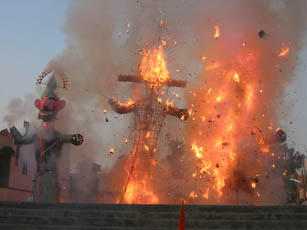
Today happens to be Dusherra.
Happy Dusherra and Shubho Bijoya to all.
Well, the burning of Ravana brings some thoughts to my mind.
If Rama would have been alive, would he have burnt Ravana alive?
Anyway, wether it is Ram or Ravana, Krishna or Banasura, Dev or Danava, every soul worshipped Shiva.
The Shiva tandava stotra was composed by Ravana is one of the greatest gifts the demon king has given to mankind.
Here is the stotra:

Jatatavigalajjala pravahapavitasthale Galeavalambya lambitam bhujangatungamalikam Damad damad damaddama ninadavadamarvayam Chakara chandtandavam tanotu nah shivah shivam .. 1
Jatakatahasambhrama bhramanilimpanirjhari Vilolavichivalara ivirajamanamurdhani Dhagadhagadhagajjva lalalatapattapavake Kishorachandrashekhare ratih pratikshanam mama .. 2
Dharadharendrana ndinivilasabandhubandhura Sphuradigantasantati pramodamanamanase Krupakatakshadhorani nirudhadurdharapadi Kvachidigambare manovinodametuvastuni .. 3
Jatabhujangapingala sphuratphanamaniprabha Kadambakunkumadrava praliptadigvadhumukhe Madandhasindhurasphura tvagutariyamedure Mano vinodamadbhutam bibhartu bhutabhartari .. 4
Sahasralochanaprabhritya sheshalekhashekhara Prasunadhulidhorani vidhusaranghripithabhuh Bhujangarajamalaya nibaddhajatajutaka Shriyai chiraya jayatam chakorabandhushekharah .. 5
Lalatachatvarajvala dhanajnjayasphulingabha Nipitapajnchasayakam namannilimpanayakam Sudhamayukhalekhaya virajamanashekharam Mahakapalisampade shirojatalamastunah .. 6
Karalabhalapattika dhagaddhagaddhagajjvala Ddhanajnjaya hutikruta prachandapajnchasayake Dharadharendranandini kuchagrachitrapatraka Prakalpanaikashilpini trilochane ratirmama .. 7
Navinameghamandali niruddhadurdharasphurat Kuhunishithinitamah prabandhabaddhakandharah Nilimpanirjharidharastanotu kruttisindhurah Kalanidhanabandhurah shriyam jagaddhurandharah .. 8
Praphullanilapan kajaprapajnchakalimaprabha Valambikanthakandali ruchiprabaddhakandharam Smarachchidam purachchhidam bhavachchidam makhachchidam Gajachchidandhakachidam tamamtakachchidam bhaje .. 9
Akharvagarvasarvamangala kalakadambamajnjari Rasapravahamadhuri vijrumbhanamadhuvratam Smarantakam purantakam bhavantakam makhantakam Gajantakandhakantakam tamantakantakam bhaje .. 10
Jayatvadabhravibhrama bhramadbhujangamashvasa Dvinirgamatkramasphurat karalabhalahavyavat Dhimid dhimid dhimidhvanan mrudangatungamangala Dhvanikramapravartita prachandatandavah shivah .. 11
Drushadvichitratalpayor bhujangamauktikasrajor Garishtharatnaloshthayoh suhrudvipakshapakshayoh Trushnaravindachakshushoh prajamahimahendrayoh Samapravrutikahsamam pravartayanmanahkada sadashivam bhaje .. 12
Kada nilimpanirjharinikujnjakotare vasanh Vimuktadurmatih sada shirah sthamajnjalim vahanh Vimuktalolalochano lalamabhalalagnakah Shiveti mantramuchcharan sada sukhi bhavamyaham .. 13
Idam hi nityamevamuktamuttamottamam stavam Pathansmaranbruvannaro vishuddhimetisantatam Hare gurau subhaktimashu yati nanyatha gatim Vimohanam hi dehinam sushankarasya chintanam .. 14
Phalastuti
Pujavasanasamaye dashavaktragitam Yah shambhupujanaparam pathati pradoshhe Tasya sthiram rathagajendraturangayuktam Lakshmim sadaiva sumukhim pradadati shambhuh .. 15
Being a very powerful prayer, when this is sung in proper rythm this song can do miracles.

Sunday, October 09, 2005

Aagaman


Although, this blog is about my Aradhya, Shiva, I cannot just distinguish Him from Shakti. Well, that is not the only reason, the other reason for doing this is a bit personal.

I am a Bengali to the core and when the whole of Bengal is echoing with "dhaker badyo", I cannot just sit here and do nothing about it.

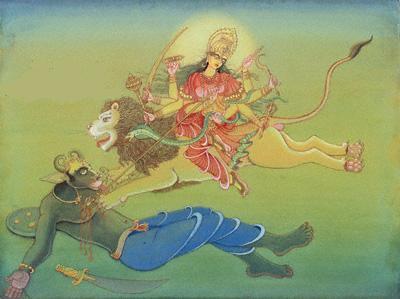
Well, tomorrow happens to be MahaSaptami, a word that brings so many happy memories in my mind. On this ocassion, I present you a short story on Maa Mahisasur Mardini, Maa Durga.

Jai Durga

Jai Bangali
(Image from here)


About Goddess Durga

Durga Puja
Capture the hearts and minds of her ecstatic devotees.
Durga, in Sanskrit means "She who is incomprehensible or difficult to reach." Goddess Durga is a form of Sakti worshiped for her gracious as well as terrifying aspect. Mother of the Universe, she represents the infinite power of the universe and is a symbol of a female dynamism. The manifestation of Goddess Durga is said to emerge from Her formless essence and the two are inseparable.

She is also called by many other names, such as Parvati, Ambika, and Kali. In the form of Parvati, She is known as the divine spouse of Lord Shiva and is the mother of Her two sons, Ganesha and Karttikeya, and daughter Jyoti. Destroyer of demons, she is worshiped during an annual festival called Durga puja, especially popular among Bengalis.


Her Appearance
There are endless aspects of Durga described in the Puranas and Agamas and the iconography is consequently very varied. She is usually pictured as having ten arms holding Sword, Conch, Discus, Rosary, Bell, Winecup, Shielf, Bow, Arrow, and Spear. She is most often shown riding a lion from which comes Her august name, Simhavahini, "She who stands astride the king of beasts". She is gorgeously dressed in royal red cloth and has several ornaments decorating Her personage. Her hair is dressed up in a crown (karandamukuta) which then flows out in long luxuriant tresses that are darkly luminous and soothing to the eye. The various tools reflects the eminent supremacy that helps in controling the universe and obey Her will.

Weilding Energy
Goddess Durga exists eternally, always abiding in her own sweet nature and inhabits the hearts and minds of her ecstatic devotees. As Shakti power, she shapes, nurtures, and dissolves names and forms, while as subtle spiritual energy called Kundalini, She lights the lotuses fo the seven centres of awareness in the sacred human body. Goddess Durga killed the powerful demon Mahish and all his great commanders. When demonic forces create imbalance all god unite becoming one divine force called Shakti or Durga.

The Bengalee Belief

Durga Puja
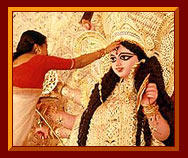
The beautiful Bengali decoration surrounding the majestic warrior.
Sati, the consort of Shiva was the daughter of Daksha Prajaapati a descendant of Bhrama. Sati had married Shiva against the wishes of her father. Daksha was sponsoring a sacrifice and attendees came from various parts of the universe. He invited all of the gods and goddesses except his son in law Shiva. Against Shiva's wishes, Sati attended this sacrifice and was insulted by her father. Unable to bear this insult, Sati immolated herself.

Enraged at the insult and the injury, Shiva destroyed Daksha's sacrifice, cut off Daksha's head and when pleaded by other gods, replaced it with that of a goat and restored him to life. Still berserk with grief, he picked up the remains of Sati's body, and danced the dance of destruction throughout the Universe. The other gods intervened to stop this dance, and the disk of Vishnu cut through the corpse of Sati, whose various parts of the body fell at several spots all through the Indian subcontinent and formed the sites of what are known as Shakti Peethas today.

Shiva was finally pacified when the last piece fell off from his shoulder. Narayana revived sati as Uma for a new life. Ever since peace was restored, Uma, with her children, Ganesh and Kartick, and with her two 'sakhis' - Jaya and Bijaya, comes to visit her parent's home each year during the season of 'Sharat' or autumn when Durga Puja is celebrated.

Regional Names of Durga Puja

Durga Puja
Goddess, invoked for protection from the powers of evil.
Durga Puja is identified by different regional names throughout India. This diversity across various states bind the people in a unique way. Durga Puja is one of the most important religious festival of Hindus, celebrating the return of the goddess to her natal home. But, this great Hindu festival is recounted and celebrated slightly differently in various regions taking on different forms and names. The festival of Durga Puja is characterized by a variety of prayers and rituals. The name of the Durga puja vary from locale to locale as common for most of the Hindu festivals. The various distinct regional names of this festival are:

* Durga Puja / Durga Pujo

* Navratri Puja

* Kullu Dussehra

* Mysore Dussehra

* Bommai Kolu

* Ayudha Puja

* Vidyaramba

* Saraswati Puja

* Simollanghan

Durga Puja / Durga Pujo
Durga Puja
Durga Pujo Celebration in West Bangal
Region: West Bengal, Bihar, Uttar Pradesh, Delhi & Madhya Pradesh.


During Durga puja or Durga Pujo (commonly called in West Bengal), the idols of Goddess Durga are worshipped for nine days in beautifully decorated 'pandaals'. It is a public festival. On the tenth day,the 'Visarjan' or immersion of idols in sea waters is performed. During this time, in various parts of India, the 'Ram-Leela' is performed. Ram-Leela is a stage inaction of Ramayana, the story of Lord Rama. Durga puja has come to be associated with a grand exhibition of cultural functions.

In towns and villages, the evenings are replete with jatra, theatre, song, music, dance programmes, sports, physical and cultural competitions etc which everyone is free to attend. Community feasts are held. The immersion ceremony (vijaya), provides an impressive finale.

Navratri Puja
Garba Dance
Famous Garba Dance from Gujarat
Region: Gujarat, Punjab & Maharashta.


Navratri is a festival of worship, dance and music celebrated over a period of nine nights. Devotees perform the 'devi-sthaapna' in their homes wherein they invite the Goddess and perform 'pooja-path' for nine days. Gujaratis perform their traditional dances 'Garba' & 'Dandiya-Raas' during Navratri. The women-folk dance in a circle, singing 'Garbas' or traditional songs.

'Dandiya-Raas' is played with wooden sticks or 'dandiyas'. Apart from Gujrat,Garbas are performed in other states & cities like Mumbai. Young men-women wear colourful traditional dresses and play Garba with great enthusiasm.The mood of Navratri is very colourful & unique.

Kullu Dussehra
Kullu Dussehra
Celebrating Kullu Dussehra at kuulu Valley, Himachal Pradesh
Region: Kullu Valley, Himachal Pradesh.


The annual mela or festival takes place in the Kullu Valley - also known as the Valley of the Living Gods, in North India. The festival celebrates the triumph of the God Ram over evil. The Rath Yatra of the idol of Lord Ragunath is led by the Kullu Raja and village deities, and is known as the running of the Gods. The procession starts a week of religious ceremonies, cultural activities, socializing and shopping at the huge bazaar, or market, that comprises most of the mela ground.

Dussehra at Kullu commences on the tenth day of the rising moon, i.e. on 'Vijay Dashmi' day itself and continues in seven days. The birth of Dussehra in Kullu lay in royal fads and it nourished on religious, social and economic factors and ultimately came to be well established, because of the inborn love of the hill-men for fun, frolic, displayed in community singing and dancing. Numerous stalls offer a verity of local wares. This is also the time when the International Folk Festival is celebrated.

Mysore Dussehra
Mysore Dussehra
In Mysore Dussehra is celebrated with the march of ornamented elephants.
Region: Mysore, Karnataka.


In Mysore, Dussehra is easily the most popular festival. It is celebrated on a grandiose scale here. Elephants are decked up with robes and jewelery and taken in processions through the streets of the city. In fact, many people visit Mysore from all over the country to watch this colorful event. There is also a floating festival in the temple tank at the foot of Chamundi Hill and a procession of chariots around the temple at the top.

The Dussehra of Mysore or Mysore Dassara as it is famously called is a 10-day long festival. On the day of Dussehra, a procession of caparisoned elephants carrying the idol of goddess Chamundi is taken through the city. The festival is celebrated in a grand style with scores of cultural performances in the great Durbar Hall of the Maharaja's Palace. On Vijaydashami, the 10th day of the festival, a colorful procession featuring caparisoned elephants winding through the gaily-decorated streets of the city, mark the occasion.

Bommai Kolu
Bommai Kolu
Dalls displayed in Bommai Kolu
Region: Tamil Nadu, Karnataka & Andhra Pradesh.


Bommai Kolu is traditionally a women's festival that Tamilians celebrate during Dasshera. Every year, a series of steps is set up and kolu bommai or dolls are displayed. These dolls typically depict gods or village scenes and weddings. A kolu can be as simple or as elaborate as one likes. The woman of the house invites other women to come inspect the kolu, eat a few snacks, exchange a little gossip and go home with a couple of small goodies.

During this time, the girls and women make rounds from house to house during those nine days of Navrathri. Sundal is a delicious confection made from bean sprouts and coconut that is traditionally served at kolu. Women set up decorated planks in a corner and place on it all the dolls in the house. This beautiful clay figurines of gods and goddesses are worshipped during Navaratri, viewing art as Divinity. Women traditionally exchange gifts of coconuts, clothes and sweets.

Ayudha Puja
Sita-Ram
Idol of Sri Ram & devi Sita
Region: Tamil Nadu, Kerala, Karnataka & Andhra Pradesh


The ninth day is also the day of the Ayudha Puja. After the slaying of Mahishasura and other demons by Chamundeswari, there was no more use for her weapons. So the weapons were kept aside and worshipped. This Ayudha puja is being celebrated since ancient times. The importance of Ayudha Puja on this occasion may also be due to the fact that on the Vijayadasami day, Arjuna took back his weapons which he had hidden in a Vani tree in order to lead a life in disguise for the promised period of exile. It is believed that one who begins or renovates his learning to work on the Vijayadasami day will secure a grand success as Arjuna did in Kurukshetra war.

The Ayudha Puja is a worship of whatever implements one may use in one's livelihood. On the preceding evening, it is traditional to place these implements on an altar to the Divine. If one can make a conscious effort to see the divine in the tools and objects one uses each day, it will help one to see one's work as an offering to God. It will also help one to maintain constant remembrance of the divine. In India it is customary for one to prostrate before the tools one will use before starting one's work each day; this is an expression of gratitude to God for helping one to fulfil one's duties.

Vidyaramba
Vidyaramba
Vidyaramba
Region: Tamil Nadu, Karnataka & Kerala.


The tenth day or Vijayadasami is also the day of Vidyaramba or beginning of study when children usually begin to learn the alphabets. On the Vijayadasami day after a Puja in the morning, the Books and implements are removed from the room and this ceremony is called 'Puja Eduppu'. The time for the break up of the puja marks the beginning of learning and work. Learning and work commence at this auspicious moment.

Literates, in general write the alphabets on sand and read a few sentences from sacred books. Similarly the craftsmen and other skilled workers do some work using their implements. At this auspicious moment the children for the first time are given instructions to write the first few alphabets on rice or sand. They are thus initiated into the world of knowledge. This is called 'Ezhuthinu Iruthu' and according to custom only after this ceremony child becomes entitled to write or read.

Saraswati Puja
Goddess Saraswathi
Goddess Saraswathi
Region: Kerala, Karanataka & Tamil Nadu.


The Goddess Saraswathi is worshipped as the Goddess of Learning, the deity of Gayathri, the fountain of fine arts and science, and the symbol of supreme vedantic knowledge. On the Durgashtami day ,a ceremony called Poojavaipu is performed in the evening in Kerala. In a village, generally, it is done only in certain households, in temples and also sometimes in the village schools. The Brahmin houses and the houses which enjoy reputation for learning, mainly take the lead in celebrating the festival. The members of other houses in the village attend the ceremony performed in these houses or institutions.

In a well-decorated room, books and grandhas (holy books) are tastefully arranged with a picture or an image of Goddess Saraswathi in front. In certain poaches weapons and implements are kept by the side of books and garandhas. Then a Puja is performed to Saraswathi during which fruits, beaten rice, roasted paddy (malar), jaggery etc, are offered to Her. These offerings are distributed among those present when the Puja is over.

Just before the Pujavaipu, all studies and work which mainly require skill, are suspended. The following day is known as Mahanavami and it is totally devoted to the worship of Saraswathi. Pooja is performed both in the morning and in the evening. Many more items such as rice, payasam, thirali, etc are also offered to Devi.

The ten-day Saraswati festival, also known as Dussehra or Navaratri, is held September-October. It's celebrated throughout India but takes on special significance in Kerala. Young children are taken to the temples and, before an image of a goddess-celebrated in Kerala as Saraswati, the goddess of wisdom and learning-they are introduced to the letters of the alphabet.

Simollanghan
Durga Puja
Simollanghan
Region: Maharashtra


In ancient times kings used the feast of Dasara to cross the frontier and fight against their neighboring kingdoms. This border crossing is known as "Simollanghan". Thus Dasara also marks the beginning of the war season.

This was also the day to worship the weapons. According to legend, Pandav went to dwell in the forest. On the way he hid his weapons in the hole of a "shami" tree. After one year he returned from the forest and on Dussehra day he took again his weapons and worshipped the shami tree and the weapons. Hence the custom of worshipping weapons on this feast.

People decorate the entrances of their homes with torans, flower studded strings, and worship the tools of trade, vehicles, machinery, weapons and even books. As the evening falls, the villagers cross the border, and worship the Shami tree. The leaves of the Apta tree are collected and exchanged among friends and relatives as gold.


The Story/ Legends of Durga Puja

Durga Puja
Lord Rama, invoked the blessings of Durga to kill Ravana.
Creation Of Goddess Durga
Goddess Durga represents a united front of all Divine forces against the negative forces of evil and wickedness. The gods in heaven decided to create an all-powerful being to kill the demon king Mahishasur who was ready to attack them. At that very moment a stream of lightning dazzled forth from the mouths of Brahma, Vishnu and Mahesh and it turned into a beautiful, magnificent woman with ten hands. Then all the gods furnished her with their special weapons. The image of Durga, the Eternal Mother destroying the demon, Mahishasur is symbolic of the final confrontation of the spiritual urge of man with his baser passions.

Pandavas
As per our great epic Mahabharat, Pandavas after wandering in the forest for 12 years, hung their weapons on a Shami tree before entering the court of king Virat to spend the last one year in disguise. After the completion of that year on Vijayadashmi the day of Dassera they brought down the weapons from the Shami tree and declared their true identity. Since that day the exchange of Shami leaves on Dassera day became symbols of good, will and victory.

Lord Rama
This festival has immense mythological significance. As per Ramayan, Ram did "chandi-puja and invoked the blessings of Durga to kill Ravana, the ten-headed king of Lanka who had abducted Seeta and had charmed life. Durga divulged the secret to Ram how he could kill Ravana. Then after vanquishing him, Ram with Seeta and Laxman returned victorious to his kingdom of Ayodhya on Diwali day.

Kautsa
Kautsa, the young son of Devdatt, insisted on his guru Varatantu to accept "gurudakshina", after finishing his education. After lots of persistence his Guru, finally asked for 14 crore gold coins, one crore for each of the 14 sciences he taught Kautsa. Kautsa went to king Raghuraj, who was known for his genorisity and was an ancestor of Rama. But just at that time he had emptied all his coffers on the Brahmins, after performing the Vishvajit sacrifice. So, the king went to Lord Indra and asked for the gold coins. Indra summoned Kuber, the god of wealth. Indra told Kuber, "Make a rain of gold coins fall on the "shanu" and "apati" trees round Raghuraja's city of Ayodhya." The rain of coins began to fall. The king Raghu gave all the coins to Kautsa, who gave 14 crores gold coins to his guru. The remaining coins were lavishly distributed to the people of Ayodhya city. This happened on the day of Dussehra. In remembrance of this event the custom is kept of looting the leaves of the "apati" trees and people present each other these leaves as "sone" (gold).