Tuesday, August 16, 2005

Alochana-II


Some tales about Shiva.
Phallic Worship
It is said that Brahma and
Vishnu, the other two gods of Indian Trinity, once while strolling in leisure along the earth, saw a massive column of column of dazzling light rising from below the earth to high skies. In quest of unveiling its source Vishnu proceeded to 'Patala', the netherworld and Brahma to sky but none of them was able to discover its end. Brahma, just to establish his superiority over Vishnu, lied. He claimed to have reached its upper end. But he had to pay for it by losing his fifth head as a penalty for lying. Another legend has it differently. Lamenting over the death of his beloved wife Sati Shiva was roaming around the world. When around Vindhyanchala he saw several great saints living there with their wives. He saluted them and asked them for some food but the saints ignored him. Shiva's bewitching charms, however, drew to him their wives and except Arundhati and Anasuya all ran after him to have sex. The annoyed sages pronounced that Shiva's phallus would drop from his body and it did but it instantly turned into a massive column of fire weighing so heavy that the earth could not bear it. It rent the earth, penetrated into it, reached the netherworld and rose to sky. It branched and cleft the earth at least at twelve places. The horrified gods with Brahma and Vishnu rushed to Shiva and prayed to relieve the world. Shiva agreed but on condition that they would first worship the phallus. Accordingly all gods worshipped it and established 'Jyotirlinga-peetha' at all the twelve places where its branches had pierced the earth.


Ganesha vs Kartikeya

On an occasion, Shiva and Parvati had been given a fruit by the gods and both the sons Ganesh and Murugan (Kartikeya or Skanda or Kumara Swamy) wanted it. Some legends claim the dispute was about who was elder of the two. Anyway The parents then suggested that the one who circled the world three times and came back first would get it as a prize. Kartikeya got on the peacock, his vahana, and flew around the world stopping at all sacred spots on the way and offering his prayers. But at every major stop, he would find Ganesha ahead of him and was perplexed. Ganesha understood that his vehicle, the mouse, would not be able to compete with Skanda's peacock and he could never beat Kartikeya. But he thought for a while and came up with a solution. He walked around his parents, Shiva and Parvati, three times, with great devotion. When his parents asked him why he was not circling the globe, he answered that his parents are the whole world. I need go no further to travel the whole world. Skanda on returning back learned of this, and accepted the superiority of Ganesha, and bowed to him.

Friday, August 12, 2005

Arambh


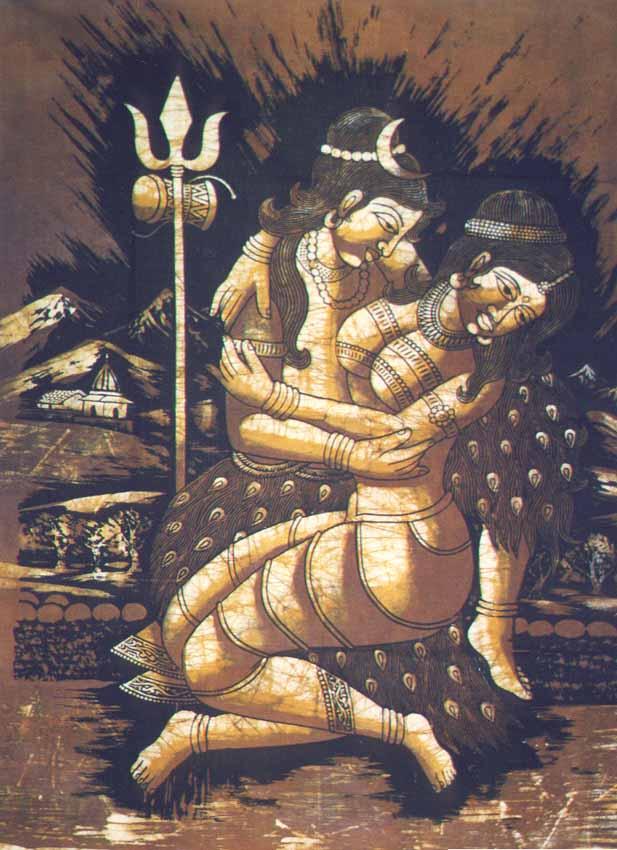
The picture depicts Kalachakra and Vishvamata in union.
Some Ideas/Views about how Tantra came into existence:
~
Like most ancient teachings, Shiva's ideas were first taught in an oral form, and only later were they transcribed into books. Shiva's wife, Parvati, used to ask him various questions regarding the spiritual science. Shiva replied to these questions, and the compilation of these questions and answers are known as the Tantra Shastra (Tantric scriptures). There are two types of Tantric scriptures. The principles of Tantra are found in books known as Nigama while the practices of Tantra are contained in books known as Agama.
~
He is the oldest, he was a non Aryan God of wild beasts, the pagan horned God, the husband of the Mother nature with his erect fallos, as the power of fertilization. Later people released he is a God of true realization. The knowledge of Absolute has 3 levels: intellectual, that correspond to Brahma, intuitive, that correspond to Vishnu and Real, that is the highest kind possible to man, the knowledge of transcendental nature of Isvara or Manesha, that is, Shiva. In his from of Parama-Shiva, he corresponds to that aspect of the ultimate Reality which is pure consciousness, pure subject, pure I, without even the slightest notion of "I am" or "I am this" or "I am here". In his Tantra-Loka, Abhinava Gupta refers to Shiva as "the Mother and the Father of the Universe". Shiva is the seed, or origin of the multidimensional universe, giving rise to all other ontological categories. Yet, there is no duality in Shiva because he is still completely immersed in blissful union with Shakti.His consort is the divine Mother herself, in her forms of Parvati, Uma, Kali, Sati, Amba, Durga and her other beautiful, wild and sexy manifestations. Only with Shiva the Mother Goddess is in her complete personality. Only Shiva was able to embrace her when she took a form of rotting corpse to test the Trimurti of Brahma, Vishu and Shiva. Brahma turned away and Vishnu jumped in the water. So, as her more subtle forms she is Sarasvati, the wife of Brahma and Laksmi, the wife of Vishnu. But as complete personality, she is the wife of Shiva. Mortals should definitely relate to this lesson, see who are you manifesting the most and how much more can you be.
His nature is very complex and very deep: he connects us, making us understand, our subcousiousness, fear, death, sex and mystic forces of human psyche. Tantra is known and feared as a practice of black magic by ordinary Hindus, since Shiva represents underworld and all its inhabitants: ghosts, goblins, vampires, mermaids, nymphs, etc., so he is the king of magic. However, in the west, Tantra becoming popular as a spiritual sex practice, and it is also correct, since Shiva is the god of sex and procreation. He is worshipped in the form of lingam, the erected member, that stands on the basis of yoni, the vagina of his spouse, his Shakti, the female. Shakti, the Divine Mother, who has many faces, manifested in every female in the world, is the creative power of Nature. By means of the sexual union between God and the Goddess the material world was and is constantly created. Tantric yantras, mantras and ritual sex were used since ancient times to harness Nature's creative power and promote more crops, more money and other goods. Chant this mantra to increase your sexual stamina and have orgasms similar to earthquake. This mantra will also help you to establish link between your physical body and the spirit, where sex will be a prayer. It will help you to create a truly divine union between you and your lover. Lingam is worshiped by all women in India: unmarried daughters pray to be blessed with good husband, and married once blesses with good sex. Shiva is the creator of the system of marriage, in which both partners accept equal responsibilities, disregarding caste or community. Shiva himself came from a mixed family and through his marriage to an Aryan princess helped a lot in unifying the warring fractions in India at that time.
He is also called Mahayogi, the God of Yoga. The three matted locks on the head of the Lord convey the idea that integration of the physical, mental and spiritual energies is the ideal of yoga. Yoga is a mental discipline that helps you to detach yourself from material reality: booth beauty and brutality. He refuses to be part of the wordily life and expresses it by not distinguishing between what is sacred and what is profane. He wonders in crematoria, makes no attempt to make himself presentable, he smears his beautiful body with ashes, wears garland of skulls, and let snakes slither around his neck. Snake around the neck symbolize the yogic power of Lord Shiva with which he dissolves and recreates the universe. Like a yogi, a snake hoards nothing, carries nothing, builds nothing, lives on air alone for a long time, and lives in mountains and forests. The venom of a snake, therefore, symbolizes the yogic power. A snake (Vasuki Naga) is shown curled three times around the neck of the Lord and is looking towards his right side. The three coils of the snake symbolize the past, present and future - time in cycles. The Lord wearing the curled snake like an ornament signifies that creation proceeds in cycles and is time dependent, but the Lord Himself transcends time. The right side of the body symbolizes the human activities based upon knowledge, reason and logic. The snake looking towards the right side of the Lord signifies that the Lord's eternal laws of reason and justice preserve natural order in the universe.The unclad body coverd with ashes symbolizes the transcendental aspect of the Lord. Since most things reduce to ashes when burned, ashes symbolize the physical universe. The ashes on the unclad body of the Lord signify that Shiva is the source of the entire universe which emanates from Him, but He transcends the physical phenomena and is not affected by it. Complete asketism has it downsides, since it is a little narrow, as detected by Srimad Bhagavatam: "(7) Great stalwarts [like Lord Shiva] can overcome their being overwhelmed by lust by means of their wrathful vision, but they cannot overcome their own intolerance. To that however with having Him within the lust is afraid to enter. How can it factually recur to the attention with His mind?" This is why Shiva is also a lord of Sex, his symbol is Lingam, the erect fallos. He rules both wild sexuality and pure asceticism, being complete as God.Emerging in dirt is another method to liberate yourself from false, or any, attachments, and unleash your self to the world of Spirit. Interesting parallel is to be found in Chinese folklore. In the book of Supernatural tales, by M.D. Kwan, the holy monk resides in the garbage dump, and the honorable lady, who was seeking his advice, "fighting down waves of nausea" came for a visit. "With every step she sunk deeper into the slime, sweat mixed with tears of desperation and humiliation bathed her cheeks, but, filthy and barefoot, she felt liberated". And she received the answer. Of course, she did it all out of love to her husband, who she had to save from an evil. Monk gave her a special fungi to break the spell not for nothing: fungi belong to the underworld and hold very strong magic properties, especially when you deal with bad spells, witches and other creatures from the kingdom of Shiva.
In our world, the punk movements can be identified as spiritual practices of the Left handed Tantra, that is, practice of non control. He helps us to go beyond the established borders of the society and of our mind, and become free. Of course, in this aspect, he always be in a great denial by the authorities and that's why Tantra was always a prohibited practice, since it can be dangerous in the hands of peoples untouched by spirit. And again, anything can be made into a spiritual practice when it is done with awareness. The Rig Vedic Shiva was known as Rudra Brahman, the wild god of the hymns who was so much of an outsider that he was not even entitled to a share in the fire sacrifices, yet the Vedic pantheon was in awe of this self sufficient Hunter-God.
Shiva, or Manesh, means The Auspicious One. He is Pure Consciousness, Chidanandaroopa, the form of joy, and the source of ultimate power. He is also called Mahadeva, the great God, and Bhava, existence. In the human body, the microcosm, that is build exactly like the universe with all its gods and demons, Shiva's region is the Sahasrara chacra, that is situated four fingers breadth above the top of the head and represent pure consciousness.
He is the oldest god known to mankind, a God with no lineage, Long before Aryans came to where India is now, local Indus valley people, Dravidians, worshipped a God, whose pictures are found on a seal - he is the oldest, primordial God from all Indian pantheon and represents the raw, untamed, supreme power. Forever young, he attacks like a ferocious wild beast and is a ruler of the heroes. When Aryan came and conquered, the legend says, during these inflaming times a great man was born, named Sadashiva. His name means "the one who dedicated his life to the well-being of his fellows". Sadashiva, known as Shiva, was an outstanding spiritual teacher or Guru. He was the one who first offered humanity a systematic presentation of a sheer spiritual thought. As the legend goes, he is the one to set the basis of spiritual dance and music in India and is therefore known also as Nataraga, The God of Cosmic Dance. As Nataraja, he is the lord of dance, the constant dance of death and birth, the order of eternal cycle of the Universe. He is dancing on the demon of ignorance, and show you how to be above and in control of your desires and karma. Moreover, Shiva is the founder of Hindu traditional medicine and also the provider of a system and knowledge in this field (bearing the name Vadyak Shastra). However, Shiva's most important contribution to the development of a truly spiritual civilization represents the concept of Dharma. Dharma is a Sanskrit word translated literally as "innate characteristic". Shiva explained that human beings seek and yearn for happiness placed beyond that originated in the satisfaction of the senses. The indisputable aim of all human beings, whether aware of this or not, is to obtain absolute peace and freedom, infinite knowledge and spiritual awareness. Shiva's teachings were transmitted orally at first, then in written form. Parvati, his wife used to ask him questions on topic raised by the spiritual practice he taught. The Tantric texts, writings which present the Tantric philosophy and practice, are in fact the dialogues between Shiva and his wife Parvati, dialogues in which Parvati asks questions on spiritual matters and Shiva gives divine answers.
Known as Rudra, the "terrible", in the ancient times, he was a god of storm and thunder,( he is the father of Maruts, the storm deities) the ruler of destructive and healing forces of Nature. Rudra also means "strict or uncompromising" and aksha means "eye." Rudraksha necklace worn by the Lord illustrates that He uses His cosmic laws firmly - without compromise - to maintain law and order in the universe. The necklace has 108 beads which symbolize the elements used in the creation of the world. As Rudra, he was worshipped more with a hope to keep his primordial destructive forces away "Do not cut us from the sight of the sun", say the ancient prayer. Rudra the terrible exists in the cult of Goddess, who is the Mother Nature itself. And as a husband of the Universal mother, he is therefore a God of procreation: "O, Rudra, let us be born again through our children". Rig Veda, 2.33.1 And since he is so close to nature, he is a great natural healer, they say: "Rise up our heroes with your healing medicines, I hear that of all the healers you are the best healer" Rig Veda, 2.33.5 He is the one who sends disaster, but he is the one who has the power to heal, also. The healer can be a killer, the energy is the same, the energy is neutral, it all depends on how you direct it. You can ask for healing of any types of wounds, asking for a merciful hand of Rudra, so healing and cooling, that removes the injury that comes from the gods", as from forces of nature. Rudra is a chief among: Aditi, the mother, Adityas, the dities of light, Agni, god of fire, Aryaman, god of ancestors, Dyaus, god of the sky, and Maruts, god of storm. In the same time, he is the Lord of mercy and compassion. He protects devotees from evil forces such as lust, greed, and anger. He grants boons, bestows grace and awakens wisdom in His devotees. Shiva holds Varda Mudra: the Lord's right hand is shown in a boon- bestowing and blessing pose. Lord Shiva annihilates evil, grants boons, bestows grace, destroys ignorance, and awakens wisdom in His devotees. He offers abhaya, protection, with his lower right hand and indicates salvation with the left. Shive known to be the most kind of all Gods: you don't need to worship him perpetually before he grants your wish.
Shiva is also called Neelkanth, the blue throated god who is dressed in a tiger skin, and has a knot of matted hair through which the river Ganga flows. His throt turned blue when he swallowed the poison of life to save mankind and the gods during the churning of the cosmic ocean- no other God could survive this. It shows his immune strength. Shiva means 'pure'.
He sits in meditative silence in the mount Kailas in the Himalayas, and due to the power of yoga, remains unmoved while world transforms around him. Damaru (drum) in his hand symbolizes the two utterly dissimilar states of existence, unmanifest and manifest. When a damaru is vibrated, it produces dissimilar sounds which are fused together by resonance to create one sound. The sound thus produced symbolizes Nada, the cosmic sound of AUM, which can be heard during deep meditation. According to Hindu scriptures, Nada is the source of creation. They say, the letters of Sanskrit emanated from that drum. The water pot (Kamandalu) made from a dry pumpkin contains nectar and is shown on the ground next to Shiva. The process of making Kamandalu has deep spiritual significance. A ripe pumpkin is plucked from a plant, its fruit is removed and the shell is cleaned for containing the nectar. In the same way, an individual must break away from attachment to the physical world and clean his inner self of egoistic desires in order to experience the bliss of the Self, symbolized by the nectar in the Kamandalu. Trident (Trisula) in his hand symbolizes His three fundamental powers (shakti) of will (iccha), action (kriya) and knowledge (jnana). The trident also symbolizes the Lord's power to destroy evil and ignorance. The structure in front of him is Lingam, symbolizing erect fallos, symbol of male sexual power. His vehicle is Nandi, the white celestial bull. Crescent moon on his head symbolizes periodicity and time. The waxing and waning phenomenon of the moon symbolizes the time cycle through which creation evolves from the beginning to the end. Since the Lord is the Eternal Reality, He is beyond time. The head of the woman with string of water coming down is river goddess Ganga. Rriver Ganges is associated with Hindu mythology and is the most sacred river of Hindus. According to tradition, one who bathes in Ganga (revered as Mother Ganga) in accordance with traditional rites and ceremonies on religious occasions in combination with certain astrological events, is freed from sin and attains knowledge, purity and peace. Ganga, symbolically represented on the head of the Lord by a female (Mother Ganga) with a jet of water emanating from her mouth and falling on the ground, signifies that the Lord destroys sin, removes ignorance, and bestows knowledge, purity and peace on the devotees. She recides on Shiva's head, because, according to myth, only Shiva could tamper her wildness and preserve land from destruction. This is the story of how Shiva tempers Ganga: "The Gods pleaded Bhagiratha's cause to Ganga, but Ganga was adamant. She had no wish nor desire to leave the heavens and, if compelled she would only destroy the earth by flooding it with her angry and indignant waters! The Gods were helpless and advised Bhagiratha to go to Lord Shiva, who, if he wished, could prevent the impending doom. As the matter was of grave consequence, Bhagiratha beseeched Goddess Parvati, Lord Shiva's wife, for her help. Parvati then convinces Shiva to receive the violent and angry currents unleashed by the feisty Ganga upon his head and divide the falling waters into a myriad of harmless streams through the locks of his hair. This having been accomplished, it became easy to guide the river to the center of the earth, pacify the 60,000 and lead Ganga to the ocean. Filtered through Shiva's hair, the Ganga emerges from the heavens bearing all the reviving powers of the universe. Temple cities dot her meandering course, the most important being Varanasi (considered India's holiest city and also known as Benaras or Kashi). Here, at the break of dawn, hundreds of devout Hindus flock together and await that special eternal moment when Indra, the king of the Gods and source of life, unites with the sacred, purifying, reviving waters of Ganga." Lord Shiva, also called Tryambaka Deva (literally, "three-eyed Lord"), is depicted as having three eyes: the sun is His right eye, the moon the left eye and fire the third eye. The two eyes on the right and left indicate His activity in the physical world. The third eye in the center of the forehead symbolizes spiritual knowledge and power, and is thus called the eye of wisdom or knowledge. Like fire, the powerful gaze of Shiva's third eye annihilates evil, and thus the evil-doers fear His third eye. When the Lord opens His eyes, a new cycle of creation emerges and when He closes them, the universe dissolves for creation of the next cycle. The half-open eyes convey the idea that creation is going through cyclic process, with no beginning and no end. Lord Shiva is the Master of Yoga, as He uses His yogic power to project the universe from Himself. The half-open eyes also symbolize His yogic posture. The two earrings, that he wear :Alakshya (meaning "which cannot be shown by any sign") and Niranjan (meaning "which cannot be seen by mortal eyes") in the ears of the Lord signify that He is beyond ordinary perception. Since the kundala (earring) in the left ear of the Lord is of the type used by women and the one in His right ear is of the type used by men, these Kundalas also symbolize the Shiva and Shakti (male and female) principle of creation. The celestrial bull, Nadi, is associated with Shiva and is said to be His vehicle. The bull symbolizes both power and ignorance. Lord Shiva's use of the bull as a vehicle conveys the idea that He removes ignorance and bestows power of wisdom on His devotees. The bull is called Vrisha in Sanskrit. Vrisha also means dharma (righteousness). Thus a bull shown next to Shiva also indicates that He is the etemal companion of righteousness. Shiva sitting in the cremation ground signifies that He is the controller of death in the physical world. Since birth and death are cyclic, controlling one implies controlling the other. Thus, Lord Shiva is revered as the ultimate controller of birth and death in the phenomenal world. A tiger skin symbolizes potential energy. Lord Shiva, sitting on or wearing a tiger skin, illustrates the idea that He is the source of the creative energy that remains in potential form during the dissolution state of the universe. Of His own Divine Will, the Lord activates the potential form of the creative energy to project the universe in endless cycles.
In buddhist tradition, Shiva is represented by Mahacala, the 11th face of boddhisattva Avalokiteshvara. He wished to turn himself into a wrathful deity in order to defeat more rapidly and effectively the obstacles to the happiness of others. With this thought the letter HUM in dark blue color came out of his heart. That Hum became Mahakala. It is not without significance that in the mantra 'Om Mani Padme Hum', the syllable Hum invokes energetic powers. The birth of Mahakala was followed by an earthquake and with one voice the Buddhas in the heaven declared that he would have the power to grant all wishes if the wishes were honest and good. Mahakala was the personal tutelary deity for the Mongol ruler Kublai Khan. "His terrifying imagery ultimately derives from the angry form of the Hindu god Shiva, known as Bhairava". The essential nature of Mahakala in the Tibetan pantheon can be gauged from the fact that he is worshipped as the Protector of the tent.
Shaivism presents Shiva as endowed with all the attributes of the Supreme Divinity, and therefore He is the Supreme Creator. His symbolic representation while performing the magic dance of creation is an iconographic theme quite rich in symbolism and offers us an idea about the rhythm of life of the whole creation, and as well of its destruction. We will discuss these aspects in detail further on. The name Shiva signifies "the good and the kind". Paradoxically, He is the designated God of destruction, he rapidly casts away the restraining ignorance and allows human beings to contemplate His magnificence.
~
The Yogini Tantra is a voluminous work held in high regard by practitioners of Vamachara. In a total of 28 chapters divided into two parts, it outlines every topic familiar to the Kaula and Vama traditions. What follows is an abstract of the first nine patalas or chapters.
First PatalaThis opens with a familiar tantrik scene on Mount Kailasa where Shiva is addressed by Parvati. She says she has heard exposition of tantras before on Shri Shaila mountain, in Varanasi, in Kamarupa and in Nepal. Now she wants to hear more from Shiva, the world guru. In answer, Shiva says he will declare the great Yogini Tantra, the giver of both wealth and liberation. It is to be concealed and is unknown to all the devatas, to the asuras, to the yakshas and others but he will declare it out of love for Parvati. He starts by eulogising the goddess as the cosmic mother (Vishvamata), dark as a thunderstorm, wearing a garland and waist-band of skulls, with dishevelled hair, completely naked (digambaram). She has a rolling tongue, makes a terrifying roar, three reddened eyes, and has a wide open mouth. She wears a moon digit on her forehead, has the corpses of two boys as her earrings, and is adorned with various gems, which are of the brightness of the Sun and the Moon. Laughing loudly, she has two streams of blood pouring from her mouth, while her throat is red with blood. In her four arms she holds cleaver, head, and makes mudras dispelling fears and granting boons. She, the supreme Nitya, is seated in reverse (viparita) intercourse with Mahakala upon the corpse of Shiva. The whole scene is set in the cremation ground. After this detailed dhyana of Kali, Shiva begins to outline the tantra, declaring that he is Parvati's slave. He starts with the characteristics of the guru, who he describes as the root of all shastra, the root of this world and the very self of Parabrahma and the essence of Shiva. The guru can save a disciple where even gods and goddesses cannot intercede. The guru's family is to be considered as identical with the guru. There follows a dhyana of guru in the palace of wish-fulfilling gems on Mount Kailasa, surrounded by hosts of Bhairavas. The palace is surrounded by the seven oceans. The guru is one with Mahakala Adinatha and knows all mantras, whether they be Shakta, Vaishnava or Ganapatya. The greatness of the guru is hymned in all the shastras. Second PatalaDevi asks Shiva to speak of Kali and Tarini. Shiva says that Kalika is the greatest of the great vidyas, supreme and giving nirvana and liberation to people. Her disciples are Brahma, Vishnu and himself. If a sadhaka recites the Kali mantra, he becomes her son. Kali, Tara and Cchinna are the mahavidyas. One successful in Kali becomes similarly successful in the others. Shiva begins to speak of initiation. He says that the rosary to be used in the puja should be made of human skullbone for long-lasting success. A sadhaka or sadhika may also use crystal or ruby rosaries. A full rosary should have 108 beads. The meru, or bead to mark the beginning and the end of the mala, should be made of a king's tooth. Shiva proceeds to outline the number of times the mantra should be recited holding the rosary and the way the fingers should count. He speaks of the nature of other rosaries including pearl, tulsi (basil) when worshipping Vishnu, ivory for Ganesha, and rudraksha or red sandalwood for Tripura. Dhattura growing in a cremation ground is used for Dhumavati. He then describes ritual accessories to be used in the puja and the times in bright and dark fortnights of the moon which are favourable and unfavourable as well as other restraints due to time as well as suitable places for the rite. Third PatalaDevi asks how catastrophes including war and fever can be warded off. In reply, Shiva recites a kavacha or armour which can be used to protect against malefic influence. It is not to be revealed lightly. He then speaks of a way to subjugate the world (jagadvashyakara). Sage Narada also asked Shiva to speak of this of old. Shiva says that when she is imagined as a naked Devi, Kali is the deludress of the world. He then gives the Trailokya Mohana Kavacha (armour bewildering the three worlds). Kalabhairava is the rishi of the mantra, anushtubh is the metre, Shmashana Kali is the devata. After giving the armour, Shiva describes how to make it. It should be written on bhurja (birch) bark and worn round the person. It should be written on the eighth day of the bright fortnight and placed inside a golden container. Wearing it on different parts of the body gives different results. On the head, it destroys disease. On the right shoulder, it gives whatever is desired. Vishnu now chimes in and says Narada achieved the desires he wanted by employing this kavacha. Fourth PatalaThe Devi now wants to know of other prayogas to give dominion, knowledge and wealth. Shiva mentions the Phetkarini Tantra and the Nila Tantra as sources. One process is to draw a hexagon with the mantra of Tara within plus the sadhya (the object). Devi asks about the satkarmas, six magical acts. Shiva says these are pacifying, subduing, causing enmity, driving away, uprooting (uccatana) and causing death. He says there are six Shaktis appropriate to these acts. The Padmini is suitable for pacifying and Sankhini for subjugation. He then outlines the mantras appropriate to the six acts. Fifth PatalaShiva describes a great sadhana in the cremation ground, involving the fifteen Kali Nityas. This sadhana can also be performed in a desert, by the side of a river, on a mountain, at a crossroads, at the root of a Bilva tree, at a place where there is a single lingam, at a place where there are no people as well as in the cremation ground. Sixth PatalaDevi asks about the different classes of sadhaka. Shiva says they are divided into the divya (divine), vira (heroic) and pashu (herdlike) categories. The meditation for the divya should be concealed, Shiva speaking of vira meditation. He says a vira should meditate on the three bindus in the form of a 16 year old woman. The first is as bright as 10,000,000 dawn suns,extending from the head to the breasts. The second extends from the breasts to the hips and the third from the yoni to the feet. This is the Kamakala form, the very essence of Brahma, Vishnu and Shiva. The vira and the divya may employ madya, mamsa, matsya, mudra and maithuna (the five 'm's) in their worship. According to Shiva, the rishis, the vasus, the daityas all became great through this puja. Shiva speaks of this worship for the four Hindu divisions (varnas) and also for the Avadhuta. Much of this material is repeated in the Yoni Tantra. He says the great nectar flows from Kundalini when it has risen to the top of the head. This is the great wine. She is the supreme Shakti within the body. Seventh PatalaDevi asks Shiva to tell her of Devi Svapnavati (she who moves in sleep). He gives the mantra. Shiva says: 'This Svapnavati Vidya is very hard to obtain in the three worlds. It is the cause of great miracles, declared by Mahakala.' It should be recited 108 times then Svapnavati visits in sleep always. A sadhaka who masters the mantra sees everything in his dreams he wishes. The god then speaks of the Mritasanjivani vidya. This appears to give the power of bringing back the dead to life. He describes other vidyas including Madhumati and the Trilokyakarshi vidya. This attracts whatever a sadhaka desires in the three worlds. Maidens will cross oceans and mountain ranges to get to him. Shiva goes on to give vidyas of Padmavati, the Vashikarani vidya. He then returns to the topic of Svapnavati. This appears to involve awakening while in the dream state (lucid dreaming?). The mantras should be concealed and given only to the devoted, the unstained otherwise hosts of Dakinis consume a person. Eighth PatalaShiva speaks of the Yoginis. They look terrifying, with blazing eyes and 50 lakhs of faces. The daitya Ghora then recites a hymn to Devi, celebrating her victory over the Daityas. Shiva chimes in, praising her greatness in battle. Towards the end of the patala, Shiva gives a meditation image of Shakti as Kali. Ninth PatalaShiva starts this lengthy chapter by speaking of the Devi as the Brahmanda, the macrocosm. In this guise, she has an immense form, with millions upon millions of arms and heads. She is the sum of everything, containing puranas, vedas, smriti and vedas. As such she is of the brilliance of millions upon millions of suns and moons and fires, consisting of all knowledge, all paths, all dharma, all bliss, all shastra, all veda and all worlds, in short, everything. Then follows a meditation on Shakti as being present in the different parts of the body. Shiva closes by saying that Kali is the form of consciousness (citrupa), the impartite absolute.
~
The primary tantric texts, the Hindu Tantras, were written after the Puranas, in the medieval period, and are usually set in the form of a dialogue between the god Shiva and his consort Parvati, in which he explains to her the philosophy and myths underlying the tantric ritual. This ritual involves reversals of normal Hindu social practices and reversals of normal physiological processes (for instance, the drawing up of the semen out of the woman and into the body of the man). It also reverses the orthodox Hindu "five products of the cow," or panchagavya (milk, butter, curds, urine, and feces) used for purification; in Tantra, these become the "five m's": maithuna ("intercourse"), matsya ("fish"), mansa ("flesh"), mudra ("parched grain"), and mada ("wine"). Tantra was a bastion of ecstatic spirituality in a landscape of asceticism.
Soon, tantra evolved into a diverse tradition of various schools, with the sexual aspect always remaining an integral theme. Mystical experiences and altered states of consciousness were central to many of these schools. Best known to Westerners are the several strands of tantra yoga in which worship takes the form of a sexual ritual featuring slow, non-orgasmic intercourse with the intent of achieving an experience of the divine. The act of ritual lovemaking was understood as participation in the cosmic process. Another major school of Hindu tantra yoga is primarily meditational. Very similar to hatha yoga (body posture) and bhakti yoga (devotion), this form of tantra focusses mainly on visualization of deity, concentrating on yantras (glyphs), chanting mantras and the practice of tapas (austerity).
~
Long before the Aryans came with their castes and Vedic teachings, the Lord Shiva and his Shakti (or consort) were worshipped throughout India and probably in many parts of Europe also. There is considerable evidence that the religion of Europe, before it was suppressed by Christianity, was a form of Phallus and Yoni worship, such as existed and still exists in India.

Monday, August 08, 2005

Adwaita


Rudra came to Prajapati for a name, and forcefully extracted one epithet after another;and the sage Upamanyu in the Mahabharata enumerates 108 names of Shiva.
The Shiva Purana lists one thousand names:

Shiva, Hara, Mrida, Rudra, Pushkara, Pushpalochana, Arthigamya, Sadachara, Sharva, Shambhu, Maheshvara, Chandrapida, Chandramouli, Vishva, Vishvamareshvara, Vedantasarasandoha, Kapali, Nilalohita, Dhyanadhara, Aparicchedya, Gauribharata, Ganeshvara, Ashtamurti, Vishvamurti, Trivargasvargasadhana, Jnanagamya, Dridaprajna, Devadeva, Trilochana, Vamadeva, Mahadeva, Patu, Parivrida, Drida, Vishvarupa, Virupaksha, Vagisha, Shuchisattama, Sarvapramanasamvadi, Vrishanka, Vrishavahana, Isha, Pinaki, Khatvanga, Chitravesha, Chirantana, Tamohara, Mahayogi, Gupta, Brahma, Dhurjati, Kalakala, Krittivasah, Subhaga, Pranavatmaka, Unnadhra, Purusha, Jushya, Durvasa, Purashasana, Divyayudha, Skandaguru, Parameshthi, Paratpara, Anadimadhyanidhana, Girisha, Girijadhava, Kuverabandhu, Shrikantha, Lokavarnottama, Mridu, Samadhivedya, Kodandi, Nilakantha, Parashvadhi, Vishalaksha, Mrigavyadha, Suresha, Suryatapana, Dharmadhama, Kshamakshetra, Bhagavana, Bhaganetrabhida, Ugra, Pashupati, Tarkshya, Priyabhakta, Parantapa, Datta, Dayakara, Daksha, Karmandi, Kamashasana, Shmashananilaya, Suksha, Shmashanastha, Maheshvara, Lokakarta, Mrigapati, Mahakarta, Mahaushadhi, Uttara, Gopati, Gopta, Jnanagamya, Puratana, Niti, Suniti, Shuddhatma, Soma, Somarata, Sukhi, Somapa, Amritapa, Sunya, Mahatejah, Mahadyuti, Tejomaya, Amritamaya, Annamaya, Sudhapati, Ajatashatru, Aloka, Sambhavya, Havyavahana, Lokakara, Vedakara, Sutrakara, Sanatana, Maharishi, Kapilacharya, Vishvadipti, Vilochana, Pinakapani, Bhudeva, Svastida, Svastikrita, Sudhi, Dhatridhama, Dhamakara, Sarvaga, Sarvagochara, Brahmasrika, Vishvasrika, Sarga, Karnikara, Priya, Kavi, Shakha, Vishakha, Goshakha, Shiva, Bhishaka, Anuttama, Gangaplavodaka, Bhavya, Pushkala, Sthapati, Sthira, Vijitatma, Vishayatma, Bhutavahana, Sarathi, Sagana, Ganakaya, Sukirti, Chinnasamshaya, Kamadeva, Kamapala, Bhasmoddhulita-vigraha, Bhasmapriya, Bhasmashayi, Kami, Kanta, Kritagama, Samavarta, Nivritatma, Dharmapunja, Sadashiva, Akalmasha, Chaturvahu, Durvasa, Durasada, Durlabha, Durgama, Durga, Sarvayudhavisharada, Adhyatmayoganilaya, Sutantu, Tantuvardhana, Shubhanga, Lokasaranga, Jagadisha, Janardana, Bhasmashuddhikara, Meru, Ojasvi, Shuddhavigraha, Asadhya, Sadhusadhya, Bhrityamarkatarupadhrika, Hiranyareta, Purana, Ripujivahara, Bala, Mahahrada, Mahagarta, Vyali, Siddhavrindaravandita, Vyaghracharmambara, Mahabhuta, Mahanidhi, Amritasha, Amritavapu, Panchajanya, Prabhanjana, Panchavimshatitattvastha, Parijata, Paravara, Sulabha, Suvrata, Shura, Brahmavedanidhi, Nidhi, Varnashramaguru, Varni, Shatrujita, Shatrutapana, Ashrama, Kshapana, Kshama, Jnanavana, Achaleshvara, Pramanabhuta, Durjneya, Suparna, Vayuvahana, Dhanurdhara, Dhanurveda, Gunarishi, Gunakara, Satyasatyapara, Dina, Dharmaga, Ananda, Dharmasadhana, Anantadrishti, Danda, Damayita, Dama, Abhivadya, Mahamaya, Vishvakarma, Visharada, Vitaraga, Vinitatma, Tapasvi, Bhutabhavana, Unmattavesha, Pracchanna, Jitakama, Ajitapriya, Kalyanaprakriti, Kalpa, Sarvalokaprajapati, Tarasvi, Tavaka, Dhimana, Pradhanaprabhu, Avyaya, Lokapala, Antarhitatma, Kalpadi, Kamalakshana, Vedashastrarthatattvajna, Aniyama, Niyatashraya, Chandra, Surya, Shani, Ketu, Varanga, Vidrumacchavi, Bhaktivashya, Anagha, Parabrahmamrigavanarpana, Adri, Adryalaya, Kanta, Paramatma, Jagadguru, Sarvakarmalaya, Tushta, Mangalya, Mangalavrita, Mahatapa, Drighatapa, Sthavishtha, Sthavira, Dhruva, Aha, Samvatsara, Vyapti, Pramana, Paramatapa, Samvatsarakara, Mantrapratyayakara, Sarvadarshana, Aja, Sarveshvara, Siddha, Mahareta, Mahabala, Yogi, Yogya, Siddhi, Mahateja, Sarvadi, Agraha, Vasu, Vasumana, Satya, Sarvapapahara, Sukirti, Shobhana, Shrimana, Avanmanasagochara, Amritashashvata, Shanta, Vanahasta, Pratapavana, Kamandalundhara, Dhanvi, Vedanga, Vedavita, Muni, Bhrajishnu, Bhojana, Bhokta, Lokanatha, Duradhara, Atindriya, Mahamaya, Sarvavasa, Chatushpatha, Kalayogi, Mahanada, Mahatsaha, Mahabala, Mahabuddhi, Mahavirya, Bhutachari, Purandara, Nishachara, Pretachari, Mahashakti, Mahadyuti, Ahirdeshyavapu, Shrimana, Sarvacharyamanogati, Vahushruta, Niyatatma, Dhruva, Adhruva, Sarvashaska, Ojastejodyutidhara, Nartaka, Nrityapriya, Nrityanitya, Prakashatma, Prakashaka, Spashtakshara, Budha, Mantra, Samana, Sarasamplava, Yugadikrida, Yugavarta, Gambhira, Vrishavahana, Ishta, Vishishta, Shishteshta, Shalabha, Sharabha, Dhanu, Tirtharupa, Tirthanama, Tirthadrishya, Stuta, Arthada, Apamnidhi, Adhishthana, Vijaya, Jayakalavita, Pratishthita, Pramanajna, Hiranyakavacha, Hari, Vimlochana, Suragana, Vidyesha, Vindusamshraya, Balarupa, Vikarta, Balaunmatta, Gahana, Guha, Karana, Karta, Sarvabandhavimochana, Vyavasaya, Vyavasthana, Sthanada, Jagadadija, Garuda, Lalita, Abheda, Bhavatmatmasamsthita, Vireshvara, Virabhadra, Virasanavidhi, Virata, Virachudamani, Vetta, Tivrananda, Nadidhara, Ajnadhara, Trishuli, Shipivishta, Shivalaya, Balakhilya, Mahachapa, Tigmamshu, Badhira, Khaga, Adhirama, Susharana, Subrahmanya, Sudhapati, Maghavana, Kushika, Gaumana, Virama, Sarvasadhana, Lalataksha, Vishvadeha, Sara, Samsarachakrabhrita, Amoghadanda, Madhyastha, Hiranya, Brahmavarchasi, Paramartha, Para, Mayi, Shambara, Vyaghralochana, Ruchi, Virinchi, Svarbandhu, Vachaspati, Aharpati, Ravi, Virochana, Skanda, Shasta, Vaivasvata, Yama, Yukti, Unnatakirti, Sanuraga, Paranjaya, Kailashadhipati, Kanta, Savita, Ravilochana, Vidvattama, Vitabhaya, Vishvabharata, Anivarita, Nitya, Niyatakalyana, Punyashravanakirtana, Durashrava, Vishvasaha, Dhyeya, Duhsvapnanashana, Uttarana, Dushkritiha, Vijneya, Duhsaha, Bhava, Anadi, Bhurbhuvakshi, Kiriti, Ruchirangada, Janana, Janajanmadi, Pritimana, Nitimana, Dhava, Vasishtha, Kashyapa, Bhanu, Bhima, Bhimaparakrama, Pranava, Satpatchachara, Mahakasha, Mahaghana, Janmadhipa, Mahadeva, Sakalagamaparaga, Tattva, Tattavit, Ekatma, Vibhu, Vishvavibhushana, Rishi, Brahmana, Aishvaryajanmamrityujaratiga, Panchayajnasamutpatti, Vishvesha, Vimalodaya, Atmayoni, Anadyanta, Vatsala, Bhaktalokadhrika, Gayatrivallabha, Pramshu, Vishvavasa, Prabhakara, Shishu, Girirata, Samrata, Sushena, Surashatruha, Amogha, Arishtanemi, Kumuda, Vigatajvara, Svayamjyoti, Tanujyoti, Achanchala, Atmajyoti, Pingala, Kapilashmashru, Bhalanetra, Trayitanu, Jnanaskandamahaniti, Vishvutpatti, Upaplava, Bhaga, Vivasvana, Aditya, Yogapara, Divaspati, Kalyanagunanama, Papaha, Punyadarshana, Udarakirti, Udyogi, Sadyogi, Sadasanmaya, Nakshatramali, Nakesha, Svadhishthanapadashraya, Pavitra, Papahari, Manipura, Nabhogati, Hrit, Pundarikasina, Shatru, Shranta, Vrishakapi, Ushna, Grihapati, Krishna, Paramartha, Anarthanashana, Adharmashatru, Ajneya, Purohita, Purushrita, Brahmagarbha, Vrihadgarbha, Dharmadhenu, Dhanagama, Jagaddhitaishi, Sugata, Kumara, Kushalagama, Hiranyavarna, Jyotishmana, Nanabhutarata, Dhvani, Araga, Niyamadhyaksha, Vishvamitra, Dhaneshvara, Brahmajyoti, Vasudhama, Mahajyotianuttama, Matamaha, Matarishva, Nabhasvana, Nagaharadhrika, Pulastya, Pulaha, Agastya, Jatukarnya, Parashara, Niravarananirvara, Vairanchya, Vishtarashrava, Atmabhu, Aniruddha, Atri, Jnanamurti, Mahayasha, Lokaviragrani, Vira, Chanda, Satyaparakrama, Vyalakalpa, Mahakalpa, Kalpavriksha, Kaladhara, Alankarishnu, Achala, Ruchishnu, Vikramonnata, Ayuhshabdapati, Vegi, Plavana, Shikhisarathi, Asamsrishta, Atithi, Shatrupreamathi, Padapashana, Vasushrava, Pratapa, Havyavaha, Vishvabhojana, Japaya, Jaradishamana, Lohitatma, Tanunapata, Vrihadashva, Nabhoyoni, Supratika, Tamasraha, Nidagha, Tapana, Megha, Svaksha, Parapuranjaya, Sukhanila, Sunishpanna, Surabhi, Shishiratmaka, Vasanta, Madhava, Grishma, Nabhasya, Vijavahana, Angira, Guru, Atreya, Vimala, Vishvavahana, Pavana, Sumati, Vidvana, Travidya, Naravahana, Manobuddhi, Ahamkara, Kshetrajna, Kshetrapalaka, Jamadagni, Balanidhi, Vigala, Vishvagalava, Aghora, Anuttara, Yajna, Shreya, Nihshreyahpatha, Shaila, Gaganakundabha, Danavari, Arindama, Rajanijanaka, Charuvishaiya, Lokakalpadhrika, Chaturveda, Chaturbhava, Chatura, Chaturapriya, Amlaya, Samamlaya, Tirthavedashivalaya, Vahurupa, Maharupa, Sarvarupa, Charachara, Nyayanirmayaka, Nyayi, Nyayagamya, Nirantara, Sahasramariddha, Devendra, Sarvashastraprabhanjana, Munda, Virupa, Vikranta, Dandi, Danta, Gunottama, Pingalaksha, Janadhyaksha, Nilagriva, Niramaya, Sahasravahu, Sarvesha, Sharanya, Sarvalokadhrika, Padmasana, Paramjyoti, Parampara, Paramsala, Padmagarbha, Mahagarbha, Vishvagarbha, Vichakshana, Characharajna, Varada, Varesha, Mahabala, Devasuraguru, Deva, Devasuramahashraya, Devadideva, Devagni, Devagnisukhada, Prabhu, Devasureshvara, Divya, Devasuramaheshvara, Devadevamaya, Achintya, Devadevatmasambhava, Sadyoni, Asuravyaghra, Devasimha, Divakara, Vibudhagravara, Shreshtha, Sarvadevottamottama, Shivajnanarata, Shrimana, Shikhi-shriparvatapriya, Vajrahasta, Siddhakhadgi, Narasimhanipatana, Brahmachari, Lokachari, Dharmachari, Dhanadhipa, Nandi, Nandishvara, Ananta, Nagnavratadhara, Shuchi, Lingadhyaksha, Suradhyaksha, Yogadhyaksha, Yugavaha, Svadharma, Svargata, Svargakhara, Svaramayasvana, Vanadhyaksha, Vijakarta, Dharmakrita, Dharmasambhava, Dambha, Alobha, Arthavita, Shambhu, Sarvabhutamaheshvara, Shmashananilaya, Tryksha, Setu, Apratimakriti, Lokottaras-putaloka, Trymbaka, Nagabhushana, Andhakari, Makhadveshi, Vishnukandharapatana, Hinadosha, Akshayaguna, Dakshari, Pushadantabhit, Dhurjati, Khandaparashu, Sakala, Nishkala, Anagha, Akala, Sakaladhara, Pandurabha, Mrida, Nata, Purna, Purayita, Punya, Sukumara, Sulochana, Samagayapriya, Akrura, Punyakirti, Anamaya, Manojava, Tirthakara, Jatila, Jiviteshvara, Jivitantakara, Nitya, Vasureta, Vasuprada, Sadgati, Satkriti, Siddhi, Sajjati, Kalakantaka, Kaladhara, Mahakala, Bhutasatyaparayana, Lokalavanyakarta, Lokottarasukhalaya, Chandrasanjivana, Shasta, Lokaguda, Mahadhipa, Lokabandhu, Lokanatha, Kritajna, Krittibhushana, Anapaya, Akshara, Kantha, Sarvashastrabhudvara, Tejomaya, Dyutidhara, Lokagrani, Anu, Shuchismita, Prasamnyatma, Durjjeya, Duratikrama, Jyotirmaya, Jagannatha, Nirakara, Jaleshvara, Tumbavina, Mahakopa, Vishoka, Shokanashana, Trilokapa, Trilokesha, Sarvashuddhi, Adhokshaja, Avyaktalakshana, Deva, Vyaktavyakta, Vishampati, Varashila, Varaguna, Saramanadhana, Maya, Brahma, Vishnu, Prajapati, Hamsa, Hamsagati, Vaya, Vedha, Vidhata, Dhata, Srashta, Harta, Chaturmukha, Kailasashikharavasi, Sarvavasi, Sadagati, Hiranyagarbha, Druhina, Bhutapala, Bhupati, Sadyogi, Yogavit, Yogi, Varada, Brahmanapriya, Devapriya, Devanatha, Devajna, Devachintaka, Vishamaksha, Vishalaksha, Vrishada, Vrishavardhana, Nirmama, Nirahamkara, Nirmoha, Nirupadrava, Darpaha, Darpada, Dripta, Sarvabhutaparivartaka, Sahasrajit, Sahasrarchi, Prabhava, Snigddhaprakritidakshina, Bhutabhavyabhavannatha, Bhutinashana, Artha, Anartha, Mahakosha, Parakaiyaikapandita, Nishkantaka, Kritananda, Nirvyaja, Vyajamardana, Sattvavana, Sattvika, Satyakirti, Snehakritagama, Akampita, Gunagrahi, Naikatma, Naikakarmakrita, Suprita, Sumukha, Suksha, Sukara, Dakshinanila, Nandiskandhadhara, Dhurya, Prakata, Pritivardhana, Aparajita, Sarvasattva, Govinda, Adhrita, Sattvavahana, Svadhrita, Siddha, Putamurti, Yashodhana, Varahabhringadhrika, Bhringi, Balavana, Ekanayaka, Shrutiprakasha, Shrutimana, Ekabandhu, Anekakrita, Shrivatsalashivarambha, Shantabhadra, Sama, Yasha, Bhushaya, Bhushana, Bhuti, Bhutakrita, Bhutabhavana, Akampa, Bhaktikaya, Kalaha, Nilalohita, Satyavrata, Mahatyagi, Nityashantiparayana, Pararthavritti, Vibikshu, Visharada, Shubhada, Shubhakarta, Shubhanama, Shubha, Anarthita, Aguna, Sakshi, Akarta.

Gradually, the accumulation of contradictory epithets becomes overwhelming,and Shiva is revealed to be literally Everything.

Friday, August 05, 2005

Anek Rupam Ekam Shivam

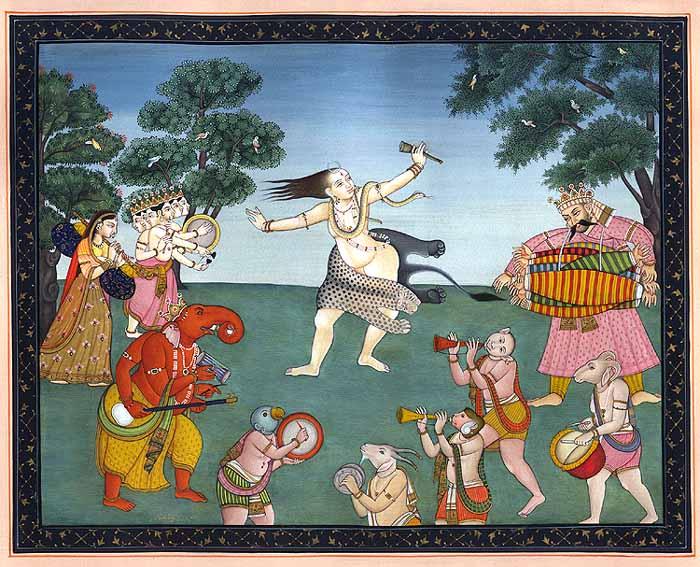
Shiva with family and disciples in a mood so unique only to Himself.


Shiva, Devadidev Mahadev, The God of Gods, being worshipped by all Gods on Kailash with His family.


Shiva, the family man.


Adbhut


This story is related at the time of breaking Monday fast. Unshakeable belief in Lord Shiva brings prosperity and nonbelievers get sufferings. If the husband and wife have the same belief they are bound to lead a happy life. Even repentance at some stage is as good.
Once Lord Shiva visited the famous city of Amravati. Parvati also accompanied him. On their way, they saw a beautiful Shiva temple and decided to spend some time there. One day, Parvati found Lord Shiva in a playful mood. She said to him, Oh my Lord, let us have a dice game. Lord Shiva obliged her and the game started. Meanwhile, the priest of the temple had come there. Parvati turned towards him and said Please foretell who will win this game?
The Brahman gave no serious thought to her question and abruptly said, Lord Shiva will win the game. Incidentally Parvati won the game. She was angry because the Brahman had told a lie. Lord Shiva tried to pacify her, but she cursed the Brahman that he be a leper.
In due course, the Brahman became a leper and spent a miserable life. After some time a few fairies descended on the earth and pitied the fate of the priest. On asking him, the priest narrated the whole episode. One of the fairies said, You observe Monday fasts for sixteen weeks without break. On the seventeenth Monday, prepare some holy food or Prasaad with flour mixed with ghee and gur. Distribute this prasaad among the members of your family and take some yourself. You will be free from this leprosy.
The fairies disappeared and the priest followed the instructions. Soon, he regained his normal health. Once Lord Shiva and Parvati again visited that temple. Parvati was surprised to see the priest. He was his normal self. She enquired about this feat and the priest narrated the whole story.
Parvati was happy, she also decided to observe Monday fasts for sixteen weeks. Incidentally, on the seventeenth Monday, when she broke her fast, her beloved son Kartikeya, who was displeased with her, appeared and said, 0 dear mother what is that power with which you have called me? What is the mystery? Parvati said, 0 my dear son, all this miracle is due to observing Monday fasts for sixteen weeks without interruption. Kartikeyas Brahman friend had been in a foreign land for quite some time. Kartikeya said, I shall observe Monday fasts for sixteen weeks for happy reunion with my friend. He observed the 16 weeks fasts as per rules and to his great surprise his friend returned hale and hearty. The friend enquired about the miracle and Kartikeya told him the modalities to be observed for Monday fast. The Brahman friend was very curious about his marriage. He decided to observe the Monday fasts for sixteen weeks. On the seventeenth Monday, the Brahman friend went to a city. The ruler of the city decided to marry his daughter to a person on whose neck his well-decorated elephant would put the garland. The Brahman joined the show. Incidentally, the elephant garlanded him. The ruler of the city gave him his daughter and also a lot of money. The couple departed the next day and were back in their home. On the honeymoon night, the bride said, 0 my dear, how is it that the elephant ignored all the princes and garlanded you? How did you succeed on the auspicious moments? The bridegroom said, I observed fasts on sixteen Mondays. Monday is Lord Shivas day. It is due to his blessings that I got a beautiful wife like you. My friend Kartikeya revealed this secret to me. The bride too decided to observe fasts on sixteen Mondays for a beautiful son full of knowledge. Her devotion bore fruit and she gave birth to a beautiful son. As the son grew up, he said to his mother, 0 my dear mother, what is the mystery behind my birth? Please reveal it to me. The mother told him how she observed Monday fasts. The son also decided to observe the fasts to gain a kingdom for his parents. Incidentally, an old kings messengers from a nearby State came there in search of a beautiful and learned bridegroom for the princess. They proposed the princess hand for him and he readily agreed. The king expired after sometime and the boy became the king. The newly-made king continued his fasts for the next sixteen Mondays. On the seventeenth Monday, he arranged a large prayer party at a temple. All the arrangements were made well in advance. The king requested the queen to accompany him to the temple for breaking the fast after taking prasaad from the priest. The queen refused to go with him. The king had to go alone. The king heard an oracle who echoed, 0 king, turn out the queen from the palace or destruction will fall upon you. The king returned to his palace. He summoned a conference of his ministers and told about the oracle. All of them were taken aback, as it was due to that princess that he became the king of the state. They agreed to his proposal only with a heavy heart. The queen was ultimately turned out. The queen left the palace bare footed and in worn-out clothes. She was thirsty and fatigued. She met an old lady who had a load of spinned spindles on her head. She was going to the city. She felt pity on her and asked to help her in selling the yarn because she did not know the art of selling. The queen took that load on her head. Incidentally, strong wind blew away the spindles which disappeared in the dusty wind. The queen felt sorry and the old lady asked her to go away. The queen went to an oilmans house and sought shelter. The oilman obliged her, but as she stepped in, all of his oil pots developed cracks and the oil began to flow on the ground. The oilman immediately turned her out. The queen was now disheartened. She went to the bank of a river to quench her thirst. As she touched the water, the water dried up. She then went to a deep jungle and saw a tank of water. As she went down the stairs and touched the crystal dear water, it became muddy. She cursed her fate and put a few drops of the muddy water in her mouth. She was now tired and wanted to take rest under a shady tree. As she went near the tree its leaves began to fall and soon it became leafless. The cowherds saw this incident and told the whole story to the priest of a nearby temple. The priest called for the woman. He was surprised to see that the woman had royal features. He consoled her and provided her with all the facilities. But after some days, he also got fed up with her because whatever the woman touched became impure — may it be milk, food or water. One day, the priest said, 0 lady, what curse has fallen upon you? You reveal the mystery. The woman told him how she rejected a proposal to attend Monday fast prayer. The priest understood the whole thing. He knew it was Shivas curse. He said, 0 dear lady, you observe fasts on sixteen Mondays and Lord Shiva will absolve you of your sins. The woman realised her mistake and observed the Monday fasts for sixteen Mondays. On the seventeenth Monday, the king said to himself, My queen left my palace long ago. Her condition must be very miserable. He called for his courtiers and ordered them to search out the queen. The courtiers reached the temple where the queen was residing. The priest refused to hand over the queen to them and said, Let the king himself come to receive her. The courtiers went to the king and related the whole story. The king was happy to hear the news. He went to the temple and requested the priest to return his queen to him. The king admitted that he deserted the queen to avoid Lord Shivas wrath. The priest trusted the kings words and the queen returned to the palace. She was given a royal welcome. The king distributed money among the needy and arranged food for the hungry. The king and queen now regularly observed fasts on sixteen Mondays each year and lived a very happy life. After their death they found abode in Lord Shivas city, Shivapuri. Since, then it is believed that a person who observes fasts on sixteen Mondays, gets all pleasures and enters Shivapuri after his death.

Aahankaar


Namdharak prayed to Siddha Yogi to tell him about the Gokarna Mahatmya. He said it must have had great significance as it was a place chosen by Sripad Sri Vallabha, in preference to all other holy places in Bharat, for his sojourn and stay.
Siddha Yogi began the narration of the birth of Gokarna Atma-Linga, as originally related by Lord Ganesha.
In the most ancient times in the Treta Yuga, there was a great Brahmin sage by name Pulasthya in the kingdom of Lanka, His wife's name was Kaikasi. They had a son named Ravana, who was the ruler of the kingdom. Ravana had ten heads and twenty arms and he was unusually mighty and strong. Kaisaki was a great devotee of Lord Shankar, and she offered worship to Shivalinga every morning. She would not take food until she finished her worship. For her worship, she must daily find a new and original Shivalinga. If she failed in finding a new Shivalings she would fast for one day. For that day, when she did not get an original Linga, she would prepare a Mrithika Linga (the Linga form moulded out of clay) and would do her worship to it and would fast for the whole day.

One day, as Kaikasi did not get an original Shivalinga, she was doing her worship to a Mrithika Linga which she had prepared. Ravana saw this and felt in his pride and conceit that it did not befit her, the mother of a mighty person like him, to have to do worship to a mere Mrithika Linga, instead of an original Shivalinga. He said that he would bring down the Kailash itself along with Shankara into Lanka for his mother's worship. he made a vow to this effect and set out for Kailash. Reaching there, he tried to put out the Kailash mountain, for taking it to Lanka. The mountain began to totter; the Devas-Ganas and even Goddess Parvati were being tossed about. Even the heavens and the neither worlds became shaky and all became extremely panicky. Goddess Parvati asked Shiva what was happening and Shankara told her that Ravana, the son of his great devotee Kaikasi, was trying to pull out Kailash to take it to Lanka for his mother's worship. He said that even Ravana was a great devotee of his, and hence he was refraining from doing anything in the matter. But with further pleading of Parvati, Shankara intervened and pressed down with just the mere toe of his right foot, which nearly crushed Ravana under the mountain. Ravana realised his folly and started praying to Shankara for His mercy and grace. In his rich musical voice he began singing Sama Vedic hymns in praise of the Lord. He undertook penance; he made a new musical instrument (Yantra Karkamalika - Rudra Veena) with his head, veins and nerves and started playing on it rich and enrapturing music to please the Lord. He was cutting off his heads and offering as sacrifice in oblation to the Lord. It was a penance unprecedented and never undertaken by any one, ever before. Shankara was very much moved by his devotion and austerities of Ravana. He appeared before Ravana and told him that he would give him whatever boon he would wish for. Ravana prayed he wanted Kailash itself for his mother's worship.

Shankara said that it was an impossible wish; but he would, instead, give him his Atma-Linga, which is the Divine Core and Essential Principle of Lord Shiva himself. He said the Atma-Linga embodied in itself the Highest Divinity, and whoever worshipped it for just three years, would himself become like Shankara. He, however, warned and cautioned that the Linga should not touch the ground till it reached Lanka and was enshrined there.Ravana was elated at winning the Atma Linga, but all the Gods were frightened because the new power which Ravana won through the possession of the Atma-Linga would make him the mightiest person and unconquerable even by Gods and unconquerable even by the Trinity. Ravana had already subdued and enslaved the Five Elements and the Nava Grahas. Now his pride and power would have no bounds and restraints. The Gods started shuddering in fright and prayed to Vishnu to save them and the worlds from impending doom. Lord Vishnu approached Ganesha and together with Narada, they planned out how to deprive Ravana of the Atma-Linga. Ravana was still mid-way and had not reached Lanka yet. Vishnu would create an artificial dusk by covering the orb of the sun with his Sudarshan Chakra. Ravana would then break his journey, wherever he be, to perform his Sayam Sadhya (evening oblations). Ganesha should then appear there as a rustic boy. Ravana would then request Ganesa to hold the Atma Linga in his hands till he (Ravana) would finish his Sandhya-Vandan. Narada would then appear and draw Ravana into conversation and delay the latter in completing his Sandya-Vandan, Ganesh should ground the Atma-Linga in the meanwhile there itself. Such was the plan.

Ravana was midway to Lanka, but proudly carrying the Atma-Linga. The sun suddenly dimmed down due to the contrivance of Vishnu, and giving the impression that it was already nearing dusk. Ravana was a meticulous observer of the daily rituals and, therefore was keen on doing his Sandya-Vandan before sunset was over. But what to do with the Atma-Linga while doing the Sandya-Vandan? Shiva told him not to keep it on the ground before he reached Lanka. While he was in a dilemma, there appeared nearby a shepard boy playing around who looked so guileless and innocent. It was Lord Ganesa himself in that guise. Ravana called out to the boy and pleaded with him to hold the Shiva-Linga for him till he finished his evening oblations to the Sun-Deity. The boy pretended that he was in a hurry to get back home as it was getting dark. On Ravana's further pleading, the boy said that the Shiva-Linga seemed to be too heavy for him, and anyway he would hold it, but Ravana should return soon. He said "If you delay I shall lay it on the ground and go away." He added "However, I shall count to thrice before putting it on the ground before leaving".

Ravana, placing the Shiva-Linga in the hands of the boy, hurried to the river. There he was accosted by Narada, who went on complimenting and congratulating him for winning the Atma-Linga which is the most powerful Linga in the world. He said "it will make you the mightiest person in the world, and you will forever rule all the gods". Narada thus delayed Ravana, engaging him in conversation. Before Ravana took it easy, but never the less completed the Sandhya-Vandana fast and hurried back. Lo! by the time he reached back, the boy had already grounded the Shiva Linga. Ravana was furious with the boy, but the boy pleaded "it was too heavy for me, I called out for you thrice. As you did not return I couldn't help laying it on the ground".

Ravana tried with all his might to pull out the Shiva-Linga, the more he pulled the more firmly it was getting stuck in the ground. However, with the pull of Ravana, the Linga got twisted and elongated in the shape of a cow's ear (Go-Karna). As it withstood the mighty strength of Ravana, the Shiva-Ling came to be know as "Gokarna Mahabaleswar" and it is deemed most holy, as the Shiva Linga was installed there by Lord Ganesha, the foremost of Deities and further more, the installation was done at the instance of Lord Vishnu Himself.

It is said that Ravana did severest penances at this place only, and attained all the boons from Lord Shiva. All the gods also are said to have done great penances at this holy place.
The power of this place has been described in detail in Skandha purana.
Thus narrated Siddha Yogi to Namdharak about the origin of Gokarna, where Sripad Sri Vallabha chose to stay for three years in this sojourn in the South.

Aagaman


According to the Indian mythology King Sagar had 60,000 sons. He defeated all the asuras (daemons) in the earth and wanted to stage a Ashwamedha Yagya to declare his supremacy. For this as was the practice prevalent in ancient times, he sent his horse across the earth accompanied by his sons.
The King of Heaven, Lord Indra feared the power of King Sagar and to stop him, he stole the horse and tied it to the ashram of Sage Kapil. When the 60,000 sons saw the horse in Kapil's ashram they got furious and started to attack the hermitage. Sage Kapil was in deep meditation and on hearing the disturbance he opened his eyes in anger and all the 60,000 sons of King Sagar were reduced to ashes, except for prince Asamanjas.
Anshuman the grandson of King Sagar brought the horse back from the Sage and asked for his forgiveness. Sage Kapil told him that the sons can be brought to life only if Ganga is brought from heaven to earth. Neither Anshuman nor his son Dilip were successful in this task. But Dilip's son, Bhagirath was determined to get this task done. He started meditating intensly for several years and finally Ganga got pleased and descended to the earth. To prevent the earth from flooding, Lord Shiva received Ganga on his matted locks. King Bhagirath then worshipped Lord Shiva and Shiva blessed him and released Ganga from his locks in seven streams. The water of Ganga touched the ashes of Sagar sons who rose to the their eternal rest in heaven. The seven streams of Ganga are Bhagirathi, Janhvi, Bhilangana, Mandakini, Rishiganga, Saraswati and Alaknanda which merge into Ganga at Devprayag. The rock on which King Bhagirath is believed to have meditated, is called Bhagirath Shila and is located near the temple of Ganga. To this date the water of holy Ganga is believed to have Amrit (nectar) in it. It has been studied by Scientists that the water collected from Ganga at its origin is in a pure state and even after being kept for several years, does not get contaminated.. These medicinal properties of Ganga-Jal are attributed to the medicinal secretions of herbs and mineral content which get mixed with the water.

Thursday, August 04, 2005

Ananda Tandava


"I saw cascades of energy coming down from outer space, in which particles were destroyed and created in rhythmic pulses; I saw the atoms of the elements and those of my body participating in this cosmic dance of energy; I felt its rhythm and I heard its sound, and at that moment I knew that this was the Dance of Shiva, the Lord of Dancers."
—Fritjof Capra, Tao of Physics
According to mythology, Shiva first performed Ananda Tandava (the dance of bliss), to enlighten some sages who had been so immersed in their scholasticism that they had forgotten the existence of God. This Ananda Tandava was later revealed at the Jnana Sabha, one of the shrines of Chidambaram. Myth has it that, at a particular time every year, Shiva still performs the dance here.
In Indian mythology,Lord Shiva is considered as the supreme lord of dance. This divine art form is performed by Lord Shiva & his wife Goddess Parvathi. The Dance performd by Lord Shiva is known as Tandava, which depicts his violent nature as the distructor of the universe. The tandava performed with joy is called Ananda Tandava and performed in violent mood is called Rudra Tandava. There are 7 types of Tandava. Namely Ananda Tandava, Tripura Tandava, Sandhya Tandava, Samara Tandava, Kaali tandava, Uma Tandava and Gauri Tandava. There are few people who believa that there are 16 types of Tandava. Tandava has vigourous, brisk movements.The dance performed by Goddess Parvathi is known as Lasya, in which the movements are gentle, graceful and sometimes erotic also. Some scholars call Lasya as the feminine version of Tandava. Lasya has 2 kinds. Jarita Lasya and Yauvaka Lasya.
The dance of bliss, or the Ananda Tandavam of Shiva is said to symbolize the five divine acts (pancha krityas) of creation, sustenance, dissolution, concealment and bestowment of grace. The dance of Shiva has been frozen in metal and held in worships in Nataraja Sabhas, in virtually all of the Saivite temples in Tamilnadu. Five of the foremost Sabhas (Pancha Sabhai) are at Chidmbaram (Kanaka Sabhai the hall of gold), Madurai (Rajata Sabhai the hall of Silver), Tiruvalangadu near Chennai (Ratnasabhai the hall of rubies), Tirunelveli (Tamrasabhai the hall of copper) and Kutralam near Tirunelveli (Chitrasabhai the hall of pictures). Other dance halls of significance are Adri Sabhai (the Himalayas), Aadi Chitsabhai (Tiruvenkaadu near Chidambaram) and Perur Kanakasabhai (Patteeswarar temple at Perur near Coimbatore).
Some Legends:
Aadi Sesha, the serpent (couch) of Vishnu, heard from Vishnu the grandeur of Shiva's cosmic dance. Filled with irrepressable desire to witness this dance in person at Chidambaram, Seshan descended to the earth as Patanjali (the one who descended). Vyagrapaadar, another devotee of Shiva prayed to obtain the tiger's claws so that he could obtain with ease the sacred Vilva leaves meant for Shiva's worship at Chidambaram. At the appointed hour, Shiva (with Sivakami) granted to Patanjali and Vyagrapaadar, a visual treat in the form of his Cosmic Dance of Bliss, to the accompaniments of music played by several divine personalities in the Hindu pantheon. This Dance of Bliss is said to have been witnessed by Vishnu, and there is a Govindaraja shrine in the Natarajar temple commemorating this. The dance of bliss of Shiva, is also said to have been enacted upon Shiva's (Bhikshatana) victory over the married ascetics of Daruka Vanam.

Yet another legend, commemorating the dance duel between the doyens of dance Shiva and Kali is associated with Chidambaram. Shiva is said to have lifted his left foot towards the sky in the Urdhuva Tandava posture, a definite male gesture, which out of adherence to protocol, Kaali could not reciprocate, thereby causing Shiva to emerge victorious, delegating Kaali to the status of a primary deity in another temple in the outskirts of Chidambaram. This legend is portrayed in the Nritta Sabha, one of the halls within the Chidambaram temple.

Friday, July 29, 2005

Ardhangini


The Story of Parvati
After the death of Shiva’s first love Sati, Shiva isolated himself into a dark cave buried amongst the snow covered peaks of the Himalayas. He rejected the world outside so distraught was he by the lose of his first true love.
Meanwhile the demons lead by Taraka, rose from the netherworld and drove the devas, gods, out of the heavens. The gods sought a warrior who would help them regain the celestial realm.
"Only Shiva can father such a warrior," informed Brahma.
But Shiva, immersed in meditation, was oblivious to the problems of the gods. As he performed tapas, meditations that produce great heat and energy, his mind was filled with great knowledge and his body became resplendent with energy. But all this knowledge and energy, bottled within his being, was of not use to anyone.
Parvati as Shivakami. Most Shiva or Nataraja Statues have a Parvati statue of similar proportions next to them.
Birth of Parvati
The gods invoked the mother-goddess, who appeared before them as Kundalini, a coiled serpent.
"I will coil myself around Shiva, wean out his knowledge and energy for the good of the world and make him father a child," said Shakti.
Shakti took birth as Parvati, daughter of the Himavan, lord of the mountains, determined to draw Shiva out of his cave and make him her consort.

Parvati as Bogashakti, "Boga" Pleasure. "Shakti" Goddess, Energy. Priti and Rati
Everyday Parvati would visit Shiva’s cave, sweep the floor, decorate it with flowers and offer him fruits hoping to win his love.
But Shiva never opened his eyes to look upon her charming face. Exasperated, the goddess invoked Priti and Rati, goddess of love and longing, to rouse Shiva out of his mediation.
These goddesses entered Shiva desolate cave and transformed it into a pleasure garden filled with the fragrance of flowers and the buzzing of bees.
Death of Kama
Guided by Priti and Rati, Kama, the lord of desire, raised his sugarcane bow and shot arrows dripping with desire into the heart of Shiva.
Shiva was not amused. He opened his third eye and released the flames of fury that engulfed Kama and reduced his beautiful body to ashes.
The death of Kama alarmed the gods. "Without the lord of desire man will not embrace woman and life will cease to be."
"I shall find another way to conquer Shiva’s heart. When Shiva becomes my consort, Kama will be reborn," said the daughter of the mountain, Parvati.
Not Even a Leaf
Parvati went into the forest and performed rigorous tapas, wearing nothing to protect her tender body form the harsh weather, eating nothing, not even a leaf, earning the admiration of forest ascetics who named her Aparna.
Aparna matched Shiva in her capacity to cut herself from the world and completely master her physical needs. The power of her tapas shook Shiva out of his mediation. He stepped out of his cave and accepted Parvati as his wife.
Shiva married Parvati in the presence of the gods following the sacred rites and took her to the highest peak of the cosmos, Mount Kailasa, the pivot of the universe. As the world revolved all around them the two became one and Kama was reborn.
Hermit to Householder
Parvati melted Shiva’s stern heart with her affection. Together they played dice on Mount Kailas or sported on the banks of Lake Manasarovar, discovering the joys of married life.
The goddess awakened Shiva’s concern for the world by questioning him on various issues. As he spoke, he revealed the secrets of the Tantras and the Vedas that he had gathered in eons of mediation.
Inspired by her beauty, Shiva became the fountainhead of the arts, of dance and drama. He sang and danced to the delight of the gods who were pleased to see his enchantment with the goddess.
The Birth of the Celestial Warlord
Parvati gave Shiva’s aura to the gods. "From this will rise the warlord you seek," said the goddess.
The gods gave Shiva’s aura to Svaha, consort of Agni, the fire god. Unable to bear the heat of the auro and the god Agni for long, Svaha gave the aura to Ganga the river goddess who cooled it in her icy waters until Shiva’s aura turned into a seed.
Aranyani, the goddess of the forest, embedded the divine seed in the fertile forest floor where it was transformed into a robust child with six heads and twelve arms.
Six forest nymphs called the Krittikas found this magnificent child in a lotus. Over come by maternal affection they began nursing him. The six headed son of Shiva, born of many mothers, came to be known as Kartikeya.
Parvati taught Kartikeya the art of war and turned him into a the celestial warlord called Skanda.
Skanda took command of the celestial armies, defeated Taraka in battle and restored the heavens to the gods.
Kali drinks Raktabija’s Blood
Skanda, guardian of the heavens, went on to destroy many demons who opposed the reign of the gods.
But he could not defeat the demon Raktabija. Whenever this demon’s blood touched the ground, a thousand new demons sprang to life. He seemed unconquerable.
To aid her son in his endeavor to rid the three worlds of the demon, Parvati entered the cosmic battlefield as the dreaded goddess Kali - dark as death, gaunt with sunken eyes, gaping mouth, with long disheveled hair covering her naked body.
Kali spread her tongue over the battlefield and licked the demon’s falling blood catching on her long, outstretched tongue before the drop could find its way to the ground springing a demonic life anew. Raktabija, without his multiplying numbers was left powerless. Skanda was able to dispatch Raktabija and all his remaining duplicates with ease.
Skanda thanked his mother for her timely help. To celebrate her victory, Kali danced wildly on the battlefield, bedecking herself with a garland of served heads and a girdle of severed hands.
Shiva Calms Kali
Intoxicated with Raktabija’s blood, Kali ran amuck across the three worlds, destroying everything and everyone in her sight.
To restrain her, Shiva took the form of a corpse and blocked her path. As the goddess, blinded by bloodlust, tripped on his lifeless body, she was jolted out of her frenzy. She wondered if she had killed her own husband. She placed a foot on Shiva’s chest and brought him back to life.
Shiva then took the form of a little child and began to cry, stirring maternal love in the heart of Kali. This forced her to shed her fierce form; Kali became Gauri, the radiant mother, bestower of life.
Parvati’s Son
Guari told Shiva that she wanted a child.
But Shiva was not interested in a family. He turned away from her and went into to the forest to perform tapas.
Determined to be a mother, Parvati decided to create a son for herself without the aid of her husband. She scrubbed her skin with sandal paste, scrapped off the dead skin, mixed it with clay and molded out of it a beautiful doll into which she breathed life.
She ordered her newly created son to keep watch over her cave and keep out all strangers.
Guardian of Thresholds
When Shiva returned to Kailas, Parvati’s son failed to recognize his mother’s consort and prevented him from entering the cave.
Irritated by the child’s insolence, Shiva raised his trident and cut off his head.
When Parvati saw her son’s headless body she wept and out of her tears came her fierce handmaidens, the Yoginis, who threatened to destroy the whole world.
To placate Parvati, Shiva resurrected the child by placing an elephants head on the severed neck. Shiva also accepted Ganesh as the first of his sons.
Ganesh, who had prevented Shiva from crossing the threshold of his mother’s cave, became keeper of thresholds, an obstacle to all that is undesirable.
He who seeks access to the wisdom, bounty and mystery of Nature worships Ganesh beloved son and sacred doorkeeper of Shakti.

The Divine Homemaker
With Parvati by his side, Shiva became a family man. But he did not abandon his ways as a hermit: he continued to meditate and immerse himself in narcotic dreams. His carefree attitude, his refusal to shoulder household responsibilities sometimes angered Parvati. But then she would come to terms with his unconventional ways and make peace. The consequent marital bliss between Shakti and Shiva ensured harmony between Matter and Spirit and brought stability and peace to the cosmos.
Parvati thus became Ambika, goddess of the household, of marriage, motherhood and family.

Alochana


The Fascinating Deity
Shiva is 'Shakti', Shiva is power, Shiva is the destroyer, the most powerful god of the Hindu pantheon and one of the godheads in the Hindu Trinity. Known by many names - Mahadeva, Mahayogi, Pashupati, Nataraja, Bhairava, Vishwanath, Bhava, Bhole Nath - Lord Shiva is perhaps the most complex of Hindu deities. Hindus recognise this by putting his shrine in the temple separate from those of other deities.

Shiva As Phallic Symbol
Shiva, in temples is usually found as a phallic symbol of the linga, which represents the energies necessary for life on both the microcosmic and the macrocosmic levels, that is, the world in which we live and the world which constitutes the whole of the universe. In a Shaivite temple, the linga is placed in the centre underneath the spire, where it symbolises the naval of the earth.

A Different Deity
The actual image of Shiva is also distinct from other deities: his hair piled high on the top of his head, with a crescent tucked into it and the river Ganges tumbling from his hairs. Around his neck is a coiled serpent representing Kundalini or the spiritual energy within life. He holds a trident in his left hand in which is bound the 'damroo' (small leather drum). He sits on a tiger skin and on his right is a water pot. He wears the 'Rudraksha' beads and his whole body is smeared with ash.

The Destructive Force
Shiva is believed to be at the core of the centrifugal force of the universe, because of his responsibility for death and destruction. Unlike the godhead Vishnu, the Creator, Shiva is the dissolving force in life. But Shiva dissolves in order to create, since death is the medium for rebirth into a new life. So the opposites of life and death and creation and destruction both reside in his character.

The Most Fascinating of Gods
He is also often portrayed as the supreme ascetic with a passive and composed disposition. Sometimes he is depicted riding a bull called Nandi decked in garlands. Although a very complicated deity, Shiva is one of the most fascinating of Hindu gods.
The God Who's Always High!
Since Shiva is regarded as a mighty destructive power, to numb his negative potentials he is fed with opium and is also termed as Bhole Shankar, one who is oblivious of the world. Therefore, on Maha Shivratri, the night of Shiva worship, devotees, especially the menfolk, prepare an intoxicating drink called Thandai (made from cannabis, almonds, and milk) sing songs in praise of the Lord and dance to the rhythm of the drums.
Maha Shivratri: The Night of Shiva
Maha Shivratri, the night of the worship of Shiva, occurs on the 14th night of the new moon during the dark half of the month of Phalguna. It falls on a moonless February night, when Hindus offer special prayer to the lord of destruction. Shivratri (Sanskrit 'ratri' = night) is the night when he is said to have performed the Tandava Nritya or the dance of primordial creation, preservation and destruction. The festival is observed for one day and one night only.
Origin Of Shivratri
According to the Puranas, during the great mythical churning of the ocean called Samudra Manthan, a pot of poison emerged from the ocean. The gods and the demons were terrified as it could destroy the entire world. When they ran to Shiva for help, he in order to protect the world, drank the deadly poison but held it in his throat instead of swallowing it. This turned his throat blue, and since then he came to be known as Nilkantha, the blue-throated one. Shivratri celebrates this event by which Shiva saved the world.
A Festival Especially For Women
Shivratri is considered especially auspicious for women. Married women pray for the well being of their husbands and sons, while unmarried women pray for an ideal husband like Shiva, who is the spouse of Kali, Parvati and Durga. But generally it is believed that anyone who utters the name of Shiva during Shivratri with pure devotion is freed from all sins. He or she reaches the abode of Shiva and is liberated from the cycle of birth and death.

Shiva Rituals
On the day of Shivratri, a three-tiered platform is built around a fire. The topmost plank represents swargaloka (heaven), the middle one antarikshaloka (space) and the bottom one bhuloka (earth). Eleven urns or kalash, are kept on the swargaloka plank symbolising the eleven manifestations of the Rudra Shiva. These are decorated with bilva (woodapple leaves) and mango leaves atop a coconut representing the head of Shiva. The uncut shank of the coconut symbolises his tangled hair and the three spots on the fruit Shiva's three eyes.
Bathing The Phallus
The phallus symbol representing Shiva is called the lingam. It is usually made of granite, soapstone, quartz, marble or metal, and has a yoni or vagina as its base representing the union of the male and female sexual organs. Devotees circumambulate the lingam and worship it throughout the night. It is bathed every three hours with the five sacred offerings of a cow, called the panchagavya - milk, sour milk, urine, butter and dung. Then the five foods of immortality - milk, clarified butter, curd, honey and sugar are placed before the lingam. Dhatura and jati, though poisonous fruits, are believed to be sacred to Shiva and thus offered to him.

"Om Namah Shivaya!"
All through the day the devotees keep severe fast, chant the sacred Panchakshara mantra "Om Namah Shivaya", make offerings of flowers and incense to the Lord amidst ringing of temple bells. They maintain long vigils during the night, keeping awake to listen to stories, hymns and songs. The fast is broken only the next morning, after the nightlong worship. In Kashmir, the festival is held for 15 days. The 13th day is observed as a day of fast followed by a family feast.
The Stories Of Shiva
There are a number of mythological tales and legends surrounding Lord Shiva. Here're a few popular ones:
The Ganges Comes Down To Earth
A legend from the Ramayana speaks of King Bhagirath who once meditated before Lord Brahma for a thousand years for the salvation of the souls of his ancestors. Pleased with his devotion Brahma granted him a wish. He requested the Lord to send the river Ganges down to earth from heaven so that she could flow over his ancestors' ashes and wash their curse away and allow them to go to heaven. Brahma granted his wish but asked him to pray to Shiva, for he alone could support the weight of her descent. Accordingly he prayed to Shiva and he allowed the Ganges to descend on his head, and after meandering through his thick matted locks, the holy river reached the earth. This story is re-enacted by bathing the linga.
The Tiger & The Leaves
Once a hunter while chasing a deer wandered into a dense forest and found himself on the banks of river Kolidum when he heard the growl of a tiger. To protect himself from the beast he climbed up a tree nearby. The tiger pitched itself on the ground below the tree fostering no intention to leave. The hunter stayed up in the tree all night and to keep himself from falling asleep, he gently plucked one leaf after another from the tree and threw it down. Under the tree was a Shiva Linga and the tree blessedly turned out to be a bilva tree. Unknowingly the man had pleased the deity with bilva leaves. At sunrise, the hunter looked down to find the tiger gone, and in its place stood Lord Shiva. He prostrated before the Lord and attained salvation from the cycle of birth and death.
Why Shiva Is Worshipped In His Phallic Form
According to another legend, once Brahma and Vishnu, two other deities of the holy Trinity, had an argument as to their supremacy. Brahma being the Creator declared himself to be more revered, while Vishnu, the Preserver, pronounced that he commanded more respect. Just then a colossal lingam, known as Jyotirlinga, blanketed in flames, appeared before them. Both Brahma and Vishnu were awestruck by its rapidly increasing size. They forgot their quarrel and decided to determine its size. Vishnu assuming the form of a boar went to the netherworld and Brahma as a swan flew to the skies. But both of them failed to accomplish the self- assumed tasks. Then, Shiva appeared out of the lingam and stated that he was the progenitor of them both and that henceforth he should be worshipped in his phallic form, the lingam, and not in his anthropomorphic form.